Thinking Global About Games Development
There is an interesting article about the thoughts of Jason Della Rocca, former IGDA head on tax breaks and global ambitions…
The tax-break issue… It’s not about the tax-breaks alone. When I talk about the industry I talk about an eco-system kind of metaphor. It’s very dynamic, it’s a complex system, there’s lots going on, it’s not clear that introducing a tax-break is going to be the thing that all of a sudden makes your ecosystem thrive. … In fact there are regions where there’s nothing – it’s a desert. So you say, we have this desert and we’d really like there to be a game industry there because we think it’s sexy and good jobs etc. So they look at Canada and say, well, they’re doing so well because they have these tax-breaks, let’s put a tax-break in our desert. … It’s a complex system, and it’s hard to predict what one change would have on that system, but it’s really not about tax breaks, it’s about so much other stuff.
There is that ‘e’ word again as in ‘eco-system’, as in ‘ecology’, as in Media Ecology… This I think is the key approach to any kind of technology development.
Thoughts on Games Development and Education
I’ve been doing a bit of teaching on the Games Technology BSc at UWE this year. The students there were what made the whole thing for me, a really good bunch. However the University sector is something under pressure – fees going up and competition increasing. Teaching games is quite a new thing – I sound like an old man now – but when I learned games design back in the day there were no games courses. I feel my education in games design came from running paper RPGs like Dungeons & Dragons and Call of Cthulhu. It gave you a feel for designing levels, getting a grasp on the stats that run under the hood of the games system and more. Indeed I still think its worth doing (start here with a free download of the Basic Roleplay System from Chaosium). The problem for any games education course is how to spend 3 years teaching stuff to students that stays relevant after they leave. The games industry is changing so much and so fast, that keeping what you teach relevant is going to be hard. The industry is changing as it stratifies into huge 200+ teams on AAA titles and into small micro-studios. The skills needed for each do overlap but also diverge (e.g. I think teaching some basic business skills is a help for micro-studios, but that won’t be of much use in a huge studio).
I also found this article on teaching at Uni courses of interest – it talks about how, even with a degree, you are going to have to fight to get a job in the industry. Yes, or create your own thing. What University should provide is a space for experimentation and the like without needing to worry about the bottom line. This quote is from an inspiring article about MIT:
When Machover was developing the instrument, he found that the sound it made was distorted by Ma’s hand as it absorbed electric current flowing from the bow. Machover had a eureka moment. What if you reversed that? What if you channelled the electricity flowing from the performer’s body and turned it into music?
Armed with that new idea, [MIT’s Tod] Machover designed an interactive system for Prince that the rock star deployed on stage at Wembley Stadium a few years ago, conjuring up haunting sounds through touch and gesture. Later, two of Machover’s students at the media lab had the idea of devising an interactive game out of the technology. They went on to set up a company called Harmonix, based just down the road from MIT in Cambridge, Massachusetts, from which they developed Rock Band and Guitar Hero.
Sure, we can’t all go to MIT – I didn’t – but we can all experiment, mess about and mashup.
The Chromebook – A Platform Gamechanger?
For many, many years now the Internet meant the PC. Since the arrival of smart-phones, that platform hegemony has started to erode rapidly. Then tablets such as the iPad followed. Now Google is opening up a new front in the form of the Chromebook. This is an intriguing idea that re-imagines the netbook, not as a PC that also runs Internet software, but as a web-browser powering a PC. The design-ethos is akin to what Google did which Chrome as a web-browser (and did well) where they re-imagined it as an extension of a search-engine (naturally!). This is a really interesting idea and if it works out, could erode the idea that the Internet=PC, as the Internet has eroded the idea that video=TV. Here’s how Google introduced it:
And how they describe it (from the official Google blog):
These are not typical notebooks. With a Chromebook you won’t wait minutes for your computer to boot and browser to start. You’ll be reading your email in seconds. Thanks to automatic updates the software on your Chromebook will get faster over time. Your apps, games, photos, music, movies and documents will be accessible wherever you are and you won’t need to worry about losing your computer or forgetting to back up files. Chromebooks will last a day of use on a single charge, so you don’t need to carry a power cord everywhere. And with optional 3G, just like your phone, you’ll have the web when you need it. Chromebooks have many layers of security built in so there is no anti-virus software to buy and maintain. Even more importantly, you won’t spend hours fighting your computer to set it up and keep it up to date.
Now I see the Chromebook as basically a web-browser running on a netbook. Its a simple approach and for many users, given that we are moving much of the functionality we use – games, documents, music, films, email – to the cloud (and often to Google systems) it makes sense. However you are then reliant on the cloud and connectivity to operate – and there are issues with this. I also see it as another direct march into Microsoft’s territory. For good or for ill, I think the re-purposing of a netbook as a web-book is a major step forward in the ongoing networking of our technologies.
I’m blogging over on our Red Was Design site too, and our plan is to use the blog as a forum to chat about the games development, design issues and more. So here’s the first batch of issues I’ve been talking about…
First off I talked about the creation of one of the key characters in the game and what sort of a person he would be:
Professor Brightmeer knows a little of the cosmic horror that exists and has dedicated much of the last decade to combating it. He is a classic Call of Cthulhu investigator – a dilettantish academic with a wide knowledge of the emerging field of psychology, of chemistry, medicine and biology and a little dash of Mythos knowledge. Indeed his wide knowledge of the mind and body led him to be consulted in treating the victims of insanity caused by exposure to the Mythos horrors in Arkham in the US where the lives. …
Now this design is important because it follows into the next section – about how we handle emotions in general, and sanity specificity (a key Call of Cthulhu concept) in video games:
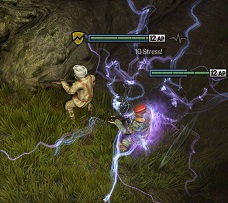
Sanity has been something we’ve debated a lot during the design of the game. For the paper RPG, IMHO, Sanity (SAN) has been a key part of not only the Call of Cthulhu playing experience but also what separates it out from other RPGs. There is a built-in shadow of insanity that stalks all players of the game and in the end will get you. As you learn more of the cosmic horror, so your character’s grasp on reality ebbs away. It makes a cool addition to the tabletop experience and is something I’ve enjoyed role-playing over the years. However in a video game, things are a bit different…
So after explaining the issues with Sanity in games, we still have to resolve the issue – and keep the important SAN score running. Here’s how we are planning to solve it…
US TV Household Ownership Drops
This article by John Naughton caught my eye:
A new report from Nielsen, the US media ratings firm, conveys some bad news to the broadcast TV networks. Ownership of television sets by US households has fallen for the first time in two decades.
Granted, the decline – 96.7% of American households now own sets, down from 98.9% previously – may not seem very much, but there will be many in the industry who will wonder if it’s the faint tremor that presages an earthquake. After all, for as long as most of us can remember, a TV set has been almost as commonplace a piece of domestic kit as a cooker. And television has been the dominant organism in our media ecosystem for just about as long.
Now there could be other factors for this change – resession being one of them. The author does address these points, but also points to another, more wide-reaching, explanation:
But there are also reasons for thinking that the current decline might be a harbinger. The main one is that for younger generations ownership of a TV set is no longer seen as a badge of adulthood. The number of kids taking a receiver with them to university, for example, is now vanishingly small. And that’s not just because most campuses have communal viewing facilities; it’s also a reflection of the fact that while young people watch a lot of video material, they increasingly do so via a laptop (with the more affluent among them viewing via an iPad or other tablet device).
This would make the news item news indeed. Along with the decline in TV audiences, its another statistic pointing to the slow fall of TV as the dominant media platform of our age. (Also, that is not to say video as media form is in decline, its not, but that TV as a platform to access it, is.)
Cthulhu Thursday: Lovecraft in Supernatural
I quite enjoy the TV show Supernatural – its a sort of X-Files meets Buffy show about a couple of brothers who fight evil week after week. So I am interested to hear that the show is going to feature none other than H.P. Lovecraft himself (played by Peter Ciuffa. Here’s how they both look:

H.P.Lovecraft 😉

and... Peter Ciuffa 😉
The Lovecraftsman has the full info including a video link.
(Cthulhu Thursday is a dose of Mythos to brighten darken your week. More on the idea can be found here and a list of posts thus far, here. Also for more Cthulhu news, sign up to the cthulhuHQ twitter feed. Enjoy!)
Technology Inspired by Nature: Solar Lilly Pads
Solar panels have sprouted on countless rooftops, carports and fields in Northern California. Now, several start-up companies see potential for solar panels that float on water.
Already, 144 solar panels sit atop pontoons moored on a three-acre irrigation pond surrounded by vineyards in Petaluma in Sonoma County. Some 35 miles to the north, in the heart of the Napa Valley, another array of 994 solar panels covers the surface of a pond at the Far Niente Winery.
And I thought, what does that remind me of? Answer – a lilly pad. A floating organic system that captures the energy of the sun!

Floating Energy Collector

Floating Energy Collector
PSP – Big in Japan
Japan has always had a games sector that is very much its own space with is own rules, hits and misses. So while the PSP has trailed the DS is most places around the world, in Japan it is not the case…
The PSP has remained the number one selling hardware format during the Golden Week series of holidays in Japan, despite the period traditionally being favourable to Nintendo products.
With many smaller shops shut for the majority of the week, sales during Golden Week are traditionally low, although with spikes for family-friendly products – as can be seen from some of the older Nintendo titles rising up to the bottom of the software top 10.
However, the PSP remained comfortably the best-selling hardware format, despite falling from its pre-holiday high of 76,974 units to 54,882. By comparison the 3DS saw sales increase by only 1,000 units to 29,149, according to early data obtained by Andrisang.
I wrote recently about the end of the PSPgo, and given the launch of the PSP2 into the post-iPhone world, I do wonder if, given Sony is a Japanese company, that the view of handheld gaming within is skewed by the larger sales at home?

Symbiotic relationships are nothing new in nature. For example in our stomach are loads of bacteria living there in a symbiotic relationship with us. We give them a safe place to live and food, they help with our digestion. Now that idea is being applied to technology:
(Observer (UK) Via Acquire Media NewsEdge) Researchers at MIT have come up with an ingenious method of reducing inefficiency in solar cells. When sunlight is absorbed by a traditional solar cell, it triggers the release of electrons that can be harnessed to create an electric current – although some electrons elude capture. Carbon nanotubes have been used to channel them towards their destination, the electrode, but nanotubes tend to bunch together, creating the risk of short circuits. Using a virus called M13, which normally infects bacteria, the team led by Angela Belcher at MIT have been able to keep the nanotubes separate, increasing energy conversion by nearly one-third. They claim the technique can also be applied to organic and quantum-dot solar cells.
Following Split Milk’s Post-Mortem II – Balancing
The second part of the Spilt Milk post-mortem is now out, and its an interesting read. One of the good bits of advice it gives is on game balancing – this is the design process where by you play and replay levels altering the stats to as to refine them from thier inital state into a playable game. Its a hard process to do and suffers from the inbuilt problem that the more you play the game, the easier it gets for you – hence your view on how easy/hard it is also gets skewed. Anyhow, here is some other advice:
Don’t tinker; be radical
There is a serious piece of advice in there though – I’ve long felt it is easier and more productive to either double up or double down when tweaking and designing. If you want an enemy to be weaker, halve his health to get a proper view on what this would mean. If you want the player to feel more rewarded by an action, double the points they receive and see what effect this has on the experience. Obviously you’ll have to tweak the numbers in smaller increments at some point, but early on this kind of ‘doubling up’ really helps figure out the key areas that need attention, in which direction you should move, and does so quicker than endless smaller tweaks would do.
Which I’d agree with. I’d also add – only alter one stat (or set) at a time, else balancing becomes trying to hit a moving target.


 A Great Becoming...