Is Google Blacklisting Torrent Searches? I don’t think they are… (yet?)
Michel pointed me towards an interesting article on Google and it’s searches:
Google started to filter search suggestions that include terms associated with copyright infringement like “torrent”, “bittorrent”, “rapidshare”, “megaupload”. It’s a slippery slope and Google’s suggestions will be less useful since they’ll no longer include many popular searches.
Last month, Google explained that this is one of the changes intended to address copyright infringement. “We will prevent terms that are closely associated with piracy from appearing in Autocomplete. While it’s hard to know for sure when search terms are being used to find infringing content, we’ll do our best to prevent Autocomplete from displaying the terms most frequently used for that purpose.”
Blacklisting keywords like “torrent” is a terrible way to prevent copyright infringement since users can always type queries without Google’s help. The main consequence is that Google will appear to be broken and users will no longer trust the suggestions because they’re censored. … As Mashable says, “this is a subtle form of censorship, and at first glance it seems trivial. However, even though the censorship is slight, it still indicates Google’s willingness to change its search protocols to satisfy the needs of a certain business group, in this case members of the entertainment industry.”
It is key to understand that Google is not filtering searches per-se, but filtering the auto-complete suggestions that it automatically generates. So as you type in a word, Google suggests possible search avenues for you by guessing the completed word/s. So how does this look in practice? Supposed I typed in ‘batm‘, Google looks at the characters so far and guesses that I’m probably going to add ‘an‘ to this so suggests searches. This is what it looks like:

.
Now I try ‘torren‘ not yet adding the last ‘t‘ to make ‘torrent‘:

.
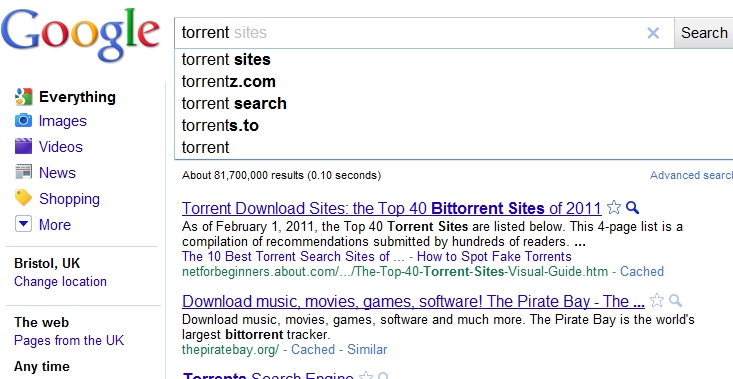
This time the partially completed word has no suggestions at all. However as soon as I add the last ‘t’ to the word:
.
You can see that the suggested searches kick in again. The top suggested link is a guide to Torrent sites, the second is to the Pirate Bay. Which brings me to what I think is driving this. During the recent Pirate Bay trial, the point was made by the defence that what the Pirate Bay did was akin to what Google does – just a search facility. Remember torrent files are neither illegal in themselves nor contain any copyrighted material – they are just simple text files. I think Google is trying to balance the difficult tasks of ensuring that we believe it to be the most authoritative search engine on the net with (legal?) pressure to censor it’s output. If we, as users, no longer trust Google to return accurate results for a search then it’s main reason for being is doomed. (Interestingly Stack Overload’s Joel Spolsky made this point on the Guardian Tech Podcast, that Google has to return accurate searches above even it’s own commercial interest…) But if it does nothing in the face of legal actions, then it could be forced to comply with a ruling that achieves the same result. This I think is their balancing act response to this situation.
It is a slippery slope, but one that slides in many directions…
(Also posted the on p2p foundation blog)
Filth Fair Preview on Gamezebo
We’re really pleased to be able to go public with the news that the Filth Fair is coming! This is the game I’ve been producing for the Wellcome Trust:
Filth Fair gets ready to dirty up the App Store this March
Updated Feb 9, 2011, 10:15am
Nobody likes filth. It’s dirty, icky, and often downright disgusting. But the folks at Wellcome Trust? They’re celebrating it. Starting in March, the Wellcome Trust will spend more than five months showcasing the subject of filth in their upcoming “Dirt Season,” a series of special events and releases all revolving around our relationship with grime. One such release is the upcoming hidden object game Filth Fair for the iPhone, iPad, and iPod Touch.

I was reading an interesting article in Granta (One Hundred Fears of Solitude by Hal Crowther, in Summer 2010 issue) about the noise of modern life – specifically modern technology. It is an interesting article that bemoans the technology yet admits a reluctance to do without it. In many respects the tone of the article can be summed up in this quote it quotes (stay with me!) by Max Palevsky, founder of Intel (spoken in 2008, sadly now deceased, p.106):
I don’t own a computer. I don’t own a cellphone, I don’t own any electronics. I do own a radio.
There is much to unpack in the sentence. The article does a god job of it, but I’d add, notice the semantic footwork whereby Palevsky re-classifies a radio as not electronic. It is almost as if he sees older technology as natural? Here’s another quote (p.103)
To me, that sounds like a prophetic glimpse of the world we inhabit today. There may be very few ways in which the Dark Ages – [author] Leigh Fermor visited the Abbey of St Wandrille, founded in AD 649 – compare favourably to the twenty-first century. Yet here he finds an important one. Mere small talk, that time-wasting ‘anxious triviality’ he escaped in the cloister, has become the sacrament, equivalent to the monks’ constant prayer, by which hyper-technology’s initiates declare and share their faith. A Stanford undergraduate, Sam Altman, once walked out of a huge lecture hall and observed that, ‘Two hundred students all pulled out their cellphones, called someone, and said, “Where are you?” People want to connect.’ Altman’s response was to found a company called Loopt, which with the aid of GPS chips in cellphones enables cellmates to track each other, literally, twenty-four hours a day. ‘PRIVACY LOST: THESE PHONES CAN FIND YOU’ was the sceptical headline. But Daniel Graf, founder of a similar networking service, was excited to announce, ‘Now you can share your life over a mobile phone, and someone is always connected, watching.’
I recently finished an MA module that is part of the points I need to complete my PhD. One of the things I really enjoyed reading talked about a confliced-dualism in the Victorian attitude to technology – that as they developed new technology, they also developed an ironic and conflicted spiritualism to go alongside it.
The rapid developments in some technologies such as electricity and the telegraph opened the concept of forces of action and communication that were, while invisible to the human eye, able to enact the power of language over vast distances. The ongoing ebb and reform of religion also contributed its own watermarks to the collective containment of the divine and its role in life. The unknown spaces that the retreat of biblical unity and the advance of scientific materialism, according to Durham-Peters (1999) created a duality of understanding that pulled in opposing directions;
“On the one hand there is the dream of spirit-to-spirit contact unimpaired by distance or embodiment, a dream stimulated by animal magnetism, the electrical telegraph, spiritualism, wireless, telepathy and even exotic forms of mental action at a distance. On the other is the haunting prospect that even touch is an illusion stemming from our sense organs insensitivity to the microscopic but infinite distances between bodies and the even greater chasm between souls.” (Durham-Peters 1999:178)
He takes this idea further, indeed to its logical end with a discussion and summary of the work of William James, both a founding figure of psychology and parapsychology focusing not on his psychology, which would find a place in the annuals of a fledgling science but on the parapsychology, which would not. James lived at a time when new technologies offered prowess that seemed almost magical – invisible forces (radio), communication over vast differences (the telegraph) and yet the dominant mental model still needed to connect with beyond this. For Durham-Peters, this duality is implicit in the summation,of the work of this one man, “James kept the door open, hovering somewhere between a psychological reductionism and a warm embrace of the spectres.” (1999:193) While the work of James and the technology and theory that contains it is of the age, that age was of a conflicted duality.
Is our desire for instantaneous ubiquitous connectivity via social networks and mobiles, basically the same conflicted desire? I think it is.
Science Does Sharing!
This is a really interesting article. It points to a huge advance in the transparency and sharing-potential of science. I think it can also lead to more scientists being able to call on members of the public to assist and more p2p science..
Monday [Jan 11th 2011] was a great day for public health research. It was also a scary day for researchers. Scary because on Monday, with a minimum of fanfare, the paymasters of public health research put the scientists they fund at the frontline of the data-sharing revolution. We are a reluctant fighting force.
Chivvied along by the UK’s biggest charity, the Wellcome Trust, science funders from across the industrial world issued a joint statement that essentially said they expect the data generated by studies they fund to be shared. It might not sound scary, but it could change the face of health research.
Look at what happened with genetics. In the early 1980s, geneticists worked away in their different labs, racing to sequence genes and patent them before the neighbouring lab could. The result: duplication, very slow progress and a huge bill. This infuriated the US National Institutes of Health and the Wellcome Trust, who between them footed much of that bill. So in 1986 they knocked some heads together, and decided they’d only fund geneticists who were willing to make their data available immediately. Nowadays, gene sequences get posted on the web daily and scientists build on one another’s work. The pace of discovery has increased exponentially and, as a result, so have diagnostics and cures.
Now those funders, and another 15 including the Bill and Melinda Gates Foundation, the World Bank and the national research councils of the UK, France, Germany, Canada, Australia and New Zealand, want to do the same for any research they pay for that involves collecting data from people specifically for research (samples collected during provision of health services are excluded). They reason that taxpayers and charities deserve to get the maximum public health bang out of each research buck. That means allowing researchers to trawl though one another’s data, combining the results to answer new questions. An early experiment combining data on malaria is showing how powerful sharing can be.
Also posted on p2p foundation blog.
Tweets are Ruled as Public – A Discussion
This is interesting – in a case to the PCC (Press Complaints Commission) the content of your tweets have been ruled as public:
The Press Complaints Commission has made its first ruling about the republication of information originally posted on Twitter. In response to complaints about articles published in the Daily Mail and the Independent on Sunday, the Commission concluded that there had been no breach of Clause 3 (Privacy) of the Editors’ Code of Practice.
The complainant was a civil servant working at the Department for Transport. The articles reported on a number of messages she had posted on her Twitter account about various aspects of, and her feelings towards, her job. In the complainant’s view, this information was private: she had a “reasonable expectation” that her messages would be published only to her 700 or so followers; she had included a clear disclaimer on her Twitter feed that the views expressed there were personal, and were not representative of her employer.
In their defence, both newspapers argued that the complainant’s Twitter account was not private. The posts could be read by anyone and not just those individuals who actively chose to follow her. The complainant had taken no steps to restrict access to her messages (although she did so after the Daily Mail article appeared) and was not publishing material anonymously.
There is coverage of it here and here. However there is a nuance here that is not dicussed and I could not find in either of the official adudications (here and here). What the above quote from the PCC seems to state that the Twitter account is public, but I can’t see that to be the case as you can use Twitter to send private messages – does that mean that those are to be considered public too? Though the PCC do make a point suggesting private is content you’re taken steps to make private. In the adjudications the PCC state:
The complainant said that her activities on Twitter and other social networking sites were private. While it was true in theory that anybody could view the information she had posted online, she argued that she had a “reasonable expectation that my [Twitter] messages…would be published only to my followers”. Only her 700 or so followers could see the full context of her messages. Others would only find her account by actively searching for her, which seemed an unlikely thing for most people to do, and would only see messages she had posted, not those she was responding to.
This was particularly the case as any message could be “re-tweeted” without the complainant’s consent, or control, to a larger subscription list. This was a notable feature of Twitter. The publicly accessible nature of the information (for which the complainant was responsible) was a key consideration in the Commission’s assessment as to whether it was private.
Which seems to suggest that it is the twitter feed of re-tweetable tweets, and not the whole account that is public? But this seems to ask more questions than it answers. What about Facebook? The big difference between the two (in privacy terms) is that Facebook is by default pivate in that the content is limited to friends whereas Twitter by default is public (able to be viewed by anyone. However it is easy to turn Facebook content, even if private – into a group page anyone can join. So how would they rule on Facebook? I think it should be ruled as private by this ruling’s standards, but there is a grey area…
Hat-tip to Simon for the link.
Cthulhu Thursday: I Can Has Lolthulhu
I don’t know if you heard the news, but the Lol Cats network – based on images of cats with funny captions – just got $30 million in funding.

Well cats don’t get all the lols – no sir-e! There is a Cthulhu version – LOLTHULHU!

from lolthulhu.com
(Thoug,h sadly it does not seem as if this site has been updated in recent years. Shame as it’s got some funny content on it.)
(Cthulhu Thursday is a dose of Mythos to brighten darken your week. More on the idea can be found here and a list of posts thus far, here. Also for more Cthulhu news, sign up to the cthulhuHQ twitter feed. Enjoy!)
The Evolution of the Smart Phone
There is a fascinating article in Wired (Jan 2011) about an anthropologist who travels around looking at how people hack technology. This is a clear case of technology evolution – of taking the existing form meme/genotype/phenotype – and modifying it. Oh yeah – and it’s illegal…but it shows the more complex relationships around copyright and patents than exist in the legal world…
The process by which ideas move from blueprint to market stall is massively accelerated in China’s technology hot-houses, where electronic devices can come to market in a matter of weeks. What if the speed of innovation could influence every aspect of the country’s technological development, from consumer goods to green energy? Chipchase believes that the speedy, lean approach of China’s counterfeiters has created an environment for accelerated technical expertise: through shanzhai, entrepreneurs, designers and engineers are poised to become world experts in rapid, market-based innovation – and that has implications way beyond making knock-off smartphones.
“There are two levels of design in China,” says one young software developer, who asked not to be identified because he works for a company with origins in the shanzhai business. “The first is to copy from the western market, and the second is to exceed what they’ve done. Shanzhai products are innovative because they’re mainly aimed at niche markets… the big brands need to design for the mainstream, for the mass populations.” In the past, western technology giants would interact only with shanzhai companies through lawyers. But the relationship is shifting. Shanzhai has shown that there is consumer demand for more than one SIM-card slot. So last summer Nokia announced the introduction of two dual-SIM phones, the C1 and C2. The launch tallied with Chipchase’s vision: manufacturers borrow from each other and quickly iterate, responding to local tastes while also improving products. Rather than cheap knock-offs, shanzhai represents a radical new model of business innovation.
Pg. 132-33 Wired Jan 2011
Call of Duty Black Ops: Return on Investment is 400% (Updated)
Developing games in an inherently risky venture (check out our new development project here for example…). Lots of games fail and make no return on their development costs. In addition the marketing cost can often be equal if not more than the development cost. But when the magic formula is got right – boy-o-boy is it got right…
Call of Duty: Black Ops Vital Stats:
Cost to develop Call of Duty: Black Ops Estimated $18-28M USD Release Day Sales 7M Units Release Day Revenue $350,000,000 Approximate break even time after release 1.5 Hours* Total Unit Sales 20,000,000 +/- Total Revenue $1,000,000,000 Return On Investment* 4350% Approximate Hours Logged By Gamers to Date 600,000,000 *Based on a development cost of $23,000,000
To put these numbers into prospective, if James Cameron enjoyed the same profit margin on Avatar as Activision’s Call of Duty: Black Ops, then Avatar’s $760M Gross would be closer to $33B, or the gross national product of a small Eastern Block Country.
(And £40 of that $1,000,000,000 comes from me!!)
Updated! Since writing this a couple of people have contacted me to point out the headline figure that originally caught my eye is a little misleading. This figure is only the development cost. Nicholas Lovell of Games Brief helpfully spells it out:
You omit (off the top of my head), sales tax (in jurisdictions where it is included in the price), retail margin, the $7 per unit that Sony and Microsoft charge for manufacturing (that adds up to $140m on your numbers alone), the warehousing, distribution and marketing costs.
The approximate launch cost for Modern Warfare 2 was $200 – $250 million, including development, marketing, distribution, console royalty and manufacturer. That’s more than 10x your figure for Black Ops, and that was just for day one launch. If you add in the subsequent manufacturing and markeing costs, you can probably add another $100 million or more to that.
So the correct figure to estimate is the Return on Investment (ROI) is not $23 million but more like $250 million. If so that gives us a ROI of 400%, which is not 4350%, but impressive nonetheless.
(Also thanks to Hut_v)
PS. Interesting article from now (2017) saying that the cost to do this type of a game has come down (a lot) & a tweet in response.

To see what I’m working on now, click here…
Monday Morning Gamification: Game it all!
Somthing to get you thinking on a Monday morning!
In this 28-minute presentation, Jesse Schell talks about the psychological and economic aspects of Facebook games and what that means for the future of gaming and living. If you make products or software that other people use, this is pretty much a must-see kinda thing…the last 5 or 6 minutes are dizzying, magical, and terrifying.

Jesse Schell @ DICE 2010
Only 500K Users Needed to Make Star Wars MMO Profitable
Electronic Arts upcoming MMO Star Wars: The Old Republic can reach profitability with 500,000 subscribers, according the CEO John Riccitiello.
Speaking in a conference call to investors, he said that half a million subscribers would be “substantially profitable, but it’s not the sort of thing we would write home about.”
“Anything north of one million subscribers is a very profitable business,” continued Riccitiello. “Essentially it turns on a dime from being quite sharply negative in terms of its EPS impact to positive the day the product ships.”
The MMO (Massively Multiplayer Online game) is potentially a huge money-maker; you get monthly income from uses who subscribe. But it also has huge costs – running servers, customer service etc. Not only that but the space is dominated by World of Warcraft;
[In 2008] the same question was asked near the release of a few majorly hyped MMO titles such as Warhammer Online and Conan. Neither of those did so hot, to be honest. We’ve seen MMOs come, claiming to be able to topple, or at least compete with, the king of the hill. Yet, time and again all that big talk is lost in the wind of the WoW-dominated MMO market.
World of Warcraft, being on top of the totem pole, is a great thing for Blizzard. They can sit by and pretty much do as they please. They have a game convention just about every year dedicated to themselves, after all. In a general sense, I’m a big fan of WoW. I played the game from launch, in November 2004, until earlier this year, with only a few breaks in between to try out other MMOs and give my often-neglected consoles some love. This article isn’t about how much I hate WoW or me hoping it crashes and burns. Far from it. I’m glad Blizzard is having success with the franchise and still get excited when new patches are released and new expansions are announced.



 A Great Becoming...