I’m at the XX Game Jam!
I’m currently at the XX Game Jam in London. We’ve kindly been hosted by Mind Candy (the creators of Moshi Monsters) and have been supported by a number of organisations and people – UWE’s Digital Cultures Research Centre, UKIE, Ada Lovelace Day, Connection Point Technology, PlayMob, London Games Festival as well as us at Auroch Digital. We’re down to the last couple of hours of the event now and I’m going to be judging it along with a great group of people: Jo Twist from UKIE, Suw Charman-Anderson from Ada Lovelace Day and Martha Henson from Wellcome Trust.
I’ll be posting more links and images here as we go along…
Here’s the event in progress in pictures:

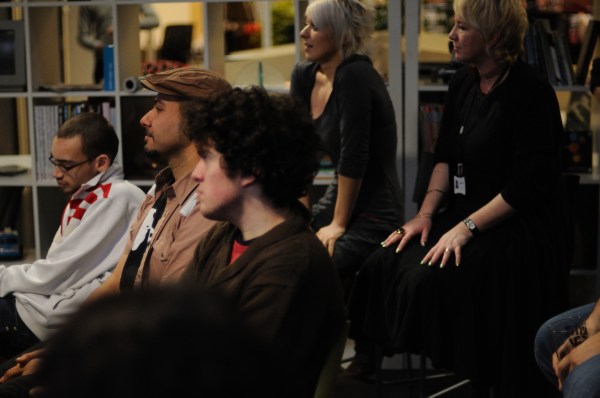
The XX Game Jam gets underway…(images from xxgamejam.tumblr.com)

Tech at XX Game Jam (images from xxgamejam.tumblr.com)

One of the teams talks ideas (images from xxgamejam.tumblr.com)
Learning from Faliure
This is an interesting post on GamesBrief.com:
Two years ago, in an article that generated much flak and for which I had to write anexplanation of my reasons for writing it, I wrote down ten games businesses or ideas that were doomed. Two years on, it seems like a good time to assess how well I did.
It is always interesting to look not only at what did work, but what didn’t. Failure can be a huge driver of learning; because you can’t avoid asking the questions, whereas with success you can be too busy basking in it to ask the hard questions. It is always important to review things to see why they didn’t go as well as planned. The temptation is to blame external factors, and while you need to be open minded, you also need to look at internal factors and also the wildcards – such as luck (or lack of it).
Kaul’s Diary on Wired.com
A kindly Geek Dad has written about our new DLC for Call of Cthulhu:The Wasted Land:
The good news is that Red Wasp has released a new “Extra Mission” as an in-app purchase to CoC:TWL called “Kaul’s Diary.” This time around, no more mister nice guy. You play the evil mad genius – yes, there are “good” mad geniuses – Docktor Kaul as he works tirelessly to bring about the end of the world. This is a prequel to the events in the first adventure, and pits you against the forces of good as you collect your resources to summon Cthulhu. This would be a near impossible feat if not for the many friends you are able to enlist along the way, including a particularly feisty Leng Spider and a few of the reanimated dead provided by the ever resourceful Herbert West.
PS. We’re also on The Greenlight Bundle, but only for a few days, so get it while you can!

On GamesIndustry.biz: How We Evolve Fun
I’ve got a new article online over at GamesIndustry.biz:
In software development, the individual is not each install of the software, for these are just clones from the same source code (or genotype). In software the individual is each iteration or version of the program in question. It is then the desirable traits that version displays (its phenotypes) such as functionality and gameplay which determine its fitness. The landscape is not the forests, fields or oceans but the mass of potential users with their functional, economic and political demands. It is their wishes and whims that create the environment in which each individual iteration of software is born and so may thrive or die. Two thirds of all apps released are never downloaded more than a tiny handful of times; to paraphrase Darwin, many more individuals will be born than the environment can sustain and so the differences between them will determine their fate. (More)

(image, the machinc evolution of Cylons via popsci.com)
A FAQ Guide to Game Jams and Hacks
So I’ve been involved with a number of game jams/hacks now (Global Game Jam, Gamify Your PhD, Wellcome Explay Game Jam etc) and am finding that I really enjoy the format. When I first got involved, the idea of giving up my free time to make games was not an attractive prospect. I’d done far too many lates and weekends on game projects to see that as fun. But happily, I was wrong. It’s great fun. Freeing yourself from the more red-tape aspects of a game (important but boring) such as save systems and settings menus means you can just enjoy the creativity and ideas. I’m now a huge proponent of game jamming.
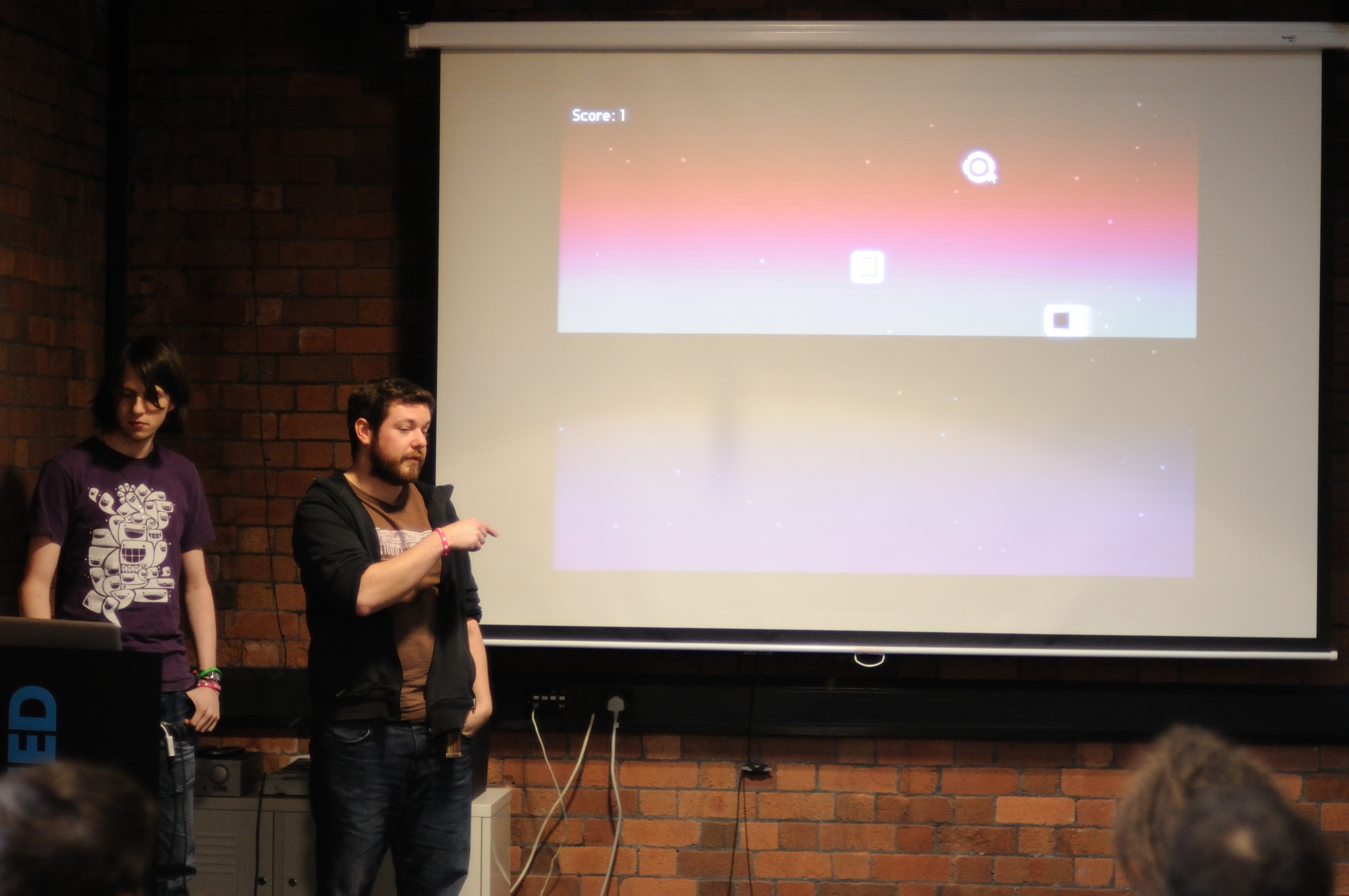
Bristol Wellcome/Explay Game Jam 2012
So what if you’ve never done it and are interested in taking part – here’s a brief FAQ I’ve compiled to help you find out more.
What is a games jam (or hack)?
A Game Jam is a method of rapid prototyping of a video game, going from concept to a working version in anything from a matter of hours to days. This is in contrast to the normal development cycle of a game which runs from weeks to years. Game Jams tend to run around a loose theme. In contrast to full game development, Game Jams tend to ignore many of the wrapper and longer-term functionality aspects of a game (option screen, save systems etc) in favour of a focus on gameplay.
Why are games jam’s so good for development?
Lots of reasons, but key ones are:
- The mixing of so many people, skills and ideas results in a hybrid form of parallel competition and cooperation. Such methodologies result is a surprisingly low rate of redundancy of ideas, while producing multiple solutions to meet the brief (Kornish & Ulrich, 2010).
- The focus is on the limitation of time but using older development techniques such as sprites on more powerful modern technology, can often produce creative results.
- Game Jams are good melting pots for skills. They create a space where non-developers can get involved in the development process.
- The low risk atmosphere created by the largely volunteer process, in contract to the growing size of mainstream development budgets creates a space where experienced and skilled developers can experiment freely further driving innovation.
- Games are an inherently interactive medium and many ideas are only fully appreciable once playable. Game Jams result in a huge number of playable ideas, so if the aim was to search for one to take forward, this decision can be judged far more robustly with the playability to hand.
OK, I’m sold – where can I find a games jam?
Search for one online. There are loads of such events. See the Global Games Jam or this list of events. There is no shortage of such events. If you can’t find one near you – organise your own!
What do I need to know for a jam?
I asked fellow jammers about what they felt was important and this is what I kindly got back from Sam Phippen:
- Work in a framework and language you know like the back of your hand. Debugging will be faster and your morale will stay high because you’ll be making progress.
- If you’ve got a dedicated game designer, break your constants that effect gameplay (things like player jump height/gun fire speed) out into a text file ASAP, that way the designer can tweak them to their hearts content and build something that plays well quickly, it doesn’t matter if this doesn’t start complete, you should expect to add to it. Use a merge tool to pull the designer’s changes in with yours if they don’t speak revision control.
- Use dropbox, most artists don’t understand svn/git and instead of spending the time teaching them, just use a tool they understand that you can easily sync with your revision control system. Make it automatic sync art from Dropbox into your revision control, if you can do this then every time the artist wants to change the look of something it’ll automatically show up as changed in your RCS, which means you can integrate those changes more quickly. Postits, write down every single task that needs to be done on a post it, and grab one whilst your working on it, have a wall of tasks that you’ve done so you can see what’s done, what’s in progress and what’s left to be done. These stick quite well to the back of a laptop, which is great.
- Don’t go overkill on the software architecture, you probably don’t need much more than a list of things to update every frame, a list of things to draw every frame and then special cases for any other weird behaviour. Think about your abstractions as you’re going, don’t spend too much time thinking beforehand.
So does that mean you have to be a tech-y person to take part?
Not at all. Jams use game designers, artist, sound designers. If you want to make games but never have, they are a good way to get some experience. There are also street game jams and many jams also allow you create board or card games too.
Tools, Links & Resources:
Engines/Frameworks
- Twine (easy to use non-linear story telling tool)
- Game Salad
- Box2D
- Game Maker
- Flash Punk
- LibGDX
- Papaya
- Scirra
- Unreal
- Unity
& a list of game engines.
I will update this list more as I go along…
Games Jammers in Bristol get to work. (photo by Jon Cooper)
Wired for Space
I’m spending more time than normal over at Wired.co.uk – all will become clear soon. Wired have a got some great space-related stories up currently! Including plans for Flying Saucers;
The newly declassified materials show the US Air Force had a contract with a now-defunct Canadian company to build an aircraft unlike anything seen before. Project 1794 got as far as the initial rounds of product development and into prototype design. In a memo dating from 1956 the results from pre-prototype testing are summarised and reveal exactly what the developers had hoped to create.
The saucer was supposed to reach a top speed of “between Mach 3 and Mach 4, a ceiling of over 100,000 ft. (30,480 metres) and a maximum range with allowances of about 1,000 nautical miles (1,850 kilometres),” according to the document.
Plans to send robot probes to the Moon:
Europe and Russia plan to send a moon-drilling robot to Earth’s satellite in 2020, where it will penetrate the north or south poles and return with frozen soil samples.
The Lunar Polar Sample Return mission ideally hopes to dig for samples in craters, where two-billion-year-old impacts have left deep materials nearer the surface.
However, until the European Space Agency (ESA) and Russian Federal Space Agency (Roscosmos) has the technology to do so, they are limited to only drilling in areas where the surface is permanently illuminated by the sun.
And the crazier plans for the Moon – including sending a nuke up there to show off a bit:
After the early Soviet successes in the Space Race, the US wanted to come up with something dramatic to show everyone who was the most macho imperial space country on this planet. The US Air Force developed a top-secret project codenamed A119 that proposed detonating a nuclear bomb on the lunar surface. As completely crazy as it sounds, the project went on for many years, even roping a young Carl Sagan in to explore the effects of a nuclear explosion in low gravity.
TV’s Professor Bruce Hood to open the 2012 Games Jam
Really pleased to be able to say that we’ve got Professor Bruce Hood to open the 2012 Games Jam and announce the theme!
We are extremely pleased to announce that Professor Bruce Hood, who holds the chair of Developmental Psychology in Society in the School of Experimental Psychology at the University of Bristol, will be opening the game jam and revealing the theme for the following 24 hours of frenetic game development.
Professor Hood is known to millions of people from his numerous books, articles and TV appearances including the 2011 Royal Institution Christmas Lectures broadcast on the BBC, continuing the venerable tradition started by Michael Faraday in 1825. His written works include two popular science books “SuperSense” (HarperOne, 2009) about the natural origins of supernatural beliefs and “The Self Illusion” (Constable & Robinson 2012) about the fallacy that we are coherent, integrated individuals but rather a constructed narrative largely influenced by those around us.
Professor Hood said, “I’m really excited to be unveiling the theme for the 2012 Welcome Trust Game Jam – science opens so many potential doors of inspiration for developers, I will be fascinated to see how it inspires new games from this event.”
You can find out much more at Bruce’s blog.

My Picks from #EuroGamerExpo
So I’ve been at the Euro Gamer Expo today and here’s my thoughts on what I liked there…
Of the bigger games Assasin’s Creed 3 looked really good; amazing visuals and the re-invented Tomb Raider, there as the new hunter’s mode with bow & arrow, looked amazing too. In both cases the environment art looked stunning. I also liked the look of Company of Heroes 2 and the new XCom game, which is a really fun playable looking strategy game.
But of the mainstream titles that were there I liked the look of Crysis 3 the most. The hunter multiplayer game looks great fun, balancing the numbers of the Cell team vs the stealth of the Nanosuit.

Crysis 3 Poster from EuroGamer Expo 2012

Crysis 3 Start EuroGamer Expo 2012

Crysis 3 Hunter View EuroGamer Expo 2012
Of the Indie stuff that caught my eye was the parallax retro side scrolling game, Towers of Gorillion which I really like the mechanics of and also love the look of too:

Tower of the Gorillion EuroGamer Expo 2012
And also a simple yet really fun atom-building game called Sokobond where the player has to link the elements together:
Play the Games From #GamifyYourPhD
The teams in action at Gamify Your PhD
They are all online now (and free and great) so no excuse for not getting the high score!
Thomas Forth, ‘The Researcher’
“I saw the advert for ‘Gamify your PhD’ at wired.co.uk, via a long chain of fellow scientists on twitter, just six days before the deadline. I immediately knew that this was the chance I needed to develop some new ideas. I wanted to see if the computational technique I’ve worked hard to make visual could take the next step and become interactive.
“The games designers we worked with during the hack are masters of creating intuitive ways of interacting with complex systems. In minutes they could come up with solutions to problems I hadn’t even thought of. The final game needs some small improvements, but I’m already thrilled with what we’ve achieved. Ours was an extremely ambitious project and a lot of what we tried didn’t work. The Wellcome Trust deserves huge credit for letting us learn from our mistakes to create something better than I had ever hoped for.
“Progress in science often comes from using our understanding of existing systems to come up with new ideas. In the 21st century we are studying systems more complex than ever and we have fantastic new tools and techniques. But we are often held back by the cost, in time and training, of innovating. The solution is to look at problems differently and play with different solutions. We should work more with the gaming experts who have mastered that art.”
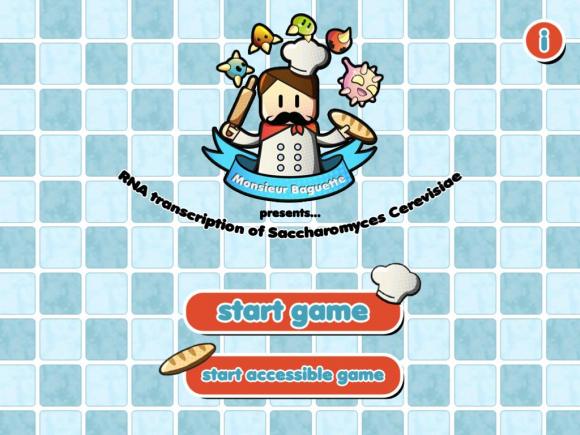
Front screen of Monsieur Baguette – click to see more!
How Games Drive Platforms and Technology
There is a great little song, Hey Hey 16K, about the now classic icon of British design, the ZX Spectrum. The song celebrates the pioneer of home computing and how it launched the UK games industry:
What it pokes fun at it that these machines were purchased under the pretext of helping with homework and household account, but all they were ever used for was games. That is no bad thing, imho. Games drive technologies, because games give a reason for all the flashy stuff they can do. Games are the fun reason you want to use technologies and if the games are there you’ll make any excuse to get that technology (“It’ll help with my homework, dad!”) and overcome any problems (remember loading game via tape? I do) or issues for the fun they provide.
At the time the ZX Spectrum was going up against the BBC Micro. The BBC had the support of the establishment and was introduced though schools to kids. But the ZX Spectrum was cheaper and had games – loads and loads of cheap games. It became the clear winner.
It not really much different now with games being the singles largest type of app on the iPhone:
According to a March 2012 study by App Store monitoring company Distimo, “Games is the single most important type of application (50% of all top paid applications are Games)” in the iPad App Store. In the new “All-Time Top Apps” list revealed by Apple in March, 17 apps from Top Paid for iPhone chart were from the Games category; 10 apps from Top Free for iPhone chart were from the Games category; 13 apps from Top Paid for iPad chart were from the Games category; and 6 apps from Top Free for iPad chart were, you guessed it, marketed as Games.
As then, as now, games drive technology adoption.


 A Great Becoming...
