Cthulhu Thursday: H.P.Lovecraft Action Figure!
This is very, very cool!

The HPL action figure by Alex CF! (Click to go to the creator’s homepage.)
Hat-tip to Adam for the link.
(Cthulhu Thursday is a dose of Mythos to brighten darken your week. More on the idea can be found here and a list of posts thus far, here. Also for more Cthulhu news, sign up to the cthulhuHQ twitter feed. Enjoy!)
Cthulhu Thursday: Cthuldroid!
So we released Call of Cthulhu: The Wasted Land on Android last week. As part of the art for this, our artist Stu did a great mashup of the Android robot and Cthulhu, so enjoy!

Cthuldroid!
Also check out the making of the game illustrated via another game about making a game (phew & meta!)
(Cthulhu Thursday is a dose of Mythos to brighten darken your week. More on the idea can be found here and a list of posts thus far, here. Also for more Cthulhu news, sign up to the cthulhuHQ twitter feed. Enjoy!)
Notes from Exploiting the Feedback Loop #xosummit
On Wednesday I chaired a session about feedback, games and media at the Crossover Summit at Sheffield Documentary Festival (image) for the Wellcome Trust. This post has my notes and links from the session.
The idea for the session is rooted in biological processes that happen around us (and in us!) everyday. For example, the image (right) is of 6 linked insulin molecules.
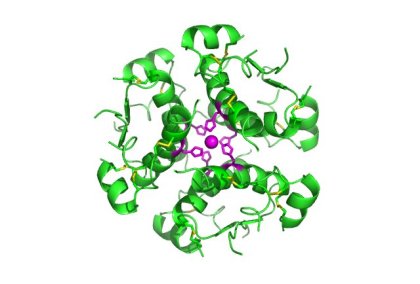
Computer-generated image of six insulin molecules assembled in a hexamer. (Source, Wikipedia)
These are part of a number of biological systems we have that together make up our homeostatic systems. This is a series of monitoring and control systems that measure various facets of the body (blood sugar, temperature etc) via feedback loops and trigger the body to respond to external and internal changes. So while the body is striving to keep a form of stasis (being alive!) the chemical composition of the body is in a state of constant flux.
There are similar ideas going on in how we create, consume and develop media. This biomedia approach sees the media form itself and something in flux, connected and responding to feedback loops. It sees media artefacts themselves (games, films, novels etc) as being part of (and evolving within) a complex ecosystem, a media ecology.
Professor Jon Dovey of the Digital Cultures Research Centre shared his view of this idea, that these feedback loops are nothing new (they are called ‘ratings’) but that it is the speed and granularity of the data that has changed. At the recent iDocs event, they looked at 18 Days in Egypt, an interactive documentary that pulls in feeds from around the world. Indeed so interlinked was this to the data that as part of the project, a software system called GroupStream was also created to collate these rich seams of data/content. Also in these projects the producer loses a degree of control over the content as they become co-creators with what was the audience. In effect the producer becomes more of a gardener.
Kate Quilton from Channel 4 shared with us her experience of exploiting the feedback loop in multi-platform work on TV. The recent Foxes Live was a mash-up form of TV show, science experiment and co-creation.
Kate talked about how the show pushed a number of boundaries of data-feeds; live GPS tracking of foxes, massive use of audience as data-gatherers for the science experiments and a wide ranging use of online mapping technologies meant that it had the biggest online footprint since the Big Brother eviction.

My game of Diamond Dash – I was not doing too well as I needed to screen-grab it!
Wired carried a story that in 1747 the surgeon James Lind, on-board the ship HMS Salisbury, carried out the first ever conscious split A/B test to see if they could tackle the scurvy problem on-board. In this method you take a section of the overall population. Give one group (group A) a certain set condition and the other (group B) a different condition. You then see which works out best and apply that feedback to the whole population. On the HMS Salisbury the population is the crew. The surgeon selected one group of 6 men (group A) to have one sort of diet and the other (group B) to have another food selection. The group whose health improved most was the feedback loop resulting in that diet being applied to the whole crew.
I then talked about how games are using this approach and really running with it. A good example of this in action is Wooga, a German company who produce the game Diamond Dash. Daily the developers look at 128 data points showing how users interacted with the game. These points are fedback into meetings and discussions that result in Split A/B tests to look at changes in the game. From these results, weekly changes are made to the game. As such the games stasis (player retention and monetisation – or as I like to call it ‘fun’) is maintained by the continual ongoing tweaking of the game’s internal chemistry.
We talked about using things like YouTube’s data analytics of not just the number of views, but how much of the film they saw, when people stopped watching etc to build either online A/B tests for video and/or iterating a film repeatedly based on user feedback loops.
I also talked a little about the wider evolutionary model of what is going on here (the subject of my PhD work). In this I model a version of evolution that I believe is happening in software development. One where the individual is not each copy of the software, but each iteration/version. The environment in which these individuals live/die is one made up of us and our cultures.
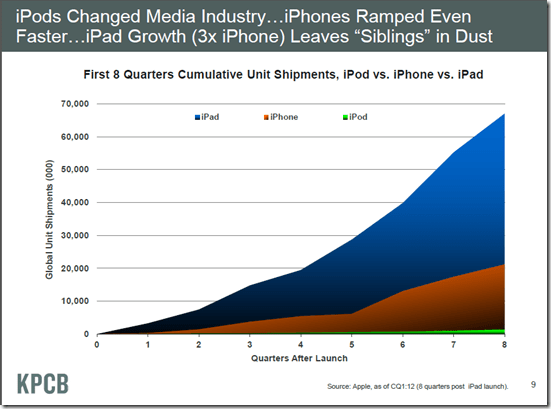
iPad: 0 to 60 Million Units in 2 Years
A reminder!
Exploiting the Feedback Loop 13:15 / The Chapel
Tom Rawlings (Chair) / Jon Dovey (DCRC) / Kate Quilton (Channel 4)
Games like Bejeweled, Draw Something or Words with Friends are not one-off media events, but are on-going almost living entities. Being connected to the network they can collect huge amounts of data from players and so feed back to the designers which elements work and which do not. This allows them to respond, changing and improving the project in response. But while this ‘bio-media model’ clearly works for video games, can it work for filmmakers? By seeing video as data, a number of media thinkers are increasingly challenging the view that a film has to be a one off creation. Join us to find out more…
If you want a flavour of the event – try this…
In total, Begemann studies 128 data points. He does the same for the six other games that wooga has released. “Some differences are obvious, like Wednesdays are better than Thursdays,” Begemann says. “But if I still can’t make sense of the reports, I forward the question to the respective product lead of the game.” Then he puts away his phone, takes his two-year-old son to kindergarten and walks to wooga’s Prenzlauer Berg offices in east Berlin.
Wooga is a new type of game developer, one that emphasises metrics over creativity. Its core discipline is A/B or split testing, in which new features are introduced to a selection of users, and their reactions measured. Features remain only if users engage with them. If they don’t respond, wooga tries new features until they do. Each wooga title is updated weekly; the initial release is just another stage in development. “After launch we become very metrics-driven,” says Begemann. “During the first two weeks of Brain Buddies [wooga’s first game], we did four or five A/B tests. It was very fast — almost daily iterations.”
Currently Playing – Dungeon Village
I’m a huge fan of Kariosoft’s games (e.g. Game Dev Story) and so was pleased to see a new one out: Dungeon Village! I’m currently having a lot of fun with it.

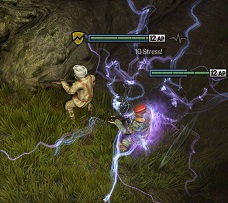
Here’s 3 of my heroes about to run off and kill a frankly very cute monster that is not really that monstrous. In fact the monsters are very polite.

Here’s my growing Dungeon Village. It has a lot of food outlets; cake stores, bakeries, cafes. Frankly I’m surprised my heroes don’t die of heart disease rather than via monster attacks.
I got an email telling about a great looking Cthulhu game that is looking for crowd funding – check it out!
A teacher at the notoriously underfunded Miskatonic University Daycare Centre sends her charges off to sleep with a story from the Necronomicon (it was the only book she could find in the library that had pictures…)
Through her not-quite-carefully-edited-enough account, we follow the dread Tiny Cthulhu on his travels through mind-blasting vortexes of madness and adorableness on his way to rain inevitable and cuddly doom on a blissfully unsuspecting humanity.
…Sleep well, kids…
Are you personally offended by the astonishing lack of 3D Platforming titles for PC/Mac/Linux?Do you further feel that there’s simply not enough Eldritch Abomination in your life?Well, in that incredibly unlikely case, you’ll probably be overjoyed to hear that THEORY32 has just launched an Indiegogo fundraiser for Tiny Cthulhu – its an upcoming game of adorable Lovecraftian mega-horror.The game’ s Teaser Trailer can be seen here:-
–
Footage from areas-in-progress can be seen here:
The page itself can be found at:
http://www.indiegogo.com/tinycthulhuDonation perks include having your house made into a stomp-able model and placed in Cthulhu’s path during the ‘Modern Earth’-set finale, having a picture of your face appear in the ‘Lost and Hidden Shrine to Those Horrors That It Is Better To Die Than To Glimpse… Even For A Second…’ easter egg, and providing screams and/or last words for the destruction of a building.
High-res screenshots, logos, more info, and etc. can be found at the Development Blog here:
http://tinycthulhu.blogspot.com.au/
Looks great!
(Cthulhu Thursday is a dose of Mythos to brighten darken your week. More on the idea can be found here and a list of posts thus far, here. Also for more Cthulhu news, sign up to the cthulhuHQ twitter feed. Enjoy!)
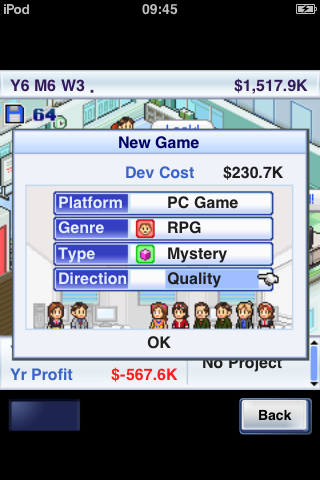
Over the last 18 months we’ve done lots of interviews and written lots of articles about the development of our game. I wanted to compile a number of these links into a single place. But also I’m a huge fan of the game, Game Dev Story, a game where you make games. So using that game to generate a few screenshots, I present for your reading pleasure the result of my experiences making the game for real AND making the game in Game Dev Story(phew!);
The Making of Call of Cthulhu: The Wasted Land (via Game Dev Story)….
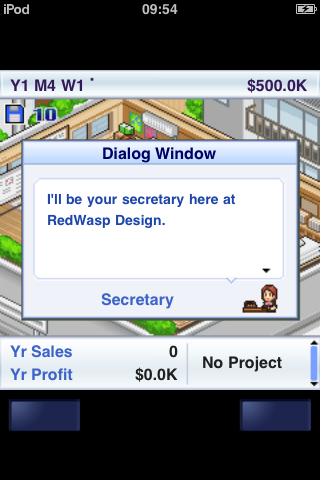
Founding Red Wasp Design
Part 1: The Founding of Red Wasp Design:
Please introduce yourself.
We’re Red Wasp Design. We’re a new games studio based in Bristol, UK (the home of Bansky graffiti, old school pirates and trip-hop.)
What made you want to be a game developer?
Playing games! We all grew up playing games and so the idea of making games came naturally. (Source: Playandroid)
Tell me a bit about Red Wasp. Maybe a bit of background about the company, what sort of games do you like, what are your goals, that sort of thing.
We are an indie developer – we’re a small developer that does the sort of games we want to do. There are three of us in the development team; myself Tomas, as designer, Michael who does the coding and Stu, our artist. We also have Debbie, our office manager and a few other people who work with us on a more flexible basis for sound design, testing etc. As with any group of people we’re fairly diverse in the sort of games we like which means we’re drawing from a wide range of sources. (source: Examiner.com)
I’ve also written three articles about how to found a games studio from my own experience which you can find on Gamezebo and it is in 3 parts the creative side,the business bit & and the all-important marketing.
What Shall we make? Call of Cthulhu!
Part 2: What Shall we make? Call of Cthulhu!
Its probably worth a quick detour for anyone who has not heard of Call of Cthulhu. The deliberately unpronounceable ‘Cthulhu’ is the titular being of a series of shorty stories and novellas written by an American horror writer of the 1920s called Howard Philip Lovecraft, the most famous of which is ‘The Call of Cthulhu‘. What lifted Lovecraft’s work above much of that written by his contemporaries was that he managed to tap into the very human desire we have to explore our own mortality. … I’d written a paper supplement for Chaosium, the publishers of Call of Cthulhu a couple of years ago called the Dark Mirror. While working on this I had talked to Chaosium about doing something in video games on a number of occasions but it never seemed to happen for one reason or another. Then, the stars aligned last year, and I found myself in a position to do a mobile adaptation of Call of Cthulhu. (Source: FlamesRising.com)
Why did you decide to go for the Call of Cthulhu license and not just borrow Lovecraft’s ideas from the public domain?
I’m a huge fan of the RPG and always felt that over the years it had evolved into a solid game system that we could use in our game. Not only that, but it felt better to try and work with people who knew the area – Chaosium – and so we could also benefit from their input and experience. (Source: IndieGames.com)
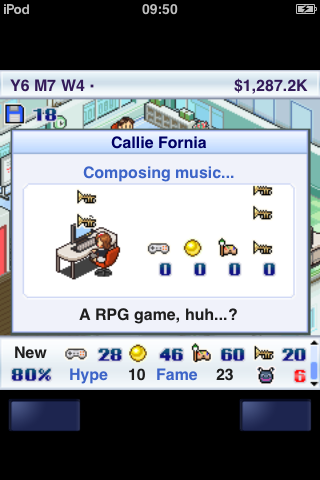
In Progress! Making the Game
Part 3: In Progress! Making the Game
Early on in the development process we sat down to plan the graphics technology of the game, and the first issue we had to resolve was the question of if we were going to do the game 2D sprite based or 3D models, or possibly a hybrid of both. …
We also wanted the game to represent the people and monsters to a realistic size. This is to help give the monsters in the game a sense of menace, so when a Dark Young attacks your character, you feel the threat of its size, whereas if each unit was just an icon, this is lessened somewhat. We also wanted the landscape to be proportional to the size of the units, to build on this idea and to give the landscape a role in the strategy of the game.
These decisions are in contrast to a game like Advance Wars, where each graphical unit on the landscape represents a squad. Another example is the strategy RPG The War of Eustrath, where each graphical unit is only a single character, and in game they are represented by icons of the units mech-helmet. I’m a fan of both of these games, especially Advance Wars, but for our game we need to see the people to develop a rapport with them, and to watch them go insane and die… For this we needed 3D. (source Gamezebo.com, you can also find out about the game’s design & art plus the sound design too! Plus see Slide to Play for more.)
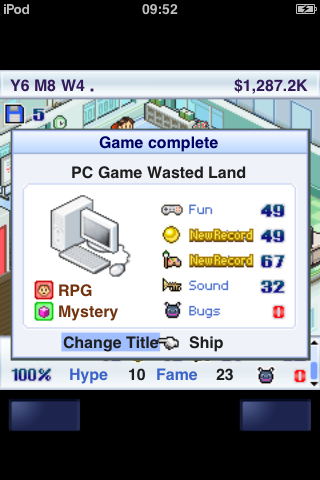
The Release of Call of Cthulhu: The Wasted Land
Part 4: Release the Hounds!
We’ve put our first game out, Call of Cthulhu: The Wasted Land. It’s done pretty well on iOS. It charted at number 1 in the Role Playing Game category in the AppStore and the reviews have been positive (“I was totally addicted to this game for weeks…” Wired.com, “The best strategy game on the iPad yet.” DigitallyDownloaded.net, 5/5 from T3 Magazine for example). Also by the time you read this article the PC version will be out on Intel’s AppUp center. So far, so good. (Source: GamesIndustry.biz)
What were the greatest successes of The Wasted Land?
I think the game balance went well. I was hoping that this would be a game that challenged and drew you in and I think we accomplished that. The marrying of the RPG and strategy elements I’m also happy with and I’m pleased with the work our artist, Stuart, did and the incredible 3D engine that our programmer, Michael, produced.
Any regrets? Any aspects of the game you’d like to change or update?
We have had bugs and being a small studio you can’t bring the amount of testing resources you’d like to have to this sort of project. The game ended up a much longer and more complex game that it was on paper originally and so bugs crept in. We are going to update the game soon to fix a few, but beyond that there are always bits you’d want to change. As a developer you’d tinker with a game forever given the chance. At some point you have to let it go! (Source: IndieGames.com)
And there you have it!
I’d written a list of my top 5 books, films, comics etc related to the Mythos. I’ve updated the list adding a few more entries including to art, mashups & contemporary fiction and a new category – websites.
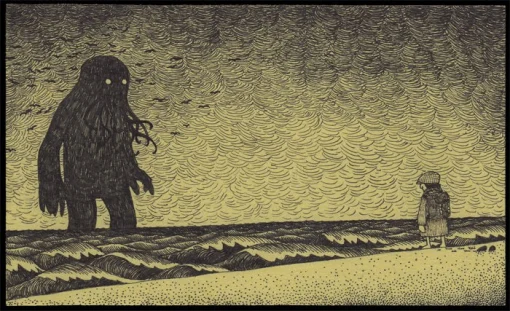
Top 5 best of Myhthos, Cthulhu and Lovecraft Film, TV, Games, Stories and more… Click to see more (Image is work of John Kenn Mortensen, added to the art category).
I also want to plug my essay on Lovecraft & Biology as I’m quite pleased with it!
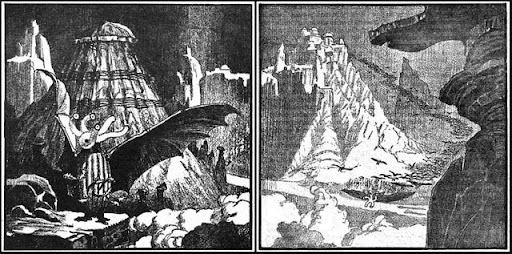
At Mountains of Madness art by Howard V. Brown – Discussed in “Three Vital Things Cthulhu (and Lovecraft) Show Us About Biology (and Tentacles)”
(Cthulhu Thursday is a dose of Mythos to brighten darken your week. More on the idea can be found here and a list of posts thus far, here. Also for more Cthulhu news, sign up to the cthulhuHQ twitter feed. Enjoy!)
Normal Service Will Be Resumed…
Dear reader, I’m away for a few days on holiday so my blogging will dry up a little. This is a welcome break to play games, read books, watch films and relax. Blogging will be resumed when I’m back around 6th June. Have fun 🙂


 A Great Becoming...