#Hollywood and Technological Innovation
An interesting post arguing that it was Hollywood’s success in using political routes to protect its buisness that has lead it into a corner where it seems unable to innovate well:
In the 1920’s individual states were beginning to censor movies and the federal government was threatening to do so as well. The studios set up their own self censorship and rating system keeping most sex and politics off the screen for 40 years. Never again wanting to be at the losing side of a political battle they created the movie industry’s lobbying arm, MPAA.
By the 1960’s, the MPPA achieved regulatory capture (where an industry co-opts the very people who are regulating it,) when they hired Jack Valenti, who ran the studios’ lobbying efforts for the next 38-years. Ironically, it was Valenti’s skill in hobbling competitive innovation that negated any need for studios to develop agility, vision and technology leadership.
As a previous post pointed out, getting too comfortable is a recipe for disaster long term…
Battlestar Galactica as Retro RPG
This is ace fun – but note; it is a huge spoiler if you’ve not seen BSG and plan to:

Story source: Kotaku
We Knew That: Survey Shows More Play On Mobile, Less On Consoles
This is no surprise, but interesting to have the data, anyway…
Mobile gaming company MocoSpace surveyed over 15,000 gamers in their network of 25 million gamers to ask them about their gaming habits. The survey revealed that 46% of those surveyed said they are spending more time playing mobile games this year, and only 26% said they are spending more time gaming on their consoles. Only 23% said they are playing more games on their PCs.

What also surprised me is the resilience of the PC – some have been declaring the PC dead as a games platform for some time and yet it continues to thrive.
Video Games Predictions for 2012 – The Console Wars
It used to be that the console wars had very defined lines, like a Napoleonic battle field. Armies would turn up in clear colours and fight it out – Sony, Sega, Nintendo. When one lost, another would try to mount a new offensive – Microsoft for example.

Then Apple went and the smart phone a ubiquitous general purpose machine that excelled at games and followed it up with a pad. Now the battlefield is a mess and while the big players are still slugging it out, the lines are no longer clear and the fighting is all over the place. It’s all a bit Goya.

So what does 2012 hold for this section of the console wars? Industry Gamers asked some analysis what they thought Sony should do:
Their big focus for 2012 will be the launch of the PlayStation Vita. If Sony can dedicate themselves to launching strong first-party content, I don’t see any reason, not even the price tag, that could hold the Vita back. With early reviews of Uncharted for the Vita coming in positively, it looks like they are on the right track.
He was not the only one in the article to say the Vita could work out. Sony are also up-beat about it. I have to admit I’m not sure I agree with this. I think the PSVita is a console pitched to the pre-iPhone world. Sony has amazing technology and games (I’m a PS3 gamer!) – you can see this in the PSPgo for example. But it was not the fully-networked device and system that a smart phone is. Sony are clearly trying to make it more mobile and have got some great looking games for it. But for the price of one of those games I could buy 40-50 games for my iPod. In Japan (Sony’s home turf where the PSP did very well) the first weeks sales were an impressive 324,859 but the following week, after the hard-core fans had got theirs sales were 42,648 (and it was out-sold by the PSP). Compare that to the opening week sales of the iPad2 in Japan which were between 400,000 and 600,000. Also note that in December 2011 Google say they activated 42 million Android devices worldwide. I know that is worldwide, but that is about 10 million per week. A change of strategy is needed there I feel. However there is plenty of opportunity as the games bit of Sony is profitable.
That’s not to let Nintendo off the hook. They also have the same problem. In the past Nintendo has not been very network-centric. A bad move in the digital age. It seems that in 2012 they are trying to fix this by creating their own app store. If they can internalise the changes of the post-iPhone world fully, they they could do well. If. Remember this is against a backdrop of Amazon selling 1 million+ Kindles in a week, including the Kindle Fire.
The console wars are going to be messy in 2012, bit it seems Microsoft are starting to understand the position they are all in and are making moves to link to mobile via Android…Which is brave (and the right strategy, imho) rahter they trying to lock everything into Windows Phone only.
The Case for Smart Phones in the Developing World
From a longer write up by the Guardian, but the words here are by Google’s Andy Rubin (their head of Android):
Historians are, however, going to make note of how the open source Android platform (or its later forks and clones) played a role in facilitating everything from low-cost solar-powered devices in the remotest villages in India and Africa, to a hundred million tablets computers in the classroom each revolutionizing education for children all across Asia and the Middle East, to putting an internet-connected smartphone in the hands of every man, woman, and child in America, even those from the perpetually overlooked majority that simply can’t afford a shiny brand-new iPhone or Galaxy Nexus every Christmas.
So ultimately I don’t give two hoots about which vendor or which carrier gets to ship which device on which network with which apps. But I’m stunned, stunned, by the audacity of releasing the Android platform as free and open source software. Not just because how it has already shaken things up at the top. But how it will go on to shake the rest of the planet upside down.
Agreed. Now all we’ve got to do is address the Coltan issue in making all those phones.
Video Games Predictions for 2012 – Social Media and Games
Following on from my last post on the topic of the future, I’m going to move from Free-to-Play games into the the closely related turf of social media. The ‘traditional’ games industry has struggled to make sense of social media. They have been trying to make their own systems (e.g. Playstation Home) or buying their way in (e.g. EA buying PlayFish, the Facebook gaming company) or trying to integrate with existing systems (e.g. Sony’s Playstation App for iPhone). However in 2011 we did see companies trying to get a grip on what this means for gaming, lead by companies like Zynga who have been blending social media into gaming very well. So what is to come in 2012?
This post on Facebook and how it’s gotten a bit too crowded caught my eye:
A year ago Steven Levy suggested that Facebook should give us each a single “friend-list do-over.”
A lot of commenters challenged him. “Grow some balls and just unfriend people,” said one of the more even tempered readers. Another – “These comments are too constructive. Someone should just call this guy an idiot.”
Steven probably didn’t see that criticism coming, because he probably assumed people understand how difficult it is to unfriend people on Facebook at any sort of scale. You have to find the person, hover over the friend button, select unfriend and then click a confirmation.
That’s a few seconds, and when you are trying to remove hundreds, or thousands, or people you don’t know as friends, that takes Too Long. And so the friends stay, for the same reason that every clock in my house is off by an hour for half the year.
So, no, most of us aren’t going to spend the time removing friends on Facebook. Instead many of us are using new social networks, like Path (we’re an investor) and the upcoming Just.Me (we’re also investors, guess how much we like this space) to start fresh. Facebook is for thousands of people you don’t know. The start fresh new services can be finely crafted from the start to include only your actual friends. And they’re made for mobile. Update: Check out Ourspot as well.
So what does all this mean for gaming? I think we’re going to see much more integration of systems. Microsoft have done a pretty good job of this with Windows Phone 7, of getting social feeds into one place and also linking to the gamer stuff from Xbox live. I think we’ll see more alliances of gamers developers as content creators looking to help build new social platforms – after all games are a major draw for new platforms – software and hardware. Put simply in 2012 I think we’ll see more developers ‘getting’ social media, which is a good thing.
Problem is (as you can see from the post above) just as we’re all getting Facebook, social media is moving on…
Playability Workshop Coming Soon…
I’m happy to say that I’m taking part in this interesting event:
Studies have suggested that children share a more ‘intuitive’ and tactile relationship with objects and environments than adults. Rather than accepting the given meaning of things, children get to know objects by manipulating them and using them creatively, releasing ‘new possibilities of meaning’. Whilst developmental theorists have perceived this relationship as a sign of naivety and inability to be gradually overcome, others have celebrated it as an incisive, masterful way of knowing. Interest in play, as a fundamental experience across the life course and a force for social good, is growing. The role of material connections in play sit at the heart of these concerns as it is the ‘felt’ intensity and tactile creativity of play that are signalled in these engagements. The toy/games industry and play sector have a great deal to offer in furthering academic understanding of the important role of material connections in play. Playability brings these communities together for the first time.
- Who should attend? Play practitioners, play and toy industry representatives, games designers and academics.
- Where and when will it take place? Northcote House, University of Exeter on Tuesday 31st January 2012.
- What’s the wider project? ‘Playing with Toys: the animated geographies of children’s material culture’ funded by the Economic and Social Research Council (ESRC). More details about the project can be found at: http://materialsensibilities.wordpress.com
- Who is sponsoring the event? The University of Exeter’s Geographies of Creativity and Knowledge Research Group. More details about the group can be found at: http://geography.exeter.ac.uk/research/groups/geographiesofcreativityandknowledge/
- Who is co-ordinating the event? Playability is being co-ordinated by Tara Woodyer
Apparently there are still a couple of places left, so if this sounds of interest to you, sign up!
I did a talk about the making of The Wasted Land and @verityalexander took a piccy!
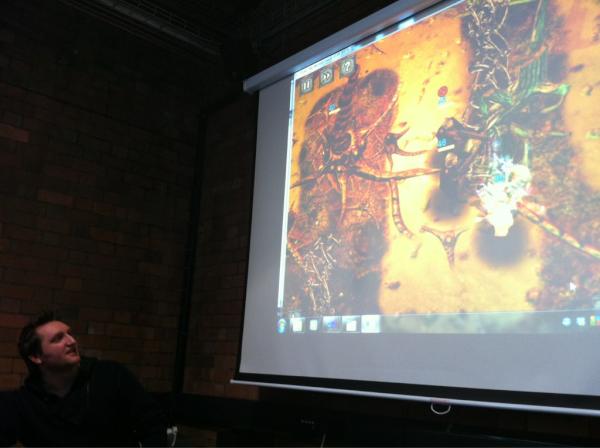
Me doing Red Wasp Design talk on 6th Jan at PM Studio
Great turn-out for the event, so big thanks to all who attended. Good to meet lots of you! (I’ve posted the quiz questions from the talk on the Red Wasp Design Facebook page.
Cross Platform App Design Guest Post with AppFurnace
I’ve got a guest post over on the lovely AppFurnace people’s blog (we’ve been borrowing their iPad a lot recently – thanks, btw!)
Designing an app or a game for more than one platform is something that needs a bit of thought and planning. Why would you choose cross-platform? You don’t have to but by doing so you are able to maximise the number of people who can use your creation. However there can be a downside to this maximising process; there is a danger you may dilute the functionality of your app as you stretch the concept to cover multiple platforms, so having to lose any specialisation. To further complicate matters, each platform (e.g. iPhone, iPad, Android, Playstation etc.) has its own features from both a technical, owner and from a user perspective.
Full article is here.
Video Game Predictions for 2012 – Free to Play
It’s that time again when people start to gaze into their crystal balls see what the next 12 months holds for us. Here’s a few bits of prediction that caught my eye…
Firstly I’m going to look at the Free-to-Play predictions for 2012. No surprises for the main one – it’s a huge area:
Free-to-play and freemium will continue to make massive inroads as business models
While free-to-play and freemium opportunities don’t suit every game or P&L (see: the recent closure of high-profile virtual world LEGO Universe), expect to see more titles and companies transitioning over to the business model. Credit the continued resonance and resilience of social networks and – most importantly – Web browsers, which are enjoying a presence on an ever-increasing range of mobile devices, including smartphones and tablets. In the latter case, the advent of HTML 5 and other advancing technologies (e.g. Unity and the Unreal Engine, which now support 3D browser-based gaming) won’t just eventually give way to console-quality game experiences, graphics and online multiplayer connectivity. They could very well pave the road for commonplace programs such as Chrome, FireFox, Internet Explorer and Safari to become tomorrow’s most successful and ubiquitous game console.
While I agree that free-to-play will continue to be a major engine of development and income for gaming, I’m not so sure that 2012 will be just growth and growth. This method has huge advantages and huge disadvantages. The model came into its own with the success of Farmville – and people noticing it – at the end of 2010. I was at Gamescom in 2010 and recall seeing the Zynga stand there, it was not at all prominent. Nothing like the huge EA, Sony, Microsoft, Nintendo etc presence. Once other gaming companies noticed this emerging area, things started to take off. When other publishers saw the success of the model, they wanted in. However there is a development delay in making the games. That means that there has been a year of development of lots of titles and 2012 will see all these newcomers launching – perhaps too many for the market to sustain (as with the MMO bubble). So expect growth, but ups and downs as new titles fight it out with established players.
Gamerlaw also has a prediction in this area worth serious attention – how the players of such games are treated:
(3) The legality and ethics of free to play will be a big issue in 2011.I’ve been influenced by my friend Nicholas Lovell of Gamesbrief on this issue – read his post here. I’m going to be speaking and writing about this a fair deal more in 2012, so watch this space. In the meantime though, the short version is: the more that f2p focuses on influence/compulsion mechanics to get player to cough up dosh, the greater the legal and ethical risks it can raise – including the potential for regulators to start getting involved. Stories like a UK child running up £900 in debt on Farmville for his mum or a US child running up $1400 on Smurfville don’t really help.



 A Great Becoming...