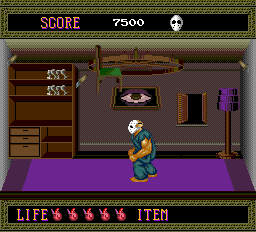
Mirrornaut Takes 2nd Prize at Games Jam! Woo!
I was very excited to get this tweet from the full Explay Games Jam event a few days ago…
@TomasRawlings @ashleygwinnell, @nedymond we got second place in the mirror theme category which means we can Go Ape… Literally…
So I was pleased and proud of the team and felt like…

–
This is a video of the game in action:
Here’s the background on the game and the jam. Also see the follow on – Spectranaut! (by @Tom_A_Parry & @ashleygwinnell)
Activision have put out a press release to this effect:
Call of Duty(R): Modern Warfare(R) 3 Sets All-Time Record for the Biggest Entertainment Launch with More than $400 Million in North America and United Kingdom Sales Alone
More Than 6.5 Million Units Sold in U.S. and U.K. in 24 Hours
SANTA MONICA, Calif., Nov. 11, 2011 /PRNewswire/ — Shattering its own day-one sales records, Activision Publishing, Inc., a wholly owned subsidiary of Activision Blizzard (Nasdaq: ATVI), announced that its highly-anticipated Call of Duty®: Modern Warfare® 3 has become the biggest entertainment launch ever with an estimated sell-through of more than $400 million and more than 6.5 million units in North America and the United Kingdom alone in the first 24 hours of its release, according to Charttrack and retail customer sell-through information.This marks the third consecutive year that the Call of Duty franchise has set day one launch records across all forms of entertainment, something no other entertainment franchise in any medium has ever accomplished. Last year, in North America and the United Kingdom, Activision’s Call of Duty: Black Ops™ had estimated day-one sell-through of $360 million and in 2009, Call of Duty: Modern Warfare 2, set day-one records with estimated sell through of $310 million, according to Charttrack and retail customer sell-through information.
Modern Warfare 3 Impressions So Far…
I got the game last night and I’m about 3 hours of play-time into it. So far so good. It’s very well polished, the engine looks great (thought a few of the effects are sub0par) however – and importantly – it plays fast, very fast. The slightly halting speed of movement and action was one of the things that didn’t endear me to Black Ops quite as much as MW2 was this vibe in the gameplay. Sounds a minor thing, but when the difference between one FPS and another are so slight, its the little things that count.
The story line is a little more polished than before. However it’s not a major reason to play. I do like the way the First-Person gamic aspect of the experience (e.g. you see events unfolding though various character’s eyes) has been woven much more into the storyline – it feels a better way to tell the story.
The action is relentless – it’s like being dropped into the the midst of an action scene in an action film – then never being allowed to leave. It’s non-stop so far. Which is fun, but I do hope there are a few missions that change the tempo a bit, else it will drain the experience somewhat. I’m most looking forward to the split-screen aspect, so will report back on that when I can…

Modern Warfare 3 gameplay
More may follow…
Rorschach Graffiti in Bristol
Spotted on Jamaca St in Bristol, Stokes Croft, Rorschach graffiti!

Wikipedia UK gets Charity Status
It’s great news that Wikimedia UK, the British arm of the Wikipedia organisation, that runs Wikipedia amongst other projects, has got charitable status:
[On 5th November] the Charity Commission has approved Wikimedia UK, the UK membership organisation supporting Wikipedia and the other Wikimedia projects, as a registered charity. The news comes shortly before the launch of this year’s global Wikimedia fundraiser. Starting on 14th November, Wikimedia UK aims to raise £1 million to support Wikipedia and its sister projects. The Charity Commission’s decision, regarded as a milestone in charity law, means that for the first time British donors to Wikimedia will be able to make their donations go further with Gift Aid. For Wikimedia UK, being recognised as a charity is a springboard for ambitious plans to work with a growing range of major organisations (including the British Museum and British Library). Wikimedia UK recently appointed its first Chief Executive and will open new offices in central London on November 14th.
This also has major implications for charity law in the UK too:
Leading charity law specialists Stone King LLP, who advised Wikimedia UK on the successful application for charity status, describe our registration as “a milestone in the development of charity law in England and Wales”, and go on to say in their own statement:“Wikimedia UK’s registration as a charity is a significant step toward the updating of charity law to reflect developments in modern communications and the evolution of user-generated content. The promotion of open access to content and user-generated and -enriched content has not, until now, been recognised as a charitable purpose. Stone King and Wikimedia UK are therefore delighted that the Charity Commission has made the bold and wholly justified step that acknowledges the profound contribution that properly managed and regulated open content makes to society.”
So I asked a solicitor friend of mine about this and he replied that they’d had to look back to the 19th Century in trying to decide! He also said:
The Charities Act 2006 specifies that for an organisation to be designated a charity, it must have a recognised charitable purpose(of which there are 12 – for more details see here) and be for the public benefit. Wikimedia’s new objects clause states:
“The Objects of the Charity are, for the benefit of the public, to promote and support the widest possible public access to, use of and contribution to Open Content of an encyclopaedic or educational nature or of similar utility to the general public…”These objects are clearly for the public benefit but they do not fit neatly into one of the 12 recognised charitable purposes. However, the Charity Commission has the discretion to designate “any other purposes currently recognised as charitable and any new charitable purposes which are similar to another charitable purpose” (see here for more information) as satisfying the test. The Charity Commission’s decision has not yet been published in full but it appears that providing a user-generated online public resource is now a legitimate charitable purpose.
Will we be seeing more UK-based open source projects becoming charities? This may well be very interesting…anyway a huge well done to Wikimedia UK.
(Thanks to Edward for the information!)
How Much Money Can a Mobile Developer Make?
It’s a good question and there is no one answer. It reminds me of the joke; Q: how do you make a small fortune in gaming? A: Start with a large fortune. 🙂 Anyway the very public spirited Streaming Colour (UK spelling!) took the time and trouble to survey developers about their work and its income and then share the results.
The first point that caught my eye is the difference between the mean and median averages of income:

Notice that the mean average is £161K – which sounds a lot, but the median average is just $3K, the difference coming from the fact that a small number of companies making a lot of money skews the average. (You get the same in ‘average’ wage figures.) So helpfully there is a table that seeks to account for this:
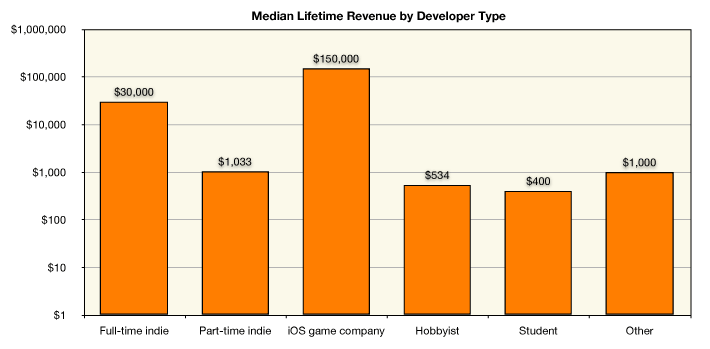
So those who do it professionally and full time seem to be those making the most money, as one might expect. It tallies with my experience of running a games studio; what that is your income, you find ways to make it pay! However that does mean there will possibly be a sample bias in the selection in that those full-timers who are not making money won’t last long and so not be in the survey.
Here’s the next pointer: Who earns the most; working alone or in a team?

So it seems, the developers working in teams make more and specifically team sizes of 10-19 are optimum. Now the author of the article does note the lower response rate that the larger team scale, so the results will not be accurate. But again it tallies with my experience of studio size vs. speed of action (getting a project done) and creativity (i.e. too many layers of management tend to dampen it).
And the final point I want to make is about the number of games released per developer;
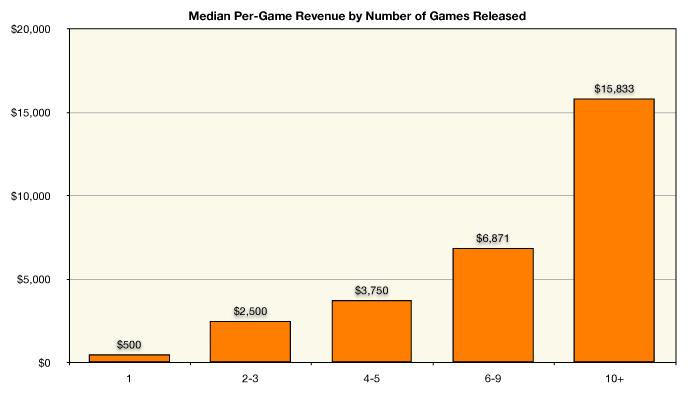
So the more games you get out there, the money money you make, which a dramatic rise in the 10+ games category. This tallies with the story of the developer of Angry Birds only striking gold after many lots of games. It also fits with my PhD research of development being an iterative and evolutionary process; each new game you make you should be getting better as a game and more efficient in the making. If not – ask why not? (The studio’s I’ve seen fail in my time, I’d argue, ceased to be on that iterative path).
So the answer seems to be: go full time in a team and make lots of games. That and have good ideas. There; easy.
PS. There are a couple of other examples of iOS/mobile game sales from GamesBrief here & here.
(Hat-tip to Stu for the link)
PPS. If you enjoyed the article, sign up to Auroch Digital’s newsletter here.
Gaming as a Positive Force
We’re used to the idea that games and violence and/or a waste of time and blah blah. Now there is, and always has been, much more to gaming that a tiny handful of First-Person Shooters would ever show. So it is always really exciting to come across people and projects who seek to marry the power of gaming as a medium with making a positive contribution to life. We can find this in Playmob; a company that links the virtual trading of goods in-game with donations to charity in the real world. How it works is Playmob use thier technology to match a game and a cause so objects purchased in that game donate to that cause. Here’s one example of the system in action (from the press release):
PlayMob, a social company for gaming and doing good through games, and PerBlue a mobile and social gaming software company, paired this month for a unique fundraising campaign benefitting SOS Children. The campaign aims to give 3000 meal vouchers to orphans affected by the droughts in Marsabit, a district in North Kenya. This week players of the popular MMORPG game, Parallel Kingdom (PK) can purchase the Soup Can Hat – a limited edition in-game object using virtual currency. The hat is being sold for 550 ‘Food’ (about $5.50 USD) and can be worn on the purchaser’s in-game avatar, 80 percent of contribuions are turned into realmeal vouchers for SOS Children relief efforts in Kenya.
According to the Games Blog as of 20th September 2011 a total of 1,650 kids can be cared for via the money donated for from this scheme. It’s impressive stuff and I applaud all involved from the companies to the gamers who’ve donated.
In the various game-related roles I have as a consultant or a developer, I’m also placed in the role as sort of an ambassador for games and gaming. This is an example of gaming as a positive force that I will be using!
Cthulhu Thursday: The Technology of the Wasted Land
Part 3 of our 3 part series of developer diaries on Call of Cthulhu: The Wasted Land is on online – this one is looking at the game’s technology and how we’re using our own games engine to bring Cthulhu to life!
If we’d chosen 2D, then to show all of these animations for each character means having sprite sheets for all the attacks, weapons, spells, madness, death and moment. In a 2D engine the animation is a bit like a flipbook, where you overlay one image with the next. All of the different frames of animation for each unit are stored on a single sheet – the sprite sheet, for the engine to grab and display. The problem is that the more actions a unit needs to perform, the larger the sprite sheet becomes.
So the decision to drop 2D sprites wasn’t that difficult. From the start we always wanted to target more powerful platforms i.e. iPad / iPad2 maybe Xbox 360/ PS3, but keep the quality as close as we could across all platforms while pushing up rendering quality, so opting for 3D models would help us achieve that. The graphics scale in detail according to the platform, so you can clearly see the differences between the standard resolution (480×320) and Retina version on the iPhone for example.

Gamezebo Developer Diary: Part 1 Design, Part 2 Art, Part 3 Technology.
(Cthulhu Thursday is a dose of Mythos to brighten darken your week. More on the idea can be found here and a list of posts thus far, here. Also for more Cthulhu news, sign up to the cthulhuHQ twitter feed. Enjoy!)
A Classic Game: Splatterhouse
I’m a huge fan of the original Splatterhouse & sequels). They were dark, gore-filled (for the time) and surreal. The level where you face a poltergeist, revealed via haunted household objects is a great exercise in horror gaming, as was the room of meat. It was re-made as a 3D next-gen game recently and I did buy a copy and wanted to like it and while it has some fun bits, overall it didn’t work for me 😦

Splatterhouse: The Meat Room

Splatterhouse: A boss encounter
Here’s a video of the original intro and level 1:


 A Great Becoming...