Open Object’s People Powered Database
It is said that every object tells a story. This is very true in our oft-branded world where the packaging and design of objects are there to tell us the story the object’s makers wish us to see. Some of that information is helpful – what the object is, how it works, how much it costs. But much of it is missing – the conditions under which it was made, its environmental costs and more. Open Object is an interesting project by Jessie Baker to allow us to tag objects (not locations this time) with information about it to share with others, to tell other stories:
Open Object is a novel software innovation, designed and programed by Jessi Baker, enabling access to independant data and crowd sourced and verified information (created via a wiki interface) about products and brands in Augmented Reality or via an online pop-up window.
Visit the web app using any smart phone/tablet computer, curate your information preferences and browse customised independent and wiki sourced information appended to the package or brand logo you are interested in through an AR browser (if shopping in reality), or a pop-up (if online)
The Open Object application was created as part of a degree show project at the Royal College of Art, London in June 2011 and is still in beta version. It is available for testing, however to integrate much more information and product types further development and investment is required. ….
The Open Object AR Interface for many different types of user information curation, ranging from wiki comments on animal testing, to tagging newspaper headlines to independent ratings, whilst comparing three best selling face creams. The amount and type of information is controlled by the user and the content is all editable and can be rated whilst browsing…
Design for the Open Object Web Interface


Find out more via Jessie’s blog….
(Hat-tip to Michel for the link. Also posted on P2P Foundation Blog.)
Marshall McLuhan Event Coming Soon
A date for your diary!
Marshall McLuhan Seminar at Watershed, 6th Oct 2011, 10:00-20:00To mark the centenary of the birth of influential cultural theorist Marshall McLuhan, Watershed will be hosting a day of seminars exploring McLuhan’s impact and legacy. Speakers confirmed so far include John Naughton, Professor of the public understanding of technology at the Open University, who is technology correspondent for The Observer. Please keep the date in the diary and we will send out more information on the seminars and wider centenary celebrations in the near future.
McLuhan was a fascinating guy and is much referenced in my PhD…
Lovefilm’s Interface Woes
I’ve taken Lovefilm up on their offer to have 3 months of membership for the price of one. I was a subscriber a while ago and then lapsed. Now re-signed up I get access to online streaming via my PS3 (yay!) but would have to get extra to pay for games (boo!).
However my gripe is with the user interface (UI). Its not the worse interface in the world, but finding a film to watch is hard work. The PS3 UI is much harder work that the PC UI but in both the core of the problem is the choice in finding a film to watch: For example Lovefilm lists titles by genre, which sounds fine but inevitably as the ones at the top of the list by default are the best rated, I’ve seen most of them, so I have to scroll down and down which takes time. Any system where you have to repeat the same path to find a film, but with each repeat the path gets longer and longer (as you have to scroll down more and more of the list) is an issue. So listing by rating has limited appeal. Listing by A-to-Z would also not be much help either. The UI should get easier to navigate and not harder as the user engages with it.
Also depending on who is looking to watch a film with me, impacts what sort of film I’m looking for and again the interface is blunt. The idea of user-created collections is good, but again, hard to navigate around. All in all its is not easy to use and you’re overwhelmed by choice. I guess I’m critical because in general games spend a lot of time on the UI. We know the player is going to be using that over and over, so getting it right matters. A lot. A good game with a poor UI becomes an average game. In Savage Moon I feel we got the UI right. I’d also point to Crysis 2 as having a great UI. Lovefilm does not currently and needs to help the user find films they’d like. I have a few ideas on how to do this and will try to get some time to write them up here…

That said there is also the approach Netflix took to helping people find films they’d like – where they offered a prize to that effect.
Not Everyone Loves Tiny Tower
At Develop conference this year Tiny Tower got lots of praise and notes for doing well finanically and for not trying to rip the freemium players off by overselling. However this article pokes fun at Tiny Tower:
Tiny Tower is no fun, and here’s proof. Kurt Squire and Henry Jenkins – two of the most respected scholars in their fields – agree with me. In their seminal essay “The Art of Contested Spaces” they attempt to explain how games deliver fun.
They cite “Spatial Exploration” as a key. Well let me tell you that staring at a static blocky tower for hours on end ain’t exactly my idea of exploring a space. Squire and Jenkins also mention “Virtual Romanticism” (good vs evil, heroic quests, etc.), and Tiny Tower comes up empty there too. It turns out that Tiny Tower fails nearly every Squire/Jenkins criteria (atmospheric design, social space, etc.)
Tiny Tower is not so much a game, as gamic. What is fun about the article (and the comments) is that they point to the lack of ‘true’ gaming qualities while admitting addiction… Well worth a read!
Chrome Wins Territory in New Browser Wars
Ah, the browser wars, Netscape vs Internet Explorer. Seems almost a quaint game of Browser-Battleships. Microsoft’s IE won.
Then along comes the great open source Firefox and it starts to eat user percentage like a hungry Pacman, until Chrome arrives at Sonic-speed and makes them all look slow:
Three years after launch, Chrome last month captured 22% of UK users and marginally overtook Mozilla’s Firefox browser, according to the web metrics firm Statcounter. Microsoft’s Internet Explorer is losing market share to Chrome but remains the most popular browser for UK users with 45% – although it has a head start by being pre-installed on almost all computers sold in Britain. Apple’s Safari is UK number four, with a 9% share.
Chrome is fast, really fast. Firefox is also a great design with lots of helpful plugins for it. I’m downloading v5.0.1 now to see if the Firefox people have made this version faster to compete in that area…
Smartphones Eat 33% of Mobile Gaming Revenue in 2 Years
The figures speak for themselves:
Flurry says that “iOS’s and Android’s revenue share of the U.S. portable game software category exploded to 34% in 2010 from just 1% in 2008.” At the same time, “Nintendo’s U.S. portable game revenue share contracted to 57% from 75%” (although obviously that doesn’t have to mean that Nintendo’s revenue fell: the market could just have expanded a lot).
Makes me wonder if the recent move by Sony that cut the RAM in the new Vita (formerly NGP) is related to the rapid expansion of phones into the mobile gaming space? It may mean a strategy of trying to lower the long-term unit cost to keep it closer to the cost of a high spec phone. Likewise for the 3DS price cut?
7 Habits of the Highly Effective Games Designer
Making games like Chainsaw Warrior, Call of Cthulhu: The Wasted Land and NarcoGuerra means I think not only about games a lot, but the process of making them too! Ok, so I’m not really going to say I’m ‘the highly effective’ games designer, but if makes for a good title mimicking ‘The Seven Habits of Higly Efficiently People‘. I was going to only list 6 habits to show I’m not claiming effectiveness per-se, but thought I’d have people emailing me to point this out, having not got the joke I borrowed from here. So 7 it is and here goes my habits of game design accrued over the years…
1. Play games. Sounds obvious, but once you get into the games industry and you start working long hours on games, the last thing you want to do when you get home late is look at a screen. However as a games designer it’s vital that you do. The amount of time I spend playing varies depending on what I’ve got on, but I always try to make time to play.
2. Keep an Ideas Log. Ideas either for a feature in a game or for a new game can and do happen at any time. You need to be ready to capture them. Just jot down a few notes to remind you what the idea was and what it was about. I use notepad and an iPod for this, then transfer them to a Google Document to store. Makes it easy to search though later when I’m looking for an idea to fit into an idea-space. I also then ‘mine’ these ideas when we’re at a new ideas stage. I also keep an ideas list for the current project I’m on, so there are always things I’m hoping to add or explore.
3. Use Pencil & Paper. When I’m working on outline designs for games, I often start on scrap paper. Just drawing screens, flow charts and the like. While there are lots of good tools to make these into usable images at a later date, if need be, the simple nature of pencil and paper keep the clutter of digital environments at bay and so frees to you concentrate.
4. Use a Text Editor to Start Design Documents. When it comes time to write a design document, I start in a text editor and not word-processor. When in Ubuntu I use Gedit and in Windows I use Notepad. Like the pencil and paper, it is the simplicity that is the plus here – you don’t get bogged down with auto-corrections, lists, spelling and grammar checks (though I need that!) and all the other features. You just write. I write out most of it in there then once the bulk is done, copy it over to a word-processor and to it presentable.
5. Walk. When I’m walking around is often when I do the best ideas work. Indeed, I often plan in advance what I wish to ponder before I set out. I find it a great way to ruminate on issues and formulate idea. On famous thinker who used this method was Charles Darwin who had a special ‘thinking walk’ he used for this purpose, kicking rocks into a pile after each circuit of the garden to mark time.
6. Play Paper RPGs and Board Games. The original social games! In board games and paper RPGs the guts of the games stats – and so most of the gameplay – are on display for you to see. I’d like to think I learned much of the core tools of the design trade – the stats systems that underpin a game – from playing games like Dungeons & Dragons, Call of Cthulhu and others. I was (am still am) a huge reader of RPG systems, even if I’m not playing that game. I like to understand how the games designers are using the games stat systems to model the world they seek to breath life into. Ideas from those early RPGs, like Hit Points or Character Class are so pervasive now that we take them for granted and forget from whence they came…
7. Read. A lot. My mum used to read me the Hobbit as a child and from that I developed a life-long love of fantasy and sci-fi as well as reading. I feel reading is the ultimate skill, for if you are a strong reader – everything else can follow. There are books to will teach you any subject, provided you’ve got the time and inclination to absorb the information. Being a games designer is about drawing in diverse ideas and interests. I’m an avid reader of fiction and non-fiction in many and all areas. I feel this helps to make me a better designer.
And I plan to add more, so feel free to let me know yours… (there’s a book in here somewhere!)

AD&D Cover
Do Competitions Work as Promotional Devices?
I was reading the recent Split Milk Diary over on Games Brief and noticed that they had tried a competition:
Do competitions work as a promotional tool?
In a more proactive effort to get coverage, I mentioned last time we launched a papercraft competition to win one of ten Hard Lines codes on iPhone. The aim was for people to print out the papercraft plan of my company logo, glue it together, and then take some funny or cool photos to send our way. It was a combination of apology for the crappy update we released, as well as an attempt to get a bit of fun out of the situation.
Ultimately, we’ve had very few entries. As of right now (with about 8 hours left in the competition) I can count 9 individuals have entered – so everyone who entered will be getting a code. Yay for them! The fact is that I have no idea why we failed to get more entries – though the fact that only one site mentioned it as news may have something to do with the limited entries. That said, between those 9 people we have had 25 photos sent in, which clearly shows those that did engage with the idea engaged in a pretty big way.
The code itself as a prize may not have been enough. It has a pretty low perceived value to the consumer, but then again that’s why we tried to make the competition itself quite fun. Also it didn’t take much effort on our part, so looking ahead I think I’m going to keep doing things like this!
Some good points raised there. I did a competition a while ago around the launch of Battle for Hoth Lite and the level of entries was not dissimilar, if I recall it was a little higher, but not amazing? However, like those who entered the Split Milk ones, the entries we did get were often good and showed an effort on the part of those taking part. It did get reported on a few sites too, which gave us a degree of visibility. Our prize was different too – some original action figures:

Which was a nostalgic and I feel fun prize. For us, overall, I feel it was worth it. If we’d done it again I’d have looked at a top prize being an AT-AT…

We’ve also considering competitions over at Red Wasp Design too for the Call of Cthulhu: The Wasted Land… possibly an all expenses trip to R’lyeh?
Develop Day 3 Notes
Following on from my Day 1 and Day 2 notes…First I should note that last night was the develop awards and I’d like to say a well done to Media Molecule too for the best In-House Studio award, a well deserved win, as well as a ‘well done’ to all the winners.
Hello Games were a little bit hung over in their session but did point out that making games as an indie is hard work (for those who didn’t already know…).
Honyslug’s presentation about making a game without using a coder was great fun. The speaker, Nat Marco, was challenged to make a game despite the only experience of code she had prior to this was a bit of Action Script and HTML in eBay listings a few years ago. This was a great talk with enthusiasm for her title and though it took a year, showed that with passion, creativity and Google searches combined with XML and Lua non-coders can make games.
James from Mobile Pie notes that freemium is not a one-size-fits-all solution and you can’t just add it to an existing project. It needs to be designed in. Several speakers warned on the worst examples of freemium that can be predatory in pulling cash from customers, while others who don’t behave in a predatory manner (like Tiny Towers). Also much noted that you should aim to make a great game rather then design a game to make money. With a great game, whatever the model, the money should follow. Interesting note that games devs should consider themselves as service providers in many respects. Unity powered Shadow Era is given as a freemium game that is also a good game that handles in-app purchases well, as it mimics how card games work in the real world. Also the games that just reskin to get broaden their audience, as not doing it right and as adapting to the audience needs to be done by gameplay as much as graphics.
Finally it is well worth another big ‘well done’ – this time to Fate of the World developers, Red Redemption, who did a great job of promoting thier game and went on to win the audience award for thier game. The game, as well as being a solid strategy game, is based on solid science and shows how we can make games into somthing more than just entertainment.
Develop Day 2 Notes (Updated)
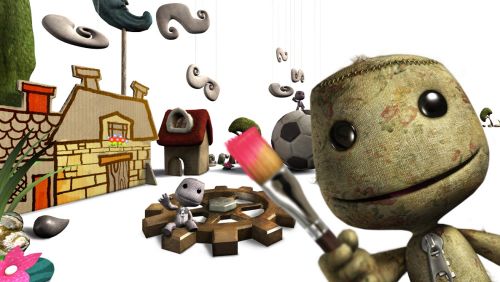
(Day 1 notes are here.) First off was Media Molecule’s key note. This was a great presentation with lots of fun and jokes, as befitting the Molecules (press links here and here). They showed the video demo that MM did (before they were called MM) to Sony to get a deal to develop what would become LBP. It is a remarkable demo and shows the raw gameplay and ethos that would evolve into LittleBigPlanet. I remember seeing this demo at Sony’s offices around the time we were pitching for Savage Moon and thinking a big ‘wow’ – it was and still is a great pitch video.
Then was the session I was part of for the Wellcome Trust. I’d say it was the most eclectic line-up at Develop this year from a neuroscientist (Demis Hassabis) to a new start-up doing 3D printing (Alice Taylor) to mainstream games development (from Jez Harris). I think it went well, at least the panel did a great job of talking about serious stuff like fun, death, sex and drugs. Paul Canty from Preloaded showed off their fascinating new game for Channel 4, that looks at death; The End. Demis also gave us some great insight from a scientific perspective on games development saying that games (and digital media) are rewiring our brains in some ways and that the data that can now be gathered from games and gaming can offer insights into not only how to make better (scarier!) games, but also into how our brain works. Notes on the Wellcome Trust’s funding for making games is here.
After lunch I joined the session on why content isn’t king. Speaker Ian Baverstock noted that in his opinion, large console focused development, while in its context is great, can also be a problem. It means the focus is no these and not what the speaker felt was the 2nd great age of the indie developer. Outside the console spaces there is a lot of interesting activity going on, however there is no great press, retail focus – but there is a lot of craft and a lot of innovation going on. The main change in this new age of the indie developer is that the relationship between the developer and the player is personal. The player is going to expect this and expect the developer to respond to them. The player is going to expect a direct line of discussion between them and the game (and the developer). A new place is content engineering – the ongoing input of player heuristics and how they feedback into changes in the game (something Demis alluded to our session). Games development has an advantage in this area (over other media forms) in that thinking about how the user interacts with technology is something we’ve (devs) been doing for some time now.
Next was ‘Innovation – A State of Mind‘. Core message is that we should be innovate in everything we do in game development. The HUD in the game Split Second is an example of this idea – in asking ‘why’ about everything we do in development. This applies much more to the smaller things within a game as much as the whole. Innovation is not about doing things differently for the sake of it, but because that is what works best – which is why you should ask ‘why’ and encourage experimentation – and failure. (Interestingly this was also noted several times by MM in the key note – that they went down a number of blind alleys before they found routes worth travelling all the way down!)
After a quick tea break, it was into the Brink writing session. I was interested to find out more about why they chose to use a post-global warming setting for the game. The key message here was that as the writer you are not writing the game’s story, as the player writes this, you are writing the story of the game. This was a great way to explain an important point. The speaker went on to note that there will be different narrative solutions for different players – where some skip the FMV and other don’t – neither are wrong. Multi-player games need to have a self-narrative function; indicate narrative and character in everything from design of uniforms to how they hold an item. In Brink there needed to be a reason why people were fighting, why did the protagonists not go their own way? The reasons why people why and don’t leave are down to isolation and scarcity. Its climate change (Interesting that the UN are considering Green Helmets to deal with the predicted coming of climate wars.) The buildings and environment needed to0 tell a story too and so they looked for ways to do this. This was done by referencing real world images such as Arcosanti and the slums of Brazil where the rich sit uncomfortably next to the poor….

Photos of this sort of imagery built the story of the environment. Interesting that they used ripomatics – videos for internal ‘selling’ of an idea build from cribbed film footage from elsewhere. (We’ve used them before too!) In Brink there are two faction, so 2 points of view and the player is encouraged to explore both. Really interesting that real science and stories from the headlines were used to generate the story in Brink – almost nothing was created for it, the ideas were all real world think re-adapted for the game.


 A Great Becoming...