Unreal on iPhone – Wow
Ok, so I’m late to the party, but one of my students just showed me the Unreal tech demo running on iPhone 4 – wow. Yes it has a bit of slow down in parts – but the particle effect, reflected surfaces, foliage.. all look great. If they can nail this from tech demo into a game – well, then mobile gaming takes a huge leap forward…
Cthulhu Thursday: Loving the Mi-go
Anything that has two names is often either cool, interesting or hard to ignore. Why is why this Cthulhu Thursday we’re going to look at the Mi-Go, aka the Fungi from Yuggoth. These are genuinely alien beings, not just humans with pointy ears..
If you’re a fan of H.P.Lovecraft you may recognise and hopefully enjoy seeing this. If you’re unaware of H.P.Lovecraft, then peel the rime off your eyeballs and get into this world of ultimate, sanity-blasting cosmic horror…
Mi-go surgically removing human brain
Image sourced from danial79
The Mi-go are highly intelligent and independent race, renowned for their worship of the Outer Gods: Yog-Sothoth, Nyarlathotep, and Shub-Niggurath. They can transport humans from Earth to Pluto (and beyond) and back again by removing the subject’s brain and placing it into a cylinder, which can be attached to external devices to allow it to see, hear, and speak.
…I find them a brilliant yet complex entity to bring into any Mythos scenario. You don’t want them to come across just like an Alien. Their cynical morals and blunt dissection of human interests, and human tissues, makes them fantastically sinister. Deliver the encounter in the dark hours, in remote places, with an unhealthy layer of dense fog… and you’ve got players shuddering in their sofa seats.

(Cthulhu Thursday is a dose of Mythos to brighten darken your week. More on the idea can be found here and a list of posts thus far, here. Also for more Cthulhu news, sign up to the cthulhuHQ twitter feed. Enjoy!)
The Best Cthuhlu/Lovecraft on Twitter
There are a number of Cthulhu and H.P.Lovecraft related accounts on Twitter, so who is he best ones to follow? I’ve been doing some digging and here are my picks based on both how often they update and the quality of the tweets.

The great author himself, H.P.Lovecraft, has been split into a number of personas on Twitter. Of those the two I like are:
@HP_Lovecraft – sample tweet: “No line betwixt “human” and “non-human” organisms is possible, for all animate Nature is one–with differences only in degree; never in kind”
@HowardLovecraft – sample tweet: “Though potentially entertaining, the collapse of time and space would certainly put a damper on holiday gatherings.”
There are also a number of star-spawn clamouring for Cthulhu’s throne – amonsgt those I like are..
@ElderGodCthulhu – sample tweet: “…just to get you up to speed, i’m an elder god from beyond the stars and i’m male. really, a female elder god? puullease…”
As for ongoing news about Cthulhu and related things, there are:
@cthulhuHQ – lots of updates and news with an eldritch vibe from yours truly…
@Ab_Chaosium – Tweets from the people at Chaosium, home of the amazing Call of Cthulhu RPG…
@insmouthpress – Gives the tweeting news about Cthulhu related fiction and more.
@YSDC (aka Paul of Cthulhu) which posts lots of information about Cthulhu related products amongst other things.
Feel free to email me more suggestions and ideas to update this list!
Discussions beyond the dichotomy of ‘downloading is theft’
Andersson, J (2010). Peer-to-peer-based file-sharing beyond the dichotomy of ‘downloading is theft’ vs. ‘information wants to be free’: How Swedish file-sharers motivate their action Unpublished as yet
Discussion of paper: <em>Peer-to-peer-based file-sharing beyond the dichotomy of ‘downloading is theft’ vs. ‘information wants to be free’: How Swedish file-sharers motivate their action</em> by Jonas Andersson of Goldsmiths, University of London
<a href=”http://liquidculture.wordpress.com”> Jonas Andersson’s</a> study of p2p based file-sharing, uses a methodology of combined interrogation of the technological structures, an examination of the aggregated group dynamics and individual in-depth discussions with the people involved in file-sharing. It is encouraging to see how much depth he has put into the methodological process. This is important to note as this more ‘holistic’ view (as in the whole system) is important in understanding what is a complex mix of human and non-human actors and a recognition that both bring agency to the equation, for example:<blockquote>”The idea of Internet activism can be read in the same way. While “taking on” this role requires active choice, it is not necessarily a conscious effort, and as a computer user regularly occupies several different roles while using a networked computer, it is arguable whether all such ‘actant’ modes are even optional.” (p.296)</blockquote>The depth of the interviews is doubly important as it presents an opportunity to pass though surface layers into a deeper realm of understanding. For example in the extract below the discourse between file-sharers and the media industries portrayal of them is uncovered (note the names in the text below of are of interview respondents):<blockquote>”Vega believed that what the industry would see as the main threat is the pluralism of p2p-based file-sharing, namely that more sources and more artefacts would be accessible. Agge and Pringle similarly emphasised the pernickety, discerning habits of contemporary consumers. Agge and LB noted the file-sharers’ lack of respect towards the industry. Agge maintained that while the slogan ‘downloading is theft’ makes some sense in the current legal system (where works of art are made comparable to physical objects), it ostensibly aims at mystifying and demonizing the activity, further reinforcing the ‘copyfight’ dichotomy. A corporate discourse which so fundamentally clashes with the everyday understanding of the activity risks finding users actively distancing themselves even further from corporate interests, and instead sympathising with allegedly more hard-line ‘pirate’ subcultural formations, which at the time of my interviews only appeared to have a marginal influence among everyday file-sharers.” (p.283)</blockquote>I think this extract shows why the choice of a deeper methodological interrogation is needed, as a more trite approach would not have pierced the surface slogans to undercover the interpolated meaning that lies below. In addition the research is (rightly so) keen to interrogate those to participate in file-sharing into the economic issues that inevitably are raised:<blockquote>”[A file-sharer stating that he had ‘no bad conscience’] was one of the instances prompting me to see the respondents’ dismissal of the entire content industry as, in effect, a facilitator for justification of their own actions. To claim that the conventional system is not fair, or that it is flawed and does not work properly could in effect serve as a way to simultaneously dismiss the moral concerns that go with this system – regardless of how large a part of this system one would personally be. Subjective dismissal of a system need not mean that the system is objectively flawed.” (p.284)</blockquote>This is an important point and an issue that p2p file-sharing does need to engage with, though not necessarily on the terms and within the frame set my major media corporations. (Indeed,<a href=”https://agreatbecoming.wordpress.com/2010/10/19/file-sharing-grows-up-and-grasps-the-economics-of-content/”> this is something the some file-sharing groups have started to take on</a>.)
There is also an issue of equality, not the human rights equality we are used to a discourse of (important though it is, and within the research there is an interesting discussion on the ideas of access to culture as a human right) but around the rights and empowerments of technological literacy:<blockquote>”It has been shown that the p2p systems facilitate great user emancipation, which however comes at an expense: those who are more skilled and computer literate not only benefit from being able to make better use of their Internet connection, they also reflexively see themselves as better placed to understand the technology in question – and by extension, the direction and scope of societal development. This might be primarily attributable to pre-existing differences in knowledge, skill and material accessibility in society which might however, be reinforced by current technology. This is arguably less obvious in Sweden, where levels of Internet and computer literacy are relatively high and evenly distributed in society.” (p.304)</blockquote>This has been an issue I have encountered first hand; One company I was involved with was created as a cooperative yet as it developed, there was an obvious power imbalance. Those with the skill to sell and those with the programming abilities, who skills were already more valued in the existing market place, also found they are in a stronger position with such an organisation, even though it is theoretically one-person-one-vote. I did talking with sombody from a cooperative organisation about ways of adressing these issues, but none sadly were forthcoming.
In summary, Andersson’s work is an important contribution to both the maturing of the debates around p2p file-sharing and copyright and also the broader issues of p2p theory as noted here.
Green Lantern – Motion Gaming Please!
I’ve just been watching the new Green Lantern film trailer:
Looks fun – and if ever there was a film character who’s actions would translate into PS3 Move/Xbox 360 Kinect – this is it! Green Lantern is built for motion gaming.
Game Reveals Strategies for Bargaining
A game created by scientists where players knew the value of an object and had to bid for it from sellers who did not know. This means the players can bid the right price or lower – or in some cases go higher, to make a profit by bluff bidding later on. This latter strategy is known as being a ‘strategic deceiver’:
Researchers created a game in which players were given the true value of an object on a scale of 1 to 10. The players used this information to make a bid to the seller of the object, who did not know the true value…The buyers fell into three groups. One group consisted of players who were honest in their price suggestions, making low bids directly related to the true value. A second group, called “conservatives,” made bids only weakly related to the true price. The last and most interesting group, known as “strategic deceivers,” bid higher when the true price was low, and then when the true price was high, they bid low, and collected large gains…strategic deceivers had unique brain activity in regions connected to complex decision-making, goal maintenance and understanding another person’s belief system. Though the game was abstract, there are real-life advantages to being a strategic deceiver…It’s used to bargain in a marketplace or in a store but also to recruit someone for a job, or to negotiate a higher salary.
Average Social Gamer Is a 43-Year-Old Woman
Yes indeed, important news for those of us who make games. Finally (and I’m happy about this) games are mainstreaming. That does not mean an end to sci-fi shooters, far from it – it means more games for more people. Here’s the news (or you can read the full study here)…
Rightly or wrongly, many people have a picture in their minds of the average online gamer, and it probably involves someone not yet old enough to vote, huddled in their parents’ basement killing dwarves with mystic powers in games like World of Warcraft. A growing category of what are called “social games,” however, appeals to a much different demographic, according to a recent study. The study — sponsored by PopCap, creator of popular social games such as Bejeweled and Insaniquarium — looked at game players in both the United States and the United Kingdom, and found that the average player of these online social games is a 43-year-old woman.
More than 24 percent of those who responded to the survey said they regularly play social games, a category that includes Facebook games such as Farmville, Mafia Wars and Happy Aquarium. According to survey company Info Solutions Group, that level of response suggests a total social gaming population of approximately 100 million. Social gamers were defined as those who said they play games on social networking sites such as Facebook and MySpace at least once a week.
Machines Being Charming
There is an interesting article in New Scientist about how we can make computers more easy to use by humans though the use of very human emotions such as charm..
“THAT’S ridiculous!” exclaimed the software engineer, busy working on improving a spellchecker. I was visiting her workplace as a consultant on the strength of my reputation for making computers easier, more effective and pleasant to use. Because I had come to feel that users needed a kinder spellchecker, something closer to an encouraging teacher than a disparaging critic, I had suggested the system could not only correct mistakes but praise users when they spelled difficult words correctly.
Sadly you need to sign-in to read the full version. I’ve read it in the magazine format. It documents a fascinating experiment where people rate that software giving them positive feedback is accurate even when they are told that it does not work properly. Summary – it seems we are wired for flattery.
But on the subject of using positive feedback (flattery, charm etc) in human-computer interactions; this is something that games excel at. The best place to find this is in a game’s tutorials; for example lots of FPS games give feedback on how well a player has been shooting during the training sections.
But when you think of the whole meta-structure of most games – they are replete with reward mechanisms, machine flattery designed to keep the player, playing!
Cthulhu Thursday: South Park
(Update – check out our new Cthulhu-based project!)
Yes indeed, those cute kids from South Park recently hosted a visit from Cthulhu, whos deep sea slumber was disturbed by deepwater drilling. (Another reason not to do it, let sleeping gods lie!) Here’s the blurb:
The Lovecraftian elements are not the only storyline in this episode, but as a life-long Lovecraftian, seeing Cthulhu on South Park has made my day!
TOTAL SPOILER ALERT! DO NOT READ THIS OR LOOK AT THE SCREEN CAPTURES BELOW BEFORE WATCHING THE SHOW ON HALLOWEEN!
BP Oil, now renamed as DP (Dependable Petroleum) Oil drills into the ocean floor and rips a hole into another dimension; unleashing Elder Ones, Shoggoths, and more Lovecraftian horrors onto beach-goers, fishermen, tourists, and the rest of the unsuspecting public.
Fun by the sea!

Cthulhu in South Park
Plus here’s a cool South Park Cthulhu song:
Hat-tip to AdamDork. Update – check out our new Cthulhu-based project!
(Cthulhu Thursday is a dose of Mythos to brighten darken your week. More on the idea can be found here and a list of posts thus far, here. Also for more Cthulhu news, sign up to the cthulhuHQ twitter feed. Enjoy!)
Gameplay Evaluation: R-Type on iPhone
I’ve been playing the iPhone version for R-Type and while I think overall it is a great implementation of the game that suits the platform, a few issues have arisen. Given that it’s easy to update onto iPhone and you can then evolve the game, I’d really like to see this happen to R-Type. It’s a great game but could be better. My main issue is that there is blind-spot created by the use of the touch-screen as the controller input for movement. So, take this screen for instance:
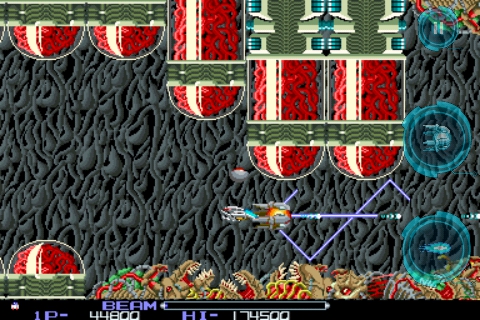
Now remeber that I’m touching the ship I control onscreen, so it get obscured by my thumb. That’s also what creates the blind spot. As I play two-handed, using my right-tumb as movement control and left for power-up shooting. So if an attack or projectile come in the shared area below, I can’t see it:

So how to fix it? They could look to make units that come in from the back avoid the area and not fire from there. This would have the negative impact on messing with the classic layout and structure of the game. So I’d suggest that they allow the user to place their finger for control at any point on the screen (other than an area dedicated for another control) and from that point of placement, is the point of movement origin. Thus the player can move the ship without obscuring it. You can sort of do this now, but it would need more work as there is a problem currently. If you remove your finger (for example to remove a battery warning message) and you can’t remember the point of origin where you placed it, then it can mess your game. So If the player can, each time they move their finger/thumb off the screen replace it anywhere else – make that point becomes the new origin of movement, I think this would improve the game.
The other thing that I would add is more places to re-start from. Currently you can start a name game from the beginning of a level you have previously completed. It would be good to expand that so that you can start a name game, not just by selecting the level, but from one of the existing checkpoints in that level.


 A Great Becoming...