Getting the Numbers Right in Game Design
Kotaku have got a fun article out about massive numbers in RPG games…
When SuikodenMUD started, it was packed with giant numbers. Your health would start in the five-figure range. You’d do ridiculous amounts of damage from the outset. I figured: Why even bother starting lower? Everyone loves big numbers. I thought people would jump at the opportunity to wield swords that strike monsters for 50,000 damage a pop.
They didn’t. Nobody wanted to play.
See, the rush we get from seeing giant numbers on our screen doesn’t happen because we’re seeing giant numbers on our screen. What matters is what those numbers mean. The story they tell. The gradual elevation from zero to hero, from a pathetic mercenary with 80-90 health to an all-powerful, world-devouring, 9999-HP-adorned warrior. When my Cloud cast Knights of the Round Table eight times and dealt some 80,000 damage to Ruby Weapon, it wasn’t cool because of the numbers: it was cool because I brought Cloud to the point where he could reach those kind of numbers.
Us humans are rubbish at framing big numbers, hence things like financial crisis tend to wash-over us with their billions and trillions of dollars. We can understand it, we just don’t conceptualize it very well.
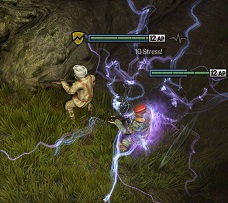
This does show how key the numbers are in a game. Design often gets hung up on the flashy stuff – especially narrative and character, but the under-the-bonnet stats that drive a game at not only important, they are the making or breaking of a game. When selecting a number range, in many ways 3 to 4 digits are best as it gives you scope to make objects with ranges within it and to add modifiers, but also is not so big as to be meaningless. The Action Points (AP) in Call of Cthulhu: The Wasted Land are a good example of a stat improved by a range. I’d initially gone with a lower range, so 1 AP to move 1 normal landscape tile, which seemed natural. But then later with the weapons, I was struggling making them feel different with the lower numbers till Stu (our artist) gave me a nudge and we upped it – so a normal square movement became 6 APs and the whole thing fitted much better!
Part of the lower number thinking in making Call of Cthulhu: The Wasted Land, with the ranges tending to be smaller – were a reflection of the paper RPG we were using as the basis, which being dice-based has number ranges that reflect that. So the core stats of a character are between 3-18, coming from the 3d6 you’d roll to generate that number. Interestingly the old DC Hero’s paper RPG got around this issue by using exponential numbers. So in a normal system, Batman might be an exceptionally strong human, say 17 or 18 STR (Strength). So what is Superman with his ability to bend steel? 17,000 or 180,000? So to get round this in their system the exponential version means a character with 18 STR is twice as strong as one with 18 STR. Less scope for granularity but it does allow for the accommodation of huge variation within the same system.

Stats in the character sheet in Call of Cthulhu
How Free Took Over the AppStore
How free took over the app store, via GamesBrief:
In June 2010, 71% of the worldwide 100 top grossing apps on the App Store were paid only. Just two years later, that figure is 16%.
If we include apps that are paid but also enable in-app purchases (IAP), the figure falls from 93% to 32%.
When you go digital, and a de facto cartel doesn’t block a zero price (as is happening in the book industry), the price trends to free.
I am fascinated by some of the famous magicians from history. I’d written before about Dr.John Dee, I also wanted to talk a little about Aleister Crowley and his role in World War One (a topic of interest currently because of my work on The Wasted Land) If you are new to Crowley, he was a self-styled magician and called himself ‘the beast’ and was famous for being tagged as ‘the wickedest man’ alive and also coined the phrase ‘Do what thou wilt shall be whole of the law‘.
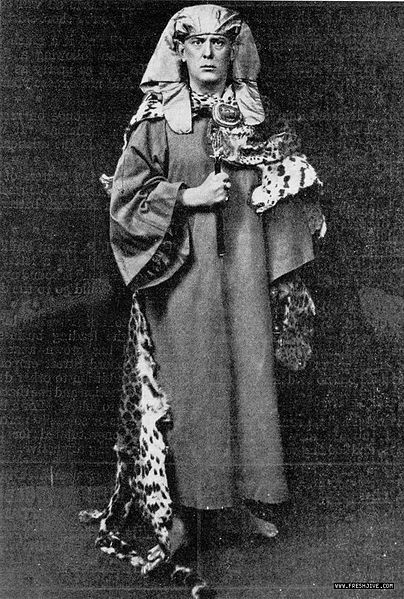
Aleister Crowley (Image via Wikipedia)
Crowley spent the period of the war in America and thought that his magic scrying work had predicted the war. At first he had offered his services to British intelligence as a secret agent and when they refused his help, he turned to the German side instead. He did propaganda work for the Germans from the US, but claimed it was a double-bluff, doing work so patently bad for the German cause, it actually hindered them. A sort of early version of Poe’s Law. Here is how Crowley decribed his first major propaganda stunt where read a speech in support of Irish independence from the British empire and to destoy his passport:
balderdash I wrote for The Fatherland must be the stark treason that the Germans were stupid enough to think it was.
A person in my position is liable to see Sherlock Homes in the most beefwitted policeman. I did not feel that I was advancing in the confidence of the Germans. I got no secrets worth reporting to London, and I was not at all sure whether the cut of my clothes had not outweighed the eloquence of my conversation. I thought I would do something more public. I wrote a long parody on the Declaration of Independence and applied it to Ireland.
I invited a young lady violinist who has some Irish blood in her, behind the more evident stigmata of the ornithorhyncus and the wombat. Adding to our number about four other debauched persons on the verge of delirium tremens, we went out in a motor boat before dawn on the third of July to the rejected statue of Commerce for the Suez Canal, which Americans fondly suppose to be Liberty Enlightening The World.
There I read my Declaration of Independence. I threw an old envelope into the bay, pretending that it was my British passport. We hoisted the Irish flag. The violinist played the “Wearing of the Green”. The crews of the interned German ships cheered us all the way up the Hudson, probably because they estimated the degree of our intoxication with scientific precision. Finally, we went to Jack’s for breakfast, and home to sleep it off. The New York Times gave us three columns and Viereck was distinctly friendly.
Over in England there was consternation. I cannot think what had happened to their sense of humour. To pretend to take it seriously was natural enough in New York, where everybody is afraid of the Irish, not knowing what they may do next. But London was having bombs dropped on it. …
Interesting there is a myth that Lovecraft and Crowley met. It does not appear to be true (at all) but is a fascinating idea. There is a good documentary on his life online:
Breaking the Fourth Wall in Video Games

Deadpool breaks the Fourth Wall
There is this concept in theatre, the Fourth Wall. The idea is a theatre set has 3 walls, with one missing so we can watch the play. To characters in the play there are 4 walls as the audience don’t exist. To the audience the 4th wall is invisible, so they can see events in the play. When a character (not actor) addresses the audience, they break this ‘4th wall’ going all meta… So ‘breaking the Fourth Wall’ has come to mean the acknowledgement of the audience within a media form. In films that can mean the character addressing the viewer. In comics it can mean acknowledging that the character is in a static world of text and images (Deadpool is especially well know for this).
Video games also play with this concept. I’ve picked four examples of this I think are really clever.
Metal Gear Solid (PS1)
This is one of my favourite games of all time. There is so much good stuff going on here. It is a brilliant example of game design; it created it’s own genre (stealth ’em up) and had an amazing array of interactions to drive home the gameplay. (That is perhaps a topic for another post…) What the game also does is break the Forth Wall. For example when you are fighting the boss Psycho Mantis, he seems to be able to counter your every move. He’s a psychic boss, so measures to counter that are needed. What emerges is that you can swap the controller from Port 1 to Port 2 – as he’s only reading the input from Port 1. This means the characters in the game acknowledge the existence of the player and that they are trapped within a game. So cool!
–
Cthulhu Saves the World (Xbox XBLA, Steam, iOS)
The best thing about this game, IMHO, is the narrative – it is great fun. Early on we see this at play as the main character (Cthulhu) breaks the Fourth Wall by reading the narrators titles to figure out what he has to do next. In the video below you can see this at 2.20.
–
Fez (Xbox XBLA)
This is a great game. Really amazing and well worth playing. I came across this via the film Indie Game: The Movie. The game is about at 2D character that realises he is within a 3D world. What is so brilliant is how the games explains this too you; once the revelation of the 3rd dimension hits you, the game appears to crash and re-boot and so places you back in the same place you were before – except now you can control that 3rd dimension, and in the process, breaks the Fourth Wall. Amazing.
–
Comix Zone (now on PS3!)
I just downloaded this SEGA classic the other day. It’s about a comic creator who get trapped within the pages of his own comic. The whole premise of the game is about the Fourth Wall. We see the evil cartoonist drawing in new enemies for you to fight, we see comic panels broken… Really great stuff!
Gary Gygax: The Father of Games Design
I’ve got an article out in GamesIndustry.biz on Gary Gygax, who died on this day in 2008.
“So how do I become a games designer?” is a question I often get asked as I engage with students and gamers in my work. The reply I often give is simple, “Shutdown your PC, switch off your tablet, turn your phone to silent then get hold of a copy of Dungeons & Dragons”. Of course I don’t mean the various video game versions (great as many of them are) and I don’t mean the recent Facebook game (which is also fun). I mean the original rule book plus some pens, paper and loads of dice (don’t forget those d20s!). Then, Level 1 Magic User, you will be ready to begin your journey…
Playing Dungeons & Dragons is one of the best ways to learn the foundations of game design. It is how I (and lots of others in the industry) learned about making games. By running Dungeons & Dragons games we had to master a number of key skills including narrative, drama, gameplay balancing and crucially, the all important stats systems. These diverse areas make Dungeons & Dragons a bit of a paradox; at once a geeky stats-fest and yet also the ultimate social game that only works with a group of friends. What makes it a great way to learn about game design also points to why all games developers owe its co-creator and gaming legend, Gary Gygax, a full horn of ale and a lot of thanks.
PS. They highlighed this quote in the article:
“I often feel that all we are doing with digital technology is trying to emulate the purity of gameplay that D&D achieved”
And I was thinking, “I wrote that? Cool!” Sometimes you forget what you did write (I wrote the original for this a few weeks ago) and then are pleased when it hangs together. They gave it a better title that my original had too.

Gary Gygax, as he appeared in Futurama
A big thanks from me Gary, D&D was one of the best things that happened to me!
Can Video Games Be Art? Quick Answer – Yes
UKIE recently hosted a screening of Indie Game The Movie, a documentary about 2 small teams of developers making passion projects. It’s a fun film and I really enjoyed it – I was expecting not to, given I also make games for a living. But I did and the key reason was that the film shows the artistry that can go into making a game. I’ll talk a little more about that in a moment but first, here is the trailer for the film:
–
What is clear in the film is that for the people making the featured games (Supermeat Boy, Fez and Braid) these not far from throwaway bits of fun, these are reflections of inner emotional states. Supermeat Boy explores vulnerability and the main character – lacking skin – is a reflection of that. Fez is about a 2D character in a 3D world and is about trying to make sense of, and rebuild a chaotic world into something that makes sense. The creators make it clear that in each case they are putting something of themselves into the game. Whether or not the player sees this is a different question, but then that has always been a key aspect of art; the interpretation of the audience.
Now I am not saying that every game is art, but it is glaring obvious that games – via interaction, graphics, narrative, gameplay – can and do make art. Consciously and intelligently – even outrageously – but art, yes. it is not just Indie games or deliberate game/art projects that can go in this direction. Even mainstream games can make art – exploring issues that society may not wish to face:
An example. One of the hottest philosophical topics on the internet is Ayn Rand. Her ‘objectivist’ philosophy, positivistic and materialistic and focused on the need to get society out of the way of the genius so that he can get on with his geniusness, is popular with a broad spectrum of alienated semi-young men tapping away at computer screens and dreaming of world domination. Complicating the picture is the fact that she was also the main intellectual influence on her close friend and protégé Alan Greenspan, author of the recent monetary boom we were all enjoying so much until it destroyed the world economy. The only thing which isn’t ridiculous about Rand and her ‘objectivism’ is the number of people who take her seriously. It would be a good time for someone to publish a work of fiction or make a movie going into Rand’s ideas and duffing them up a bit – for instance, imagining what it would look like if a society with no laws were turned over to the free will of self-denominated geniuses.
Well, someone has done that, except it isn’t a book or movie, it’s a video game.BioShock, which came out in 2007, was conceived by Ken Levine and developed by 2K Boston/2K Australia, and is set in an alternative-reality version of 1960. The main character – from whose perspective you play the game – is involved in a plane crash in mid-Atlantic, and ends up in an underwater city called Rapture which, he learns, was founded by one Andrew Ryan (spot the near anagram) as a genius-led paradise of unrestricted scientific experiment. The scientists invented a technology of genetic improvement, ‘splicing’, and under pressure to keep this secret, Ryan made a fatal mistake: he passed Rapture’s only law, forbidding contact with the surface. This law instantly made smuggling a profitable business, and a criminal empire developed. Rapture descended into civil war, and then into the world of the game: a dystopian horror in which genetically altered ‘splicers’ run amok. BioShock is visually striking, verging on intermittently beautiful, also violent, dark, sleep-troubling, and perhaps, to some of its intended audience, thought-provoking. The game was a huge hit, and I have yet to encounter anyone who has ever heard of it.
Debate over. Next topic please?
My Guest Post on PocketTactics on Authenticity in Games
I’ve got a guest post over on PocketTactics looking at what we’ve been working on to improve the authenticity in Call of Cthulhu: The Wasted Land:
Authenticity matters in media. It matters in games. Titles like Call of Duty and Medal of Honor employ military advisors to improve the authenticity. An authentic game, even one set within a fantasy world, can still build authenticity with the player.
Our turn-based strategy RPG Call of Cthulhu: The Wasted Land is inspired by both the works of pulp horror writerH.P. Lovecraft and a paper role-playing game, Call of Cthulhu. In ‘The Wasted Land’ the player leads their team of investigators to uncover a deadly inhuman conspiracy underlying the trenches of The Great War.
Authenticity was always key to us in the making of Call of Cthulhu: The Wasted Land. The game might be based on Lovecraft’s works of horror and science-fiction, but that did not stop us from trying to get the World War I setting as authentic as possible within the boundaries of good gameplay.
The medical side of the game plays a prominent role, but we found little source material for in our online research. Imagine how excited we were when The Wellcome Trust awarded us a small grant to research and improve the accuracy of the historical medical information in the game.
…
As part of our research, we went to visit the Army Medical Services Museum in Aldershot, outside London. The director, Captain Pete Starling, was incredibly helpful and gave us a tour of the fascinating museum. …Full Article.
So some of what we were doing is updating the visuals in the game. So here was how a small first aid kit looked originally:
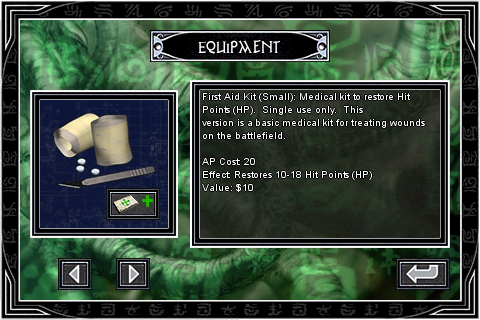
Old Small First Aid Kit (SD)
And here is what the real equivalent looked like – which as a basic field dressing – carried by all British soldiers:
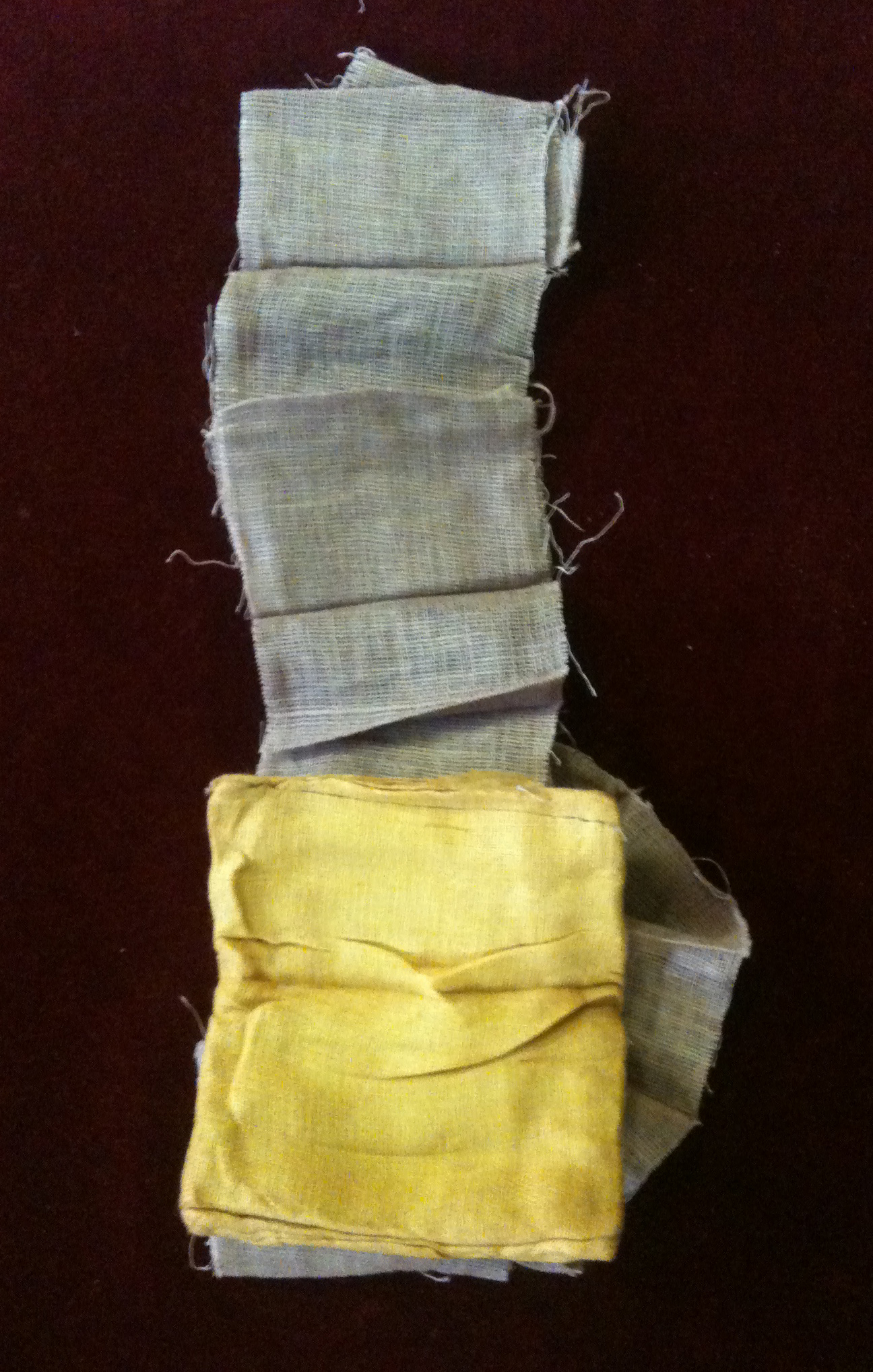
Basic Field Dressing
And here is what the re-modelled version looks like:
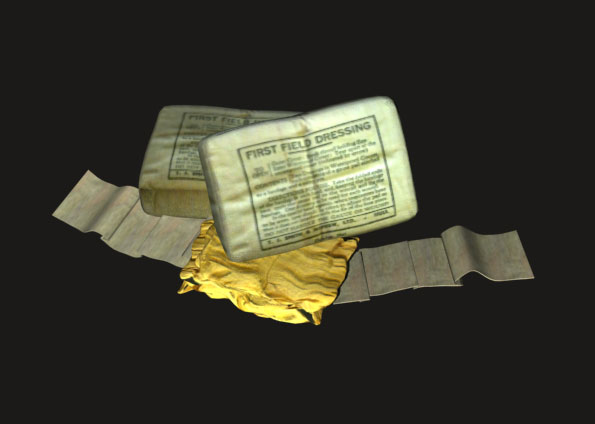
Re-modelled Basic Field Dressing
And how it looks in-game:

Revised Small First Aid Kit in-game (SD)
Gamify Your PhD on Wellcome Trust Blog
I’ve been going into a bit more detail of the creation of the Gamify Your PhD project on the Wellcome Trust blog.
We wanted to explore the ‘rules’ of game design and yet not turn it into a huge rambling lecture. We also wanted to give examples of how science could be ‘gamified’ without these examples being too prescriptive so that people may think that is the only way to do it. What we settled on was the creation of a periodic table of gaming elements – a format for organising key components familiar to scientists! We broadly broke the elements down into two main types; ‘mechanics’ and ‘motivators’. ‘Mechanics’ were elements that described how users would interact with a game, such as reaction time (as used in the Wellcome Collection game Axon) and ‘Motivations’ were why the user might choose to interact, such as achievements (as used in the Wellcome Trust game Filth Fair). We also left lots of blocks in the table deliberately ‘undiscovered’ so as to suggest that there were more ways to create games that had yet to be discovered…
A few times in talking about the Gamify Your PhD project I’ve been asked about the term ‘Gamify’ so I thought I’d muse a little about the terms as I see them. The key to me is ‘Gamify’ is not the same thing as ‘Gamification’. Here we go…
- ‘Gamify‘ is to turn something into a game. So to take a topic (in this example PhD research) and turn the whole area or a sub-aspect of it into a game. So you are using the topic as inspiration for a game either as a mechanic or narrative element or a bit of both. As another example, the game ‘Game Dev Story’ gamifys the making of video games.
- ‘Gamification‘ by contrast is to take elements of gaming and use them in a non-gaming context. So the common example is using achievements or points to motivate people to behave in set ways. It can also be to use other aspects of games such as controllers or 3D engines to assist on non-game environments. (More here)

Gamify Your PhD screenshot
Cthulhu Thursday: Call of Cthulhu: The Wasted Land News
Couple of bits of news from the far flung plains of Leng I wish to share with you…
First is that Call of Cthulhu: The Wasted Land is in an Indie Bundle – the IndieGala – out now!
As usual Buyers can “Pay What you want” starting from a minimum of $1 and choose, if they want, to support charities and good causes with part of their proceeds. This time INDIEGALA has decided to support victims of the earthquake which damaged Emilia Romagna region of Italy. For this reason part of charity share can be donated to sustain Croce Rossa Italiana (CRI) in its fundraising for Emilia Romagna. The other part will be given away for another important mission: supporting AbleGamers a foundation dedicated to bring greater accessibility in the digital entertainment space so that people with disabilities can gain a greater quality of life, and develop a rich social life that gaming can bring.
Second is we’ve got DLC for the game coming out soon, as previewed by PocketTactics:
Lovecraftian squad tactical game Call of Cthulhu: The Wasted Land was a bit of a creeper for me, you might recall. Despite an occasionally clunky interface and some over-the-top dialogue, I grew to quite like Wasted Land when I gave it a second chance a couple of months back.
Now that Red Wasp Design have finished porting their game to every conceivable platform, the UK-based devs have turned to adding new content. The still-unnamed DLC is a prequel to the original storyline, putting the player in charge of the antagonist Kaul and his tentacled minions. It’s based on a module that Red Wasp designer Tomas Rawlings created for Chaosium’s Call of Cthulhu pen-and-paper RPG.
In addition to adding the new campaign, Red Wasp worked with medical historians from the Wellcome Trustto ensure that game realistically models the state of medical science around the time of the Great War. I’m having a hard time thinking of anything nerdier than that. I wholeheartedly approve.

The Plains of Leng
Ai! Ai!
(Cthulhu Thursday is a dose of Mythos to brighten darken your week. More on the idea can be found here and a list of posts thus far, here. Also for more Cthulhu news, sign up to the cthulhuHQ twitter feed. Enjoy!)


 A Great Becoming...
