Games Are Serious Fun – Believe!
Getting away from the kneee-jerk reaction that games are at best frivious and at worse damaging is important. They are neither of those things. They can be rubbish, but so can any media form. Also like any media form they can be amazing, informative, educational, beautiful and creative. Its not just me saying this – see this recommended read from Martha Henson and Danny Birchall at Wellcome:
Globally, gaming is big business, with a market worth an estimated $50 billion (£30 billion) in 2011 and a demographically diverse audience with an even gender split. But it’s not just about numbers: the dedication of gamers to the pleasure of play means time spent at the console can exceed that spent with a feature film or novel.
Screenshot from High Tea

Cthulhu Thursday: The Playthings of Cthulhu
As well as being a trans-dimensional being intend of destroying all of creation, Cthulhu makes great toys. This is a great mashup of 2 toys to make 1 Cthulhuoid:
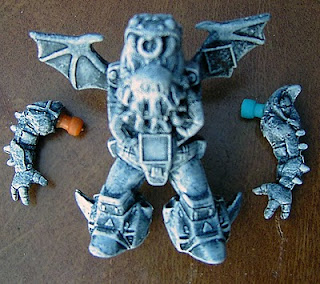
Battle Beast - M.U.S.C.L.E. Mashup Cthulhu!
The person who makes this also makes cute lil’cthulhuooze. I also game across this foot-solider-of-Cthulhu on my webby travels:

Minion of Cthulhu
But wait – we’re not done yet… here is Cthulhu in LEGO! It’s amazing!!!

Lego-thulhu!
Joy.
(Cthulhu Thursday is a dose of Mythos to brighten darken your week. More on the idea can be found here and a list of posts thus far, here. Also for more Cthulhu news, sign up to the cthulhuHQ twitter feed. Enjoy!)
Web Version of Filth Fair is now Live!
We’re all go with the web version of Filth Fair now! The front page for the Filth Fair game is here.
There is also a link to the short film we made about the game.

Filth Fair Web Version

Download Filth Fair for iPhone, iPod Touch or iPad
Summary of SXSW (and the End of Technology)
This summary of SXSW is well worth reading. It covers biomimicry, gamification and much more:
If my grandchildren ever ask me where I was when I realised the internet was over – they won’t, of course, because they’ll be too busy playing with the teleportation console – I’ll be able to be quite specific: I was in a Mexican restaurant opposite a cemetery in Austin, Texas, halfway through eating a taco. It was the end of day two of South by Southwest Interactive, the world’s highest-profile gathering of geeks and the venture capitalists who love them, and I’d been pursuing a policy of asking those I met, perhaps a little too aggressively, what it was exactly that they did. What is “user experience”, really? What the hell is “the gamification of healthcare”? Or “geofencing”? Or “design thinking”? Or “open source government”? What is “content strategy”? No, I mean, like, specifically?
The content strategist across the table took a sip of his orange-coloured cocktail. He looked slightly exasperated. “Well, from one perspective, I guess,” he said, “it’s kind of everything.”
What is a Game? (A Short Video Talk)
I’m experimenting with the idea of adding more video content to the blog. So here is a short video with me banging on about what a game is and is not…
Thanks for stopping by…
These are the notes from a talk I did at UWE on Monday 21st. I was asked to to give an overview of the games industry, to talk about how the games industry works, about commercial logics and creative dynamics, consider the pipelines of development, division of tasks, story and game design interactions etc. To look a little at how a developer company works, the relationships with publishers (if you have any), pipelines, asset development, stages of testing and coming together of elements and so on.
So here goes. Firstly I put ‘ecology‘ in the title of the talk. This is very deliberate. Understanding the games industry is not a separate entity but instead a series of entities interlinked with each other and with other media and technology industries. The best way to understand it is to think of it as an ecology. There is much more on this idea, that of Media Ecology here.
Second – it is worth asking, what is a game? With so many forms, platforms and areas, this itself becomes an interesting question..
The best place to start is with this graph:

Composition of the Games Industry by Value
It shows how the composition of the games ecology has changed since 2004. However the trends it shows go back even further. What you can see is that a few years ago the newer forms of online and mobile games emerged and grew and grew. They are now about 50% of all the industry and projected to keep growing. This is a key point. We are now in a post-App world and while that does not remove the market for consoles and PC games, their growth (in value) has not progressed in the same way. In addition, these new platforms (mobile & web) mean that publishing is not quite the same as it was either….
The Traditional Publishing Route
This still exists and will continue to. It’s how we did a game like Savage Moon. In this model you pitch an idea to a publisher, either your own original IP or something they’ve asked you to look at. That pitch as a minimum really needs to consist of screenshots mocking up how the game will look, a short (seconds) video showing how the gameplay will look and an outline design of a page or so to explain the game, platform/s and who it might appeal to. If they like the idea, they will offer you the money to develop it. However, except in rare cases they will own the IP post-development and control the distribution and marketing of the game.

Savage Moon Waldgeist Screenshot
The Newer Publishing Models
Again, its plural for a reason! As networked forms of media (the web etc) transpired, the control over distribution that publishers had enjoyed came to an end. Physical distribution is expensive. You had to put the game onto a physical format and ship it to a chain of stores to sell it. Now that distribution can be digital via mobile, online, p2p and so on, the cost is now very, very low in comparison. In addition to this, new platforms like the iOS and Android offer a space to self-publish games where the barriers to entry are low too. As a result we see a whole host of models emerging from purely self published (Fate of the World) to hybrid models of part-finance (Star Wars: Battle for Hoth was an example of this) and many variations in between. The advent of new platforms also means that games can be developed as adverts, promotions or as engagement by non-games industry institutions (Filth Fair is an example of the latter).
The Development Process
To make a game you start with an idea. This should be an idea of what the gameplay is and should not focus on the narrative as yet. This is key – games are about gameplay and not narrative. They can work together but often don’t though there are rare exceptions. There is more on this here. Then to make the game you need as a minimum; design, art and coding. These can be separate people or one person with all of these skills but in general the more ambitious the title, the more people (and/or time) you will need to create the game. There are other roles in game development such as sound and production, but to start development, the crucial roles stated are necessary. The designer then writes the Game Design Document (GDD) that collates the vision of the game, explains every aspect of the game from front-end menus to the stats system. The coder starts working on the game engine (or using a 3rd party engine) and the artist starts making a few key art assets for the coder so s/he has something to work with. And it builds from there…. The relationship with the publisher is key. You all need to have the same vision for the game, or it can be very difficult.
Production Stages
Once production starts, if you are funded by a publisher, you’ll have milestones to stick to (so you get paid£$£!) Each milestone will have set art, design, audio and code tasks that need to be completed. You should be working towards an Alpha – a version of the game where everything is in but not working yet. Then its on to Beta where all of the major bugs (crashes and things that stop you playing the game) are fixed. Then you aim for the Master Candidate. That’s the version you think is done and ready for release. While in the networked age, you can (and should) iterate a game over and over – these should be about adding more functions and features and not fixing bugs.
Quality, Speed, Cost – Pick Two!
This is an old business adage but still holds true. What sort of a games developer are you going to be? You can’t do all three. Amazing games such as Modern Warfare 2 cost hundreds of millions to develop and distribute. They have staff teams in the hundreds and take a couple of years each to make. But then the rewards are reaped; over a billion in sales in the first week. Casual games can be the work of one person and still make lots of cash (see Minecraft). Some can be a labour of love, the amazing Braid was a singular vision that took a couple of people a long time to make (but it was worth it!) The studio behind Angry Birds made 43 games before they had the big hit. In that time they learned a lot about making games but to some extent there are numbers and luck involved.
Testing, Testing….
Testing is an often overlooked area of games development and is a weakness of the newer forms of publishing. I’ve downloaded iPhone games with shocking crash bugs that you’d simply not find in a PS3 title. (But then before control slipped, publishers could be shockingly blasé about releasing buggy games, hoping to clean the mess up with patches later…)
There are two sorts of testing; QA (Quality Assurance) which focuses on the game working, not crashing, not having bugs and being of a consistent quality of speed, art and sound throughout. Testing for this is a skill and needs to be thorough. A producer should be playing the game at this point so they are aware of any bugs or issues. You need to try and break the game. For example, in text entry areas, what happens if you hit any key and don’t let go? In a tutorial when the AI trainer asks you to shoot a target, what happens if you shoot him instead? Believe me, on release the player will try all of these and more.
Second is gameplay balancing. This involves playing the game from a design point-of-view over and over. Each time you play the game, you are refining the stats in areas to eventually craft it into what your vision is. This is about making a solid difficulty curve so it starts easy and gets progressively harder. This is tough because as you play the game lots, you naturally get better at it so your judgement as to the difficulty is impacted. Others should also be playing to assess these levels too.
And good luck!
The games industry is changing and fast, which makes it an exciting place to be. I do hope to be playing one of the titles you have all developed someday soon and thinking ‘wow, I wish I’d thought of that!‘
Filth Fair, Adam and Eve…and Naughty Bits
This is a fun write up of the issues we had passing Filth Fair though the iTunes approval process:
The point of the Wellcome Trust publishing the game is that it’s part of its Dirt Season, which also features a BBC TV series, an exhibition in London, and various other events at ‘dirty locations in the UK’.
But it wasn’t all the talk of poo and other excremental substances that got the game into trouble.
Instead, it appears a couple of bare breasts were the cause of the problem – as you can see in these before and after images, taken from a pre-release version of the game we had access to, and the version now available on the App Store.
Still, the good news is you can now get Filth Fair – which is a free app – for your iPhone, iPod touch and iPad, although for some reason it’s age-rated 17 so you’ll get a warning popup to click through when you download it.


You can download the game, free, from the iTunes store…

Download Filth Fair for iPhone, iPod Touch or iPad
Cat and the Coup Documentary Game
I came across this trailer for a ‘Documentary Game’:

The Cat and the Coup – Trailer from Peter Brinson on Vimeo.
I’ve not heard of this genre of game? I found it here with this write-up:
The video above is a trailer for the “documentary game” in which “you play the cat of Dr. Mohammed Mossadegh, the first democratically elected Prime Minister of Iran.” In 1953, the CIA engineered a coup to bring him down, and that’s how it relates back to politics (because we are all about relevance here).
I’m all on board because it’s learning + history + politics + gaming + cats. Also the trailer has Nine Inch Nails. A+!
Filth Fair is Out for iPod Touch, iPhone and iPad
Filth Fair is a great little word-puzzle game that I’ve been producing for the Wellcome Trust to tie in with their Dirt season. It’s been developed by Toytek. The game is for iPad, iPhone, iPod Touch and the Web (as a Flash game) coming soon…

Filth Fair Screenshot (Click to go to iTunes)
You can download the game, free, from the iTunes store…
Download Filth Fair for iPhone, iPod Touch or iPad
What is Media Ecology? (A Short Answer)
Following on from my earlier discussion on Media Ecology as part of a talk a Goldsmiths, I want to return to the subject. At the start of February 2011 the Noika boss Stephen Elop posted a 1,300 word memo to the rest of the staff stating frankly why Noika was in trouble in the smart phone war. They had lost their mojo to Apple and Google and were struggling to get it back. For me, one of the notable things about this memo is the use of the term ‘ecosystem’ when referring to the natural world, but of the world of technology. Here’s an example:
The battle of devices has now become a war of ecosystems, where ecosystems include not only the hardware and software of the device, but developers, applications, ecommerce, advertising, search, social applications, location-based services, unified communications and many other things. Our competitors aren’t taking our market share with devices; they are taking our market share with an entire ecosystem. This means we’re going to have to decide how we either build, catalyse or join an ecosystem.
He uses the term a lot in the memo. Now why would a memo talking about manufactured plastic objects, which if anything are helping to degrade the natural ecosystem, use a term from ecology? Why? Because we’re in the age of Media Ecology.
So what is Media Ecology and why are we in its age? Put simply, its a way of understanding the media that surrounds us where the focus is as much on the connections between things as on the things themselves. Here is Fuller (2005) and his illuminating discussion of why he uses the term ‘ecology’ in his book ‘Media Ecologies‘;
The term ‘ecology’ is used here because it is one of the most expressive language currently has to indicate the massive and dynamic interrelation of processes and objects, beings and things, patterns and matter….The term ‘media ecology’ is used and in circulation in a number of ways. The term is chosen here because this multiple use turns it into a crossroads: Putting these two words next to each other produces a conjunction of two variables that are always busy with meaning. Their dynamism, however, always arises out of concrete conditions. The virtuality of such conditions, their possible reinvention or alternative state, their pregnancy with change and interrelation, is as deeply implied in this concreteness as much as it can be said to be subject to definition. (Fuller 2005:2-3)
Think of a newspaper – a physical object. It is produced by an interlinked set of operations from the manufacture of paper, to printing to the writing of what will be printed, to distribution to each individual buyer. While Media Studies may have focused what was being written in the paper and who was reading it, there is still a complex web of interactions going on. Why is Media Ecology of such interest now? When you look at a networked form of media such as a website, the complex web of interactions gets even more complex. We don’t have the paper but we do have the computer hardware and software both running the site and being used to make the site and by users to read the site. Users are not passive end-entities in this; they can be active in commenting, blogging, re-blogging, tweeting and the like. The complex web get even more, well, complex.
Biology developed a set of tools for looking at complex interactions. Tools for how they interact; ecology. Tools for how they change (and are changed) by each other and the environment; evolution. (Which is why my research looks at technology and evolution). As a Media Ecologist I seek to use those tools and ideas to understand why the situation that Nokia finds itself in is about ecosystems. Here’s two parallel examples of this in play – an Oak tree and Twitter. An Oak tree is a large organism, it has aggregated during it’s growth quite a lot of biomass. As it’s life cycle proceeds from day to day, it creates its own ecosystem around it. Dead leaves that fall, shelter for small mammals and so forth:

Ecosystem of an Oak Tree
But the relationship between the tree and those that live within its ecosystem is not always benign – its complex. So yes the organisms that consume the dead leaves contribute nutrients to the soil the tree lives within. The squirrels disburse its acorns allowing it to spread its seed. However the shade the tree creates (and other processes in its biology) stop competitors from growing within its sphere – including competitors from its own acorns.
Now Twitter. Recently Twitter made news by shutting down some 3rd-party systems. Many commentators cired foul.
UberMedia, after getting its popular UberTwitter and other mobile social media apps shut down Friday by Twitter for alleged terms of service breaches, is reportedly changing its name to UberSocial as part of its effort to meet Twitter’s terms. Twitter says it suspends “hundreds of applications” that violate its privacy and other API policies, but it was the microblogging site’s suspension of the popular UberMedia UberTwitter, UberCurrent and twidroyd apps that sparked a big social media to-do.
But when you look at it though a Media Ecology prisim, you can see it is netiehr right nor wrong. It just is. Like an Oak tree it has accumulated a lot of mass. In this case digital. Its mass and the platform it provides gives a home to many small entities to live within its branches. Many of these relationships are co-operative, but on a scale of bio-data-mass. Twitter benefits from those making Twitter a more attractive place to exist and many also add content to Twitter (adding to its data-mass). But it also ensures that those it offers shelter too, don’t impinge on its core processes. Here’s how the Twitter Ecosystem looks:

The Twitter Ecosystem


 A Great Becoming...