Self-Healing Networks
This sounds cool (my emphasis):
Mesh-Networking is where we efficiently distribute fewer internet connections, and in the scaled-up sharing, actually achieve higher speeds. Also, if one router/node goes down, the rest of the network will re-route to maintain a strong mesh. It is self healing. By all the nodes talking to each-other, we get a ‘cloud’ of coverage; so you can talk over VoIP in the street, check the news for free at transit stations, etc. We can build off of cable, DSL, fiber, etc. We’re finding for example that in some highly populated areas, that a cable or ADSL connection slows down a lot in the evening or right before work. Because our network combines all kinds of internet connections, we aren’t as subject to those slow downs.
The Iterative Method of Development
I got emailed this link following my talk in Brighton – and it’s an interesting one Hat-tip to Uwe for that). It outlines a number of methods for development. One of those is the Iterative Model:
Smaller teams have learned to maximize their learning opportunities by building lots of opportunity for rapid feedback into their process. The agile software development movement is the poster child here, but many of the same lessons are found throughout lean manufacturing, kaizen and other successful practices used by product development companies across a broad spectrum of industries.
The common metaphor is that of driving a car as opposed to launching a rocket. At every possible opportunity, you are looking ahead and adjusting the team’s trajectory in order to steer towards. Each change may seem subtle, but due to all the rapid cumulative adjustments, the team hone in on their targets quite efficiently.
It ends up being okay that the team makes little mistakes. If they veer off a little bit to the left, that’s fine. They rapidly learn it was a bad idea and correct their efforts. The short feedback cycles ensures the big mistakes happen far less often.
Instead of taking 12 to 18 months to create and evaluate a new concept, they build and put new version in front of users every 2 to 4 weeks. They also work in high bandwidth environments where all the team members are close together and close to the customer. Team members converge on and build concensus around good ideas over a period of hours, not months. Teams become experts through intense hands-on problem solving and testing. This ends up building products much more likely to serve real needs than those imagined in Platonic specs by ivory tower experts.
Agile development is favored by small start up teams because the techniques greatly reduce the risk of an individual team failing. If you only have room for one shot at the target, you might as well steer your way to success using lots of rich information instead of launching blindly into the unknown. Long term, agile processes delivering more value sooner, with lower overall risk.
An agile project is intensely focused. In the rush of completing only high priority features, many alternative concepts never get the chance to be explored. Customers, a rather vague and argumentative bunch at best, are required to speak with one voice in the name of reducing noise and thrash for the team. For many teams struggling just to get software out the door, these traits are a godsend. The downside is that there is little concept of strategic portfolio management.
Agile projects can be a bit like a hill climbing algorithm. They will steer towards the closest customer success story, but may ignore a bigger opportunity further away.


The Ecotechnic Future
Here’s a book I’m going to add to my reading list – the author does dress as a druid, but that’s no something I’m going to hold against him 🙂 it’s the quality of ideas that count – and these are big ideas:
Greer’s newest book, The Ecotechnic Future, builds on The Long Descent by sketching out some of the likely dimensions of the future that Greer believes lies on the other side of our descent. It doesn’t devote much space to explaining why our civilization is headed for collapse, or describing how people can prepare on the individual and community levels, since these were covered in his earlier book. Instead, in a series of chapters with straightforward titles like “Food,” “Home,” “Community” and “Culture,” it takes an in-depth look at the kinds of changes that we can expect in these and other aspects of our lives as industrial civilization winds down.
What, exactly, is the “ecotechnic future” to which the title refers? Well, to begin with, it’s a play on the phrase “technic society,” a term coined to describe the modern world that came into being following the Industrial Revolution. Greer’s conception of the technic society is that it’s the first human society powered primarily by nonfood energy, rather than by the food energy that has sustained, for example, the far-more-stable hunter-gatherer societies that have existed throughout history. The phase of the technic society coming to an end with the advent of peak oil is one that Greer refers to as “abundance industrialism,” in which humanity has used the immense energy contained in cheap, abundant fossil fuels to maximize the production of goods and services at the expense of gross inefficiency. In contrast, the ecotechnic society that Greer sees as the inevitable successor to abundance industrialism is one that relies wholly on renewable energy resources, and that places a premium on using them as efficiently as possible at the expense of reduced access to goods and services.

Druid Greer!
Mushrooms as Packaging
Nature has already solved the problem of materials that are lightweight yet take up lots of space – such as you’d need in packaging material: mushrooms are great at very light structural material-type thinggy: Eben Bayer wants to use mushrooms that act a lot like plastics as materials for products. Advantage: they’re made from crop waste, and totally disposable.

Star Wars: Battle for Hoth Feedback
So Battle for Hoth has come out and feedback is arriving. I’m really pleased to say that it has hit number 6 in the US chart for best selling paid apps – very pleased with that. It’s also currently one of the apps of the week on top tech site Gizmodo. Plus reviews have started appearing:
Most tower defense games are over-simplified to the point of dullness nowadays. Set up towers, watch creeps follow a pre-determind path, and hope for the best. Every now and then you’ll upgrade a tower or buy a new one, but beyond that, tower defense had managed to become something of a spectator sport. The Battle For Hoth is looking to change all that, placing you in command of an army that needs your constant supervision. … Gamers looking for a quick and simple tower defense game are going to be taken aback by the depth and strategy offered by The Battle For Hoth. Once they get past their initial shock, though, they’ll find that its depth and challenge make The Battle For Hoth one of the best tower defense games on the App Store. Just remember to bring your parka – Hoth gets mighty chilly this time of year.
BitTorrents Inc’s New Moves
There is BitTorrent as in the protocol used for p2p file sharing and BitTorrent Inc, the company founded by the writer of the BitTorrent protocol (Bram Cohen). There is also BitTorrent the software – a client that uses the BitTorrent protocol. This client was an open source application and has been hugely influential.
In this post I’m going to take a look at BitTorrent Inc. So what is the company up to these days? Well, a few years ago the company stopped using Bram’s original client and moved to the closed source μTorrent (though it is an impressive bit of software). The company is also seeking ways to make p2p into a commercial operation.
Recently it opened up the SDK forμTorrent – a not dissimilar move to what Twitter and Facebook have done, where you allow other developers to write their own apps that integrate into the mother-client. It’s a good way for a company to expand the range of functionality they offer without doing the development themselves. On the other hand they have little control over what will happen. Done right and you can generate an ecosystem of interesting and varied apps that make your platform more attractive to users. It’s a way of using the ideas of the swarm of user/developers out there.
It also posted a few job openings that give an insight into what it’s next moves might be;
Develop Day 3: Representation & Evolution
Following on from day 1 and 2 of the Develop conference in Brighton, day was another interesting day. There was a sub-conference on Thursday – Women in Games with a keynote by Sheri Graner Ray; She had a strong message (my notes from the talk, not direct quotes..);
The ‘women in games’ issue has made great progress over the last 20 years but of late there has been a backlash to that progress. This backlash was partly trying to frame the ‘women in games’ issue as one that is an old issue and thus not news. However it still is an issue. We need to argue that the games industry needs more women, however all too often the industry hears that this means; hiring unqualified women over qualified men. But this is not the reality of what we are asking for. What needs to be done is to clear the confusion. We need to point to business success; the Guitar Hero development team was a diverse and talented team and has had huge success. This shows what we are saying – that allowing for more diversity will not impact the quality of games. The games we currently make will not be challenged by diversity, it allows us to get beyond ‘boys games’ and ‘girls games’ and back to just ‘games’ – and as individuals we pick the games we like. Diversity is respecting differences, keeping a diversity of ideas. If you want products to sell in a diverse market then your ideas and the developers who make games need to reflect that. To help this process the women that are in games need to be more visible. They need to help others. Above all we need to be positive – frame all the answers in terms of how can we solve this issue – how we can move forward.
Following this was our talk. Ana was talking on the Women in Games panel that followed to help them out – and to be visible! So it was just me doing the talk:
Develop Presentation: Why are Games Sequels So Often Better Than Film Sequels and What This Can Teach Us About the Development Cycle

So first of I introduced myself – I’m the development director at FluffyLogic and doing a PhD into evolution and digital networks and stuff.
I started with a thought exercise: think of a game who’s sequel is better than the original? This is pretty easy… GTA San Andreas, Modern Warfare 2, Streetfighter 2, Uncharted 2, Fallout 3, Skate 2, FIFA 2010, God Of War 2, Resident Evil 2, Fable 2, Duke Nukem 3D, Half Life 2, Tony Hawk’s Pro Skater 2, Final Fantasy 7.. This is not a rule but a trend – but it does show that games seem to get better as they move from version to version.
Now another thought exercise: think of a film who’s sequel is better than the original? This is a bit harder; Aliens? The Dark Knight? Blade II? Terminator 2? Godfather 2? Possibly these but some of them are debatable – the ‘better’ examples are less clear than that of games. Again, this is not a rule – but a trend where it is harder to find examples – and those you do find are more contentious – for example Alien and Aliens are different kinds of film in many respects – is it fair to compare them?
On the flip-side then think of an example of a film who’s sequel is worse than the original – this is all too easy and I’ll cite the example of The Great Escape 2 as a crowing point here.
Why should this be so? A number of reasons…depending on where you are sitting…

From the sitting room (I didn’t use the word ‘audience’ or ‘player’ as the passive/active state of the end-user of a media product changes a lot!)
As a player, repeating gameplay is often a positive experience. It allows me to improve my performance in the game and games themselves are built on repetitious acts. As a viewer, repeating a story often less so… hearing the same story over and over is not a interesting experience. We do repeat stories – comics and soap opera have a turn-over of plots, but they also have a turn over of audience, so it works better. But the point is that the Matrix II cannot be the Matrix I script with better lighting and special effects.

From a Development/Production perspective: As a games developer you can re-make the same game – with improvements; improvements to controls, difficulty, speed, effects. With film production, you can’t remake the same story – with improvements – and expect the audience to return. Again this is a trend; sometimes does work when you do! The Thing! 1951/1982 versions for example – but lots of re-makes fail to improve the original even with the better effects and film technologies available.

From Hardware point of view: The end platforms for games changes, and changes a lot – better CPUs, different controllers etc. We also improve on our ability to work with the hardware – we evolve our tools and engines to squeeze more and more out of each iteration of a game. By contrast the end platforms for film changes slowly… sound, colour, HD, 3D… but changes to the end platform of film are slower to appear.
There is a middle layer of technology in both that also changes, so the software/hardware improves for making both games and films – camera, special effects, AI algorithms. However the games improvements result in an ongoing improvement with each iteration to the end-user – the gaming experience where as films less so as improvements in effects don’t improve the core point of a film; the story.
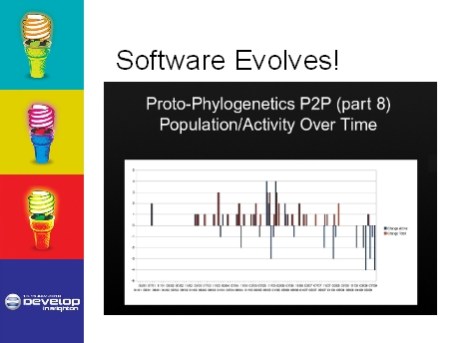
Software Evolves! Each version of a game/software is a new generation of that species – the social, economic and political landscape of users are the environment that each species (iteration) lives (and dies) upon. I’ve got a bigger talk about my research on this subject – on p2p software on the source code as the DNA and the etc.

Thus games development is an evolutionary process. Development is a hugely incremental process; the adding of lots and lots of small adaptations that build on the past success (or failure) of their predecessors.. Example; what are the differences between Modern Warfare 1 and 2? What lineage (the memes) does Modern Warfare 1 owe to past 1st person shooters? This is evolution – it’s not a revolution but an evolution. I found that in doing Savage Moon PS3, then the DLC ‘Waldgeist’ then to the PSP version, ‘The Hera Campaign’ – with each iteration we evolved the gameplay – block-pods to allow Blocking Towers to use their separate use from other functional towers on drop-pods, changed Laser Towers into into Masers Towers to highlight the a ‘slow but powerful’ weapon that works better in the games, better level design etc – but also the gene(code) was also carried over – AI, gameplay and so on – and improved each time…

So what does this mean for games development?…a lot!
Trust in the Process
Developers (should) get better with each iteration – so give us time! If a game has done just ‘OK’ in the market – but has some legs – then support the project to develop. Concepts like network updates, DLC, Minis etc will also help the iteration process to be capitalised and work for you and not against you.
We are a community
We can evolve on two levels – meme and (gene)code. Don’t hate on the people who borrow/steal ideas – it’s part of a long tradition – as long as we put new ideas back into the mix when we do. If we ever had patents on ‘1st person shooters’ etc it would be a huge blow to innovation. It would work against the evolutionary process that we’re locked within, like it or not.
Challenge assumptions
Is it like this ‘cos it’s good it just the way we are used to doing it. But also don’t be afraid to do it the way it’s been done – no point in doing it for the sake of it. This is a danger of the evolutionary process we are in; yes some things we have done over and over are done that way for good reason – they work, while others are simply habits. Knowing which is which, though, is the hard bit!
Film licences should look to games, not films
Need to tell film people that they have to allow adaptations to play a little more – copying the plot line is not enough – we have to map the characters and plot onto an incremental game process – so if we were going to make a Batman ‘Dark Knight 2’ game from the film – it’s descendent is not Dark Knight the film, but Batman Arkham Asylum or Fallout 3 or any other third person action game.
Evolutionary balance
Evolutionary thinking also helps keep players on-board – a mix of what they know and new stuff – a mid point between how we interact with music (where we tend to like to listen to what we already know) and film (where we tend to like new stories, with cool twists and turns). This is a positive and a negative – so gamers can often pick-up and game type and figure the controls out fast as they gravitate towards standard layout (that are evolutionary successful) But also a negative as the ‘language of games’ evolves – those who don’t understand it and have not moved with it can be locked out – the evolutionary process can thus create a barrier to entry – which is why the Wii works so well – before: how do you play baseball? Thumb-stick, X button, power-bar… After: you just hit it!
Evolutions not revolutions
So most games are going to be evolutions and not revolutions – these are rare – but exciting. However when publishers get risk averse – which is understandable on large budget projects – the rate of evolution slows and the change of revolution drops – which is bad.
I Heart Cambrian Explosions
New development platforms are always needed with lower barriers to entry to create a ‘Cambrian explosion‘ (e.g. Flash on the web, iPhone games) – where lots and lots of ideas are tried out – some are selected others not and the incrementing then starts on the successful ideas. Publishers can help with this by supporting places for experimentation and (as per top point) not shutting the experiments down if the 1st generation does not cut it – it takes time….
It also means we should not rush to abandon older hardware and methods – as the incrementation of the process means the best examples of the genre will often come last – so best PS2 game? Resident Evil 4… It also means that it takes time for solid ideas to arrive on a new controller – as the first generation of games using new technology will still be partly memetically/technologically based on the past generation of technology – it will take time to breed out the older tech/memes and evolve the new ones.
Here’s an example: Ahlstrand et al (2005) suggest how past technologies shape future ones; The dimensions of the space shuttle are partly derived from the need to transport the booster rockets by rail. In the US, rail road gauge (distance between rails) comes from the British engineers who emigrated and were critical in the decisions made in its design. In the UK, the gauge is derived from the same tools and designs that the workers used to build wagons. In turn, the measurements of wagon spacings come from rutted roads in the UK. The rut spacings come from the first long distance roads in the UK, build by the Roman army, who’s specifications come from the Imperial war chariot.
And that is it for now. Thank you!
Whales with Teeth!
Whales are pretty cool creatures. They come in lots of shapes and sizes and they save the world in Star Trek IV. So how cool was it to find that that the current living Sperm Whale has an ancestor in the form of a Sperm Whale with huge teeth!

Whales with Teeth!
Would they be going extinct now if they could swallow whaling vessels whole? Possibly not.
PS. Remember the message of Star Trek IV; we should save the whales!
Star Wars: Battle for Hoth is Out!
Hooray! It’s live! Star Wars: The Battle for Hoth is out today. It’s been a busy few months – we started the game at the start of the year from scratch and built it over the last 6 months – so it’s been a quick turn-around project – but the game is solid and I hope you enjoy playing it.
Needless to say I use you all to buy it. If you don’t own an iPhone, I urge you to buy one just for this game. 😉 If you want to know more, then please browse my other posts on the game…
There, I’ve done my selling bit for the day I can go an have a beer now…
I’ve also put a help/hints/tips guide up on the fluffylogic website: http://bit.ly/hothhelpguide – and the US iTunes page is here.
There is a nice write-up of the launch from MacWorld:
Battle for Hoth puts you in the unenviable position of having to defend the rebels’ Echo Base from an onslaught of probe droids, Imperial snowtroopers, fearsome AT-AT walkers, and more. You deploy soldiers, gun emplacements, snowspeeders, and more as you strive to prevent the Empire from snuffing out the light of freedom in the galaxy. From your top down view of the battlefield, you can arrange your units as you wish in order to best defend your objective.
Unfortunately, my first attempt ended in a rout as the Imperials stormed the base and mercilessly destroyed it. But at least I was rewarded with a video showing the rebels fleeing like ants from AT-ATs. So I guess that’s something. As it turns out, I’m not as good at strategic battles as I am at maneuvering an X-Wing straight down a trench. I did, however, manage to best the first level on a subsequent try, which just goes to show that you can teach an old tauntaun new tricks. The game features 15 different levels and two different gameplay modes (Classic and Fortress), as well as authentic Star Wars sound effects and music. There’s also support for the OpenFeint network, allowing you to compare your scores with friends and strangers alike.
Develop Day 2: Culture
Today at Develop we had a couple of interesting speeches one from Bioware – and international developer with a good reputation for good games and the sales to match. They are an international company with several locations talking from the point of view of a large developer that is in turn part of a larger also international publisher (EA). Following that we had the minister for Culture, Ed Vaizey talking the talk on a very national issue – tax breaks.
Bioware talked culture. Not minister for culture, but company culture – a culture that is not a national issue; Bioware did a great talk on what culture within a developer, within a studio and even within a team was – how they got it and how they kept it. It was a good talk mixing the practical with the ideas stuff. Practical; they give developers a choice of projects they wish to work on. Ideas stuff; this is a no-brainer that means that the people most passionate about a project within the company get to work on that project. Bioware suggest that developers set goal (where you want to be) and values (how you want to be) then these inform the people you hire, the structures you set in place and the policies that you have. Together this is the company culture. It’s important to keep making decisions that renforce the culture and not take away from it. All sound advice.
Seeing Ed Vaizey live is seeing a slice of political theatre – not that he particularly is, it’s just that’s the grouping he comes from; politicians. He talked a positive talk, made his policy announcements and had one eye on the audience (us developers in the room) and one eye on the wider audiences not in the room (the public, his colleagues, the press). His message seemed to be – ‘you’re not going to get tax breaks, but I will offer you something; changes to the rules on R&D tax-back (so you can claim it for work that is not your IP), a £5m Abertay prototyping project and a few other bits’.
So that was the main bits of my day 2 – creating culture and a minister for culture. A reminder that we are speaking tomorrow at 4pm in the Den. Hope to see you there!


 A Great Becoming...