News Source Goes Open Source
This is a really interesting development – a major news organisation has decided to go open source. For those new to the term ‘open source‘ it means allowing people non-commercial access to the source that built the object in question (often the source code to build some software, for example Firefox) and allowing them to use this source to build new versions and modified version of the object. It’s a really interesting approach to news and allows you to get the readers to help with the process:
The argument over the utility of open source has one more voter in the yes camp. This time, it’s the Journal Register Company, a U.S. newspaper chain with 170 publications.
Calling it the Ben Franklin Project, the company tried open source for a month. Things went so well it decided to make it permanent and company-wide for its 18 daily newspapers and their websites.
In a somewhat cutesy press release, the company declares its “independence from proprietary publishing systems.”
I co-wrote an article on open source for the Independent a while back and for that article and another one on wiki technology (as in Wikipedia type stuff) I wanted to also publish the source – the full interviews, all the links gathered etc, but sadly it did not happen 😦
The Evolution of First Person Shooters
I’m in the process of doing research for the talk at develop next week and this is one of the videos that I’ve found that conveys some of what I’m looking at – the progressive building of a concept from one iteration to the next…
Solar Cells to do what Plants Do
There is an interesting article about a prize winning solar technology development that offers the hope of driving the cost of solar cells down and down… What is also interesting is that the method of doing this mirrors nature’s own solar power plants – plants:
Silicon cells absorb sunlight and generate electric charges, but the silicon also has to transport the charges and separate positively charged carriers from negatively charged ones. To do the separation, you need a positively doped and negatively doped layer of silicon and for this to work well you need very pure materials – solar grade silicon has to be 99.9999% pure. Our cell is different in the sense that it is close to what photosynthesis does in green leaves. The charges are generated by dye molecules and other constituents take care of the conduction. That separation was achieved for the first time by our cells – except for photosynthesis, which has been working for 3.5 billion years!
Develop Conference Talk
We (FluffyLogic) are giving a talk at the Develop conference in Brighton:
Why are Games Sequels So Often Better Than Film Sequels and What This Can Teach Us About the Development Cycle
It is an oft quoted true-ism that the original of a film is best with sequels often failing to capture the magic of the original. Examples like The Blues Brothers, then The Blues Brothers 2000 or The Matrix then The Matrix Reloaded spring to mind. Yet is seems to be the opposite with games; it is easy to think of games whose sequel is equal, or indeed better, than the original – Fallout to Fallout 2, GTA to Vice City and beyond, Call of Duty to Modern Warfare 2.,,Ana (a filmmaker) and Tomas (a games designer) talk about why this is the case: why is a film better the first time around?
If you’ve there – come and have a listen – we’re on in The Den on Thursday 15th from 4-5pm. There is lots of interesting stuff there this year including Fable III, 3D gaming & Pixar Films.
How to Design Computer Games
Well, how to start thinking about the design anyway…I thought that I’d gather a couple of links on the topic of how to design computer games. Like any creative field it has it’s own ‘rules’ that are often best served by breaking them… Still for anyone wishing to know a little more, I wrote an article a few years back highlighting the difference between ‘narrative’ and ‘interactive’ which is key as lots of times when people find out that I work on computer games for a living they’ll tell me their great game idea – however 9 times out of 10 it’s not a game idea but a narrative world in which to set a game…
Narrative can be interactive, but for the two to work together and not jar, for they are as has been established, different concepts, care must be taken in the design of both the narrative and the interactivity. There are areas where the two overlap comfortably, just as there are areas where the two will conflict – and it is exploring these areas that new areas of creativity will be discovered.
Then a year or so after that was written, I gave a talk at the Watershed Media Centre in Bristol on the subject of computer game design… There are two key points to understand in considering a game design –
• ONE – Think in 5 dimensions – In a film the director controls 4 dimensions; the three dimensions of space, time – so can dictate what you see and when you see it. With games there is the 5th dimension of interactivity – the player/s as a variable. They will not necessarily do what you want, how you want, when you want! Too many people when approaching games think in 4 dimensions, they think of narratives and of worlds and characters – these are the tools of 4 dimensional thinking. A good game design begins in the 5th dimension – it begins with an interactive idea, not necessarily with a narrative idea – but I would push for aspirational, surreal or unattainable ideas as a good place to look for the 5th! For example; I want to be a rock-star! Guitar hero! It is the interactivity that drives how these games are built.
• TWO– Build the core mechanic. Games are built from a small number of core mechanic, these are interactive components and the rest of the game is simply variations of the core mechanic/s. Lets give an example; Turn based strategy. Simple idea where you have a number of units/characters who get to perform a number of actions in a turn. Variations on the core mechanic – varying the types of actions, having an action cost, varying the units action points, for example;
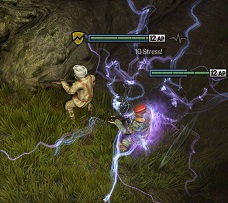
Final Fantasy /Rebel Star Raiders.
There are my rough notes from the session and a video of the talk online.
My E3 (and LBP2 plus Crysis 2)
A couple of weeks ago I attended the E3 games show in Los Angeles to demo our new game, Eat Them! The show was great and I had a really good time out there and we got a really positive reception for the game – about which I will be writing more in the coming months… (check back for links…)
For now I wanted to share a little of what else I saw there that excited me (as well as Eat Them!)…I was quite busy demo-ing the game so did not get as much time as I’d like to see stuff, however a couple of other things that I did see…
Little Big Planet 2
This is going to be huge. The first Little Big Planet (LBP) was big enough (and I loooove all the Cthulhu levels on there) but the addition of logic-gate type electronics (the ability to have the system make simple decisions such as AND, OR etc.) to the system is going to produce something really…well…I don’t know; and that’s why it’s going to be sooo huge. When you throw that sort of functionality at millions of players who create millions of objects – and can share them – it’s a massive media ecology system that is bound to produce astounding results. I guess what we will see if half-way between a kind of Skynet Sacknet melding where humanity is wiped out by nukes made of string and cardboard – or the more utopian LittleBigCulture where we get all post-Sackboy post-human as the Artificial Intelligence that players develop takes on a life of it’s own and builds a huge culture where humans and sackbots live side-by-side in perfect harmony. It’s going to be fun finding out…
I had dinner one of the evenings with some of the developers from Media Molecule and they are a crazy bunch (crazy as in the good creative type) who clearly love what they do – and that passion shows in their games. LittleBigPlanet 2 – instabuy.
Crysis 2
I queued along with lots of others for about 20 minutes to be taken into a small hot, sweaty room to see the game being played on the big screen. What I saw was the PC version (I’ll be getting the PS3 one) and it was amazing – the sheer amount of effects, polygons, sounds and particles being thrown around was pretty astounding. It looked amazing despite a few bits of slow-down. I’m a sucker for sci-fi and I enjoy 1st person shooters, so this is also an instabuy. (I also love the slight movement-wobble in the HUD which is a small touch but makes it seem more like your in the suit – the demo I saw was full of such touches!)
technorati blog claim
Here’s the token… NAJPE7AX2ASR
Ecology, The Internet and Networks
There is a great article in this Sunday’s Observer by John Naughton entitled ‘The internet: Everything you ever need to know‘. It gives 9 points of understanding that really get to the meat of understanding the Internet without getting overly technical. There is also a strong cultural/historic rooting to the piece that gives good context. I do recommend reading the whole article, but I also wish to comment on one point he makes about ecology:
As an analytical framework, economics can come unstuck when dealing with the net. Because while economics is the study of the allocation of scarce resources, the online world is distinguished by abundance. Similarly, ecology (the study of natural systems) specialises in abundance, and it can be useful to look at what’s happening in the media through the eyes of an ecologist. Since the web went mainstream in 1993, our media “ecosystem”, if you like, has become immeasurably more complex. The old, industrialised, mass-media ecosystem was characterised by declining rates of growth; relatively small numbers of powerful, profitable, slow-moving publishers and broadcasters; mass audiences consisting mainly of passive consumers of centrally produced content; relatively few communication channels, and a slow pace of change. The new ecosystem is expanding rapidly: it has millions of publishers; billions of active, web-savvy, highly informed readers, listeners and viewers; innumerable communication channels, and a dizzying rate of change. To an ecologist, this looks like an ecosystem whose biodiversity has expanded radically. It’s as if a world in which large organisms like dinosaurs (think Time Warner, Encyclopaedia Britannica) had trudged slowly across the landscape exchanging information in large, discrete units, but life was now morphing into an ecosystem in which billions of smaller species consume, transform, aggregate or break down and exchange information goods in much smaller units – and in which new gigantic life-forms (think Google, Facebook) are emerging. In the natural world, increased biodiversity is closely correlated with higher whole-system productivity – ie the rate at which energy and material inputs are translated into growth. Could it be that this is also happening in the information sphere? And if it is, who will benefit in the long term?
I think he is totally right – ecological principles are vital to understanding the Internet – indeed all human technology, but in the interest it is more apparent because of the pace of change there and the ability to track easier which bit of technology came from where. I note with interest the point about ecology as metaphor – this question is central to my current thesis – I think it is a stronger link than that. The evidence suggest to me that networked technology works on a evolutionary principle – thus it is also an ecological one (as you can’t have one without the other).
Technologies Inspired by Nature
I’m always interested in the ideas of technologies that are inspired by nature – and not just one feature or item, but by technologies that take on ecological principles to better interact with their environment and look to sustainability. With that in mind, I was reading about some new technologies around the corner… (all from Economist issue June 12th-18th 2010)
- ambient power – this is the idea that you can use existing ambient broadcasts to power devices; also know as energy scavenging. We already have sensors that are powered by a small microwave transmitter that converts the waves into power. As the power-needs of devices drop… this could really take off. It’s inspired by nature as nature does not do waste – the waste or unused products from one process/species are always used by others; whether symbiotically or not…
- vegetarian machines – EATR is a program to build an Energetically Autonomous Tactical Robot – a robot that can eat on the move and does not need to return to base to refuel. This is very nature-style; as most of natures denizens can eat on the move and can scavenge from the local ecosystem for fuel (aka ‘food’).
- self-repairing metal – The idea here is to seed the coatings of metal with microscopic capsules that contain restorative liquids, so when the metal is damage, the broken capsules leak protective fluid. It’s a bit like the clotting of human skin wounds by blood components that react to the air – but while this new idea is clever – it’s only a first step to self-healing.
There is more on this theme here…
Autonet – an autonomous internet
This sounds like an interesting project:
The internet as we know it, as a place for free exchange of information, as the center of what has been called a second 17th century with new ideas, creativity and innovation emerging daily, is rapidly coming to an end. We must use these last gasps of freedom to route around the disaster and create a truly free network. How? Advances in wireless technology such as ubiquitous wireless routers, community mesh networks which are easily expandable and self-healing as well as long range wireless efforts such as HPWREN indicate a possible future for a community based internet free of the centralized control of telephone corporations and governments. While this is definitely a fork, more forks are to come and we can only hope that a few networks will emerge which can be broad enough to span most of the globe.


 A Great Becoming...