Writings about Climate Hope

Just a note to say that I’ve started another writing project, on hope and positive news regarding climate change over here.
A newsletter focused on stories of hope in the global fight against climate chaos. While there is much to be angry, sad and disappointed about, here we’ll focus on the good news – the hope! We aim to use hope to power action!
Plymouth & Exeter Games Dev Meet-up Slides & Info
We were hosted this week by the lovley people of Not Evil Studios in Plymouth and then Tech Exeter, in Exeter.
The two Auroch talks we did can be found here (as PDFs)
If you want to sign-up to the Bristol Games Hub mailing list, which will cover events here in Plymouth/Exeter too, you can do so here.
TIGA Awards 2023 – Auroch Nominations!
Exciting news, the team at Auroch Digital have been nominated for a bunch of award categories in the TIGA Awards;
- BEST ACTION AND ADVENTURE GAME – Auroch Digital: Warhammer 40,000: Boltgun
- BEST EDUCATIONAL, SERIOUS OR SIMULATION GAME – Auroch Digital: Brewmaster: Beer Brewing Simulator
- BEST AUDIO DESIGN – Auroch Digital: Warhammer 40,000: Boltgun
- BEST LARGE STUDIO – Auroch Digital
We’ll find out on 17th November 2023 if we’ve won any!
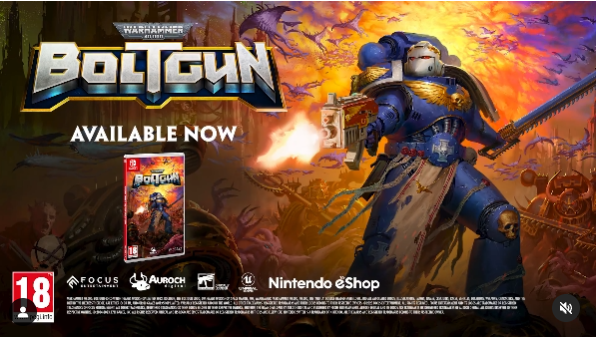
Oh and Boltgun also has a physical Switch version!
Mars Horizon (& Auroch!) has a TikTok!
We’re taking a few steps into the world of TikTok, with ones for Auroch Digital and also Mars Horizon
Here’s an example video
Why are we doing this? Its clear this is a key platform:
Q: Some people say that popular games have popular TikTok videos, and so it’s more correlation than causation when it comes to creating interest. What do you say to them?
A: It’s undoubtedly much easier to get TikTok views if your game is already popular. However, there are numerous examples of games that gained much more visibility through TikTok. You’ve covered a number of them in your newsletters already.
The inverse also doesn’t hold up. A big game definitely doesn’t automatically lead to success on the platform. There are AAA studios with wildly successful titles that are outshown by indie teams and solo devs.
But that also brings up the common question, “how valuable is TikTok visibility”? This is almost impossible to measure, but I fall back on the Rule of 7 from old-school marketing. It suggests that a potential customer will need to hear an advertiser’s message 7 times before they’ll take action to buy a product. A viral social media post on any platform adds to that number, and brings many people one step closer to buying your game.
https://newsletter.gamediscover.co/p/tiktok-how-data-changed-one-devs
Speaking Engagements in Jan/Feb 2023
So 2023 is getting off to a busy start and I’m booked into to speak at 2 events so far:
PG Connect London on 23rd/24th Jan 2023. Main site is here. Details on my contribution to follow.
Then in Feburary, I’m talking at Bristol Game Lab. Here’s the info:
Save the date! On Friday 24 February, The Bristol Digital Game Lab is delighted to be hosting a public lecture by Dr Tomas Rawlings, Studio Director of Auroch Digital.
Dr Rawlings will speak about ‘Authenticity in Game Development – Mars Horizon and the experience of working with real space agencies when making a game about running a fictional space agency’.
The lecture will be held in the Reception Room, Wills Memorial Building, University of Bristol, and is free to attend. It will run from 17:30-19:00. There will be a Q&A as well as a drinks and networking session facilitated by the Lab, which will also be hosting the first UK Digital Game Lab Summit that day.
Full details and booking link to follow. You can also find details of other upcoming Game Lab events on our website.
Hope to see you there!

Our Games Workshop Themed Podcasts
Here they are, to date!

- Warhammer 40,000: Back to The Beginning | S7 E3
- Deep Dive: Chainsaw Warrior | S2 E4
- A brief history of non-Warhammer Games Workshop Games | S5 E3
- The Road to Hell: A History of Car Combat | S3 E1
- The Dark Future… in cardboard! | S3 E2
- How to make Dark Future, the video game | S3 E3
- Dark Future: Blood Red States in now live | S3 E4
- An interview with… James Swallow | S3 E5
Getting into nerd-history: Warhammer Quest
I’ve been getting into a bunch of videos/books that dig into the history of various nerd things that I’m into and one of them I’ve enjoyed has been a three part YouTube series on Warhammer Quest. (Part 1, Part 2 and Part 3). Warhammer Quest, if you’re not sure what it is, is a hybrid dungeon-crawling RPG/miniatures wargame from Games Workshop. I’ll not say much more as the videos do a great job of that history. What I will note though is this little nugget from Part 2 at 17.32 in;
Which noted that an origin of the great Warhammer Fantasy Roleplay Game’s classic campaign, The Enemy Within, which in-turn is referenced in Warhammer Quest: Shadows Over Hammerhal, was in-turn riffing of the classic RPG, Call of Cthulhu. Apparently GW wanted some RPG adventures that had more of a horror/investigation type vibe that the more hack’n’slash of D&D.
Warhammer 40,000: Boltgun – announced!
Very, very excited to announce a new title – Boltgun! Trailer below and some commentary here.
As ever, please do wishlist the game!
Achtung! Cthulhu Tactics Podcast Episodes
Back in 2018 we worked with the good people of MODIPHIUS and Ripstone to adapt the TTRPG & tabletop wargames, Achtung! Cthulhu into a digital version. I was very pleased with what we created! Here’s the Sony blog announcing the project:
Anyhow, as part of this, we did a series of podcasts about the game and I wanted to collect them all here:
- Episode 1: Achtung! Cthulhu Tactics – The Birth of Cthulhu – What is Cthulhu and where has it come from?
- Episode 2: The Function Call of Cthulhu – How we translated the material into a video game
- Episode 3: The Momentum of Cthulhu – Getting into the details of the game and what the player gets to do.
- A potted history of turn-based tactical strategy part 1 – As Achtung! Cthulhu Tactics is a turn-based strategy game, this may be of interest!
- A potted history of turn-based tactical strategy part 2 – Part 2 of the above.
- A potted history of Cthulhu games – In this episode we looked at Cthulhu and games, so may be of interest!
Hope you enjoy listening as much as I enjoyed making these!
Mars Horizon has launched! Some links, podcasts and resources.
So proud & pleased to say that Mars Horizon has finally launched. The game is now out on PC, PS4, Xbox & Switch. You can grab it here. Here’s a quote from me:
“I’m extremely proud of all the team at Auroch Digital – from development right through to marketing – for the resoundingly successful launch of Mars Horizon.
I’m also extremely grateful to all of our partners in the project without whom it would not be the success it is; our publisher, The Irregular Corporation, who have been steadfast in their support for the project and brought considerable marketing and production resources and expertise into the mix.
Also the European Space Agency – ESA and the UK Space Agency who have been able to give us a level of expert input that completely lifted the authenticity of the game, and in the process have engaged so many more people with the actual work of space exploration.
This project hit on two key pillars of the work we do at Auroch Digital; it showed our commitment to connecting gaming to real world events and also the simultaneous cross-platform release demonstrated our development capacity to bring games to console as well as PC. We hope you all enjoy our game!”
If you want to know more, here’s the trailer:
The game’s FAQ page is here. If you’re enjoying the game, always great to get a review!
Over the years of development, we’ve put out a number of podcasts on the game, listed here in chronological order, newest to oldest:
- Why we must work together to land on Mars | S6 E4 (Nov 2020)
- What is it really like in Mission Control? | S6 E3 (May 2020)
- A brief history of Space games | S5 E7 (May 2020)
- The Mars Horizon update | S5 E6 (April 2020)
- Space is hard… | S4 E4 (Sept 2019)
- Visiting the European Space Agency (ESA) | S4 E3 (Sept 2019)
- Mars Horizon: Blast Off! Special | S2 E2 (Feb 2019)
- Andrew Kuh of the UK Space Agency chats Mars and the inner workings of an agency | S0 E3 (June 2018)
- Drama / Challenge, In-depth look at Mission Control & Meta Management Gameplay, UI design, and Meta Management playthrough | S0 E2 (May 2018)
- Mars Horizon Mission Control Gameplay Explained & Translating Space Engineering to Games | S0 E1 (May 2018)
(There is an index of other podcast episodes, indexed, that we’ve done before, here)




 A Great Becoming...