For the HTML5 web-app we (meaning Mobile Pie, myself and Nate Lanxon from Wired.co.uk) built to accompany the Gamify Your PhD project we needed to break the basic components of game design down into their component parts. What we built as a result was an interactive guide to the basic elements of game design. We broke these down into 2 basic types:
- Mechanics – How the player interacts with the game.
- Motivations – Reasons why the player would want to interact with the game.
We then arranged these in a table inspired by the periodic table like thus:

Click to play/explore!
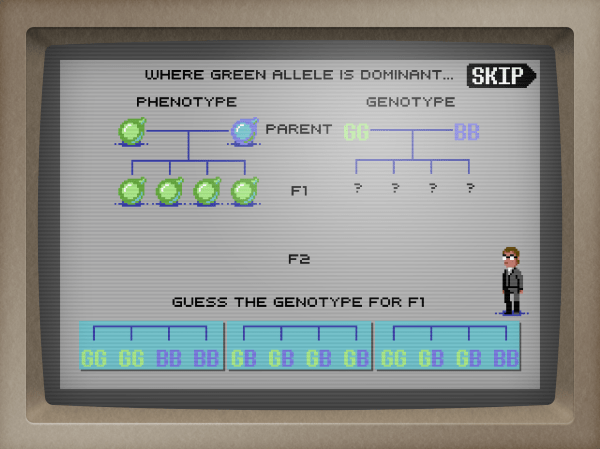
We also added mini-games; which means that you can explore how the game elements work by playing a mini-game and then seeing if you can identify the elements used in it:

Click to play/explore!
#gamifyyourphd in Tweets…
We’ve been getting some great Tweeting coverage of Gamify Your PhD – here is a sample…
http://twitter.com/pruss/status/228853120611004418
http://twitter.com/robinince/statuses/224052669042528257
http://twitter.com/varvaraephemera/statuses/223690629790699520
My First iOS Title: Two by Two
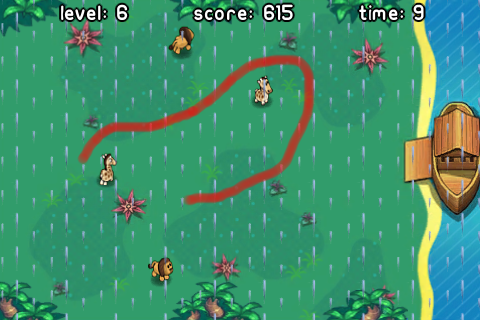
The first iOS game I worked on was a joint project between Plastic Ant and FluffyLogic and was a simple but fun puzzle game called ‘Two By Two’. Sadly it is not on the App Store any more but here is what it looked like:
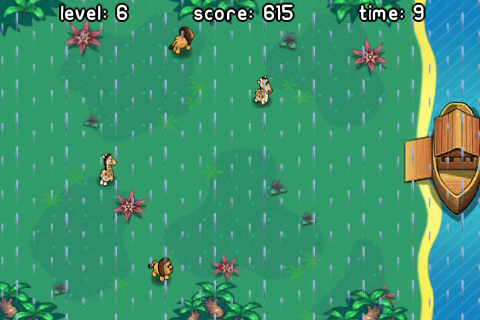
What the player had to do is draw a line around a pair of the same type of animals to get them into the ark. Then repeat this for all the pairs of animals before the rain flooded the land. If the player got more than two animals in the loop or any animal broke the line while it was being drawn, then it vanished. As I said, it was cute fun.
All About Gamify Your PhD!
It’s out! Wellcome today launched a scheme I’ve been producing called ‘Gamify Your PhD’ where scientists will become the game designer. To show how you might gamify science, MobilePie, Wired and Wellcome made this guide to designing games (complete with mini-games):
Wired have a great article up about the project:
The Wellcome Trust has launched an initiative — called Gamify Your PhD — to bring together researchers with developers in order to create games that explore the latest developments in biomedicine.
Researchers are invited to send their ideas about how their PhD research could be illustrated through a game. In order to inspire them, Mobile Pie (with the advice of Wired.co.uk editor Nate Lanxon) has created an interactive embeddable guide to basic gaming mechanics, featuring 16-bit minigames. These include a Darwin-inspired survival-of-the-fittest pigeon game, a Mendel genetics puzzle game, a game based on Asch’s work on conformity and a Newton-targeting apple physics game.
Meanwhile, teams of three or four game developers are invited to apply to join a game-hack in London in September in order to bring the researchers’ ideas to life. Each team must have all the necessary skills to create a prototype game in two days — design, code, art and audio — plus their own equipment. The best team will receive funding to develop their idea into a releasable game.
The initiative is the brainchild of Wellcome Trust’s gaming consultant Tomas Rawlings, who said: “Science and games are a natural fit, both are about the participant seeking to understand the rules that govern the world they find themselves within and achieving this by experiments such as trial-and-error. Gamify your PhD is an exciting twist and evolution of these areas.”
Here is the official press release:
The Wellcome Trust invites researchers to gamify their PhDs11 July 2012: An innovative new way of communicating science research launches today with Gamify your PhD, a project from the Wellcome Trust which brings together researchers and games developers to create new games exploring and explaining the latest developments in biomedicine.The Trust is inviting researchers to share ideas for games based on their PhD work in biomedical science or the medical humanities, and small teams of games developers to turn these ideas into addictive, challenging and educational games. Those selected will partner at a two day hack in which the games will be created. The best of these will receive funding to develop into a releasable game.To help inspire ideas and give researchers a flavour of what’s possible a web-app http://www.wellcome.ac.uk/gamify, developed by Mobile Pie, has been commissioned, offering an interactive and fully embeddable guide to the nuts and bolts of mechanics and motivation that lie behind successful game design. The web-app also features sample 16bit mini games to illustrate the different elements of gaming, including a Darwin inspired survival of the fittest pigeon game, a Mendel genetics puzzle game, a game based on Asch’s work on conformity, and a Newton-targeting apple game.Gamify your PhD is part of a wider commitment by the Wellcome Trust to using games and gaming culture as a means of engaging people with science. A range of awards schemes is open to developers interested in creating innovative, entertaining and accessible games based around biomedicine and medical history.Daniel Glaser, Head of Special Projects at the Wellcome Trust said: “The engaged researcher has lots to learn from gaming and game design can benefit hugely from the latest scientific advances. That’s why the Wellcome Trust is throwing its weight behind this innovative interaction. Today’s brightest researchers understand that science does not take place in a vacuum and the best research can engage with the most popular culture. I’m very curious to find out what these teams will come up with.”Tomas Rawlings, the Wellcome Trust’s gaming consultant said: “Science and games are a natural fit, both are about the participant seeking to understand the rules that govern the world they find themselves within and achieving this by experiments such as trial-and-error. Gamify your PhD is an exciting twist and evolution of these areas.”The deadline for applications from researchers and developers is 12 August, and the games hack will take place between the 3-4 September 2012. The resulting games will be made available online. All details about the scheme and the web-app guide to gaming can be found at www.wellcome.ac.uk/gamifyThe project’s twitter hashtag is #gamifyyourphd
So the event got lots of interest via twitter (you can see a sample here). Plus we’ve been getting some great press coverage pre-the actual jam of it including:
- wired.co.uk
- wellcometrust.wordpress.com
- Develop magazine
- NineOverTen
- gamenguide.com
- blogs.ucl.ac.uk
- killscreendaily.com
- gamasutra.com
- gameranx.com
- notcot.org
- gamesareevil.com
- beefjack.com
- thirteen1.com
- n4g.com
- sfu.ca
- www4.dcu.ie
- gamedwellers.com
- genomeweb.com
- blogs.bournemouth.ac.uk
- thecreatorsproject.com
- medicalhumanities.wordpress.com
- scientigeek.com
- genome-engineering.com
- mmoresearch.blogspot.co.uk
- thirteen1.com
- gamesforbrains.net
- earlyeducationtips.com
- einfogames.com
- zimbio.com
- London Arts in Health Forum
So the event happened (and was ace) and you can see it in tweets. So post the event we’ve had this coverage so far:
Develop 2012 Panel: The Anatomy of Fun
I’ve been helping to put together a panel at develop and it’s turning into a stonking line-up that is a must see in my un-bias view…
Wednesday 11 July 2012, 11:00 – 11:45 in Room 4
- Chair: Jo Twist, CEO of UKIE
- Marek Bronstring, game design consultant, former Head of Content at SEGA Europe.
- Paul Croft, Co-Founder of Mediatonic
- Graham McAllister of Player Research
- Robb Rutledge, neuroscientist.
Q: How good is that? A: Very.
How important is fun to a game’s success? What do we even mean when we say a game is fun to play? And how easy is it to engineer fun? This panel explores the secrets to keeping players entertained and coming back for more. We hear from neuroscientists and games developers as they share their different insights and perspectives. What is science revealing about the many elements required to make an experience fun? And what do those at the front line of gaming find are the best ways to keep their players playing – whether in casual mobile games, immersive RPGs or any other gaming experience?
Because we’ll also be unveiling a new project for developers to get involved in…

Mediatonic’s ace Robot Attack Unicorn: Evolution
Where Next for Sony? Ah – Gaikai!
I’d wondered before, where next for Sony? The answer seems to be to buy the competition in what is, IMHO, a very smart move. I’m not the only one who thinks so…
“The world isn’t ready for cloud gaming,” says Rob Fahey. That may be true, but for how much longer? Sony has to prepare for a potentially all-digital future, and most of the analysts GamesIndustry International spoke with believe the Gaikai purchase is a very smart move, and even worth the seemingly high $380 million price tag.
Knossos – Home of the Minatour
When I was a yoof, back in the day, I had a Ladybrid Book of Greek Myths. I loved the book and read it over and over. So it was when I found myself in Crete recently, it was a joy to visit Knossos, the legendery home of the Minotaur.

My photo from Knossos
The site is a bronze age city built by the Minoans. It was the first major city in Europe. It was reputedly maze-like because of its number of rooms and huge size (at a time when most people lived in one or two room huts. The Minoans were into bulls and did dances leaping over them – which has also fed into the Minotaur myth. Well worth seeing if you get the chance.
Where Next for Sony?
Sony have been having a rough time of it of late. Record losses have been announced. The company makes all sorts of stuff; not just games. However it is clear games are a bit part of what they do, so the decisions over the gaming sector matter. Now games do make Sony money, but there is software and hardware in the overall games bit of the company. Here’s what the new boss had to say on the matter:
He highlighted the fact that games was one of Sony’s more profitable divisions, and still had room to grow. And when he was questioned on the seeming lack of Vita software on show at E3, has was quick to defend the handheld strategy.
“If we were remiss on not spending enough time on the PS Vita, I’ll take that one under advisement, but you can rest assured it’s not for the want of any sense of overall commitment. We know that killer games are going to be what sells this device.”
I was wondering if they’d drop the PS Vita and focus on the PS3. It seems not. However the fact that the PSP is still out-selling the PS Vita in Japan has got to be a concern. However as a gamer, if that means investment in news games – that I’m interested…
Any fellow developers going to Brighton who have an interest in science and/or are interesting in finding out about the various pots of funding The Wellcome Trust have available, then I recommend singing up to the workshop below. The line-up is going to be very interesting – neurologists, a cell biologist and a cardiologist so far. How would you game biology?
Wellcome Trust Workshop: How Do You Make Science, Play?
Date: Thursday 12 July 2012, 14:00 – 16:00 at Develop, Brighton
From Deus Ex to Portal, science has inspired a vast array of successful games and sometimes in quite unexpected ways. This hands-on workshop explores how contemporary science can be mined for compelling ideas by games developers, going from concept to design. Whether as the inspiration for a game or for content supporting a bigger game, this workshop will see you collaborating with top scientists from across the country to develop novel ideas.
The session includes a presentation with Preloaded as they explain how a close collaboration between games makers and content specialists resulted in their latest game, Axon. There will also be a chance to find out how you can access the Wellcome Trust’s funding streams to develop science-inspired gaming ideas further.
Please note there is limited space available for this session. If you would like to attend, please email Develop@wellcome.ac.uk, with subject heading ‘WORKSHOP’.
Top 5 Films, Books & Science about Games and Gaming
I do get asked about what people should do if they are interested into getting into developing games. Other than learning to code (that way you can bring your own ideas to life) playing games is key. Games are not a medium that can be adequately experienced by watching others play. All that said, next is to have a wide range of cultural inputs; so not just from games from from all the arts and media. Not just fiction but non-fiction such as science too. It all blends! So I thought I’d explore my top other forms of media/project that intersect with games and gaming culture. As with my Cthulhu/Lovecraft list, this is a personal one, so feel free to suggesting things, but don’t be offended it I don’t add them to the list. Also, this is a work in progress – I plan to add to it.
Preamble done, lets get going!
Films
- War Games – The classic 80s film about video games that was both fascinated with computers and of scared of them. This was when home PC very very new and there was a cold war paranoia going on.
- The Last Starfighter – Another 80s classic. Worth seeing. SPOILER ALERT, it follows the same sort of plot idea as Ender’s Game (see below) whereby the game is just training for real combat. Not a million miles from where we are now. Still, the space-ship design was cool.
- Grandma’s Boy – As far as I’m aware, this is the only fiction film about games development….and they get those bits all wrong. Totally. Game development is in reality nothing as depicted. It’s about a game tester who is a bit of a slacker but has ideas of making it big. However it is fun, so I’d recommend it.
(Though us game designers are nothing like the one depicted in the film. Honest.) - The Game – A great film by David Fincher about a man who starts playing an ARG that gets more and more real. It has that sense of the deep immersion into the game that some games can make you feel – you know what I mean, when you start to dream about the game…
- Currently redacted.

The Last Starfighter (Still from the film showing the video game)
Books (Fiction)
- The Player of Games – By the Scottish sci-fi writer Iain M.Banks. I am a huge fan of his works. This, IMHO, is the best of his ‘Culture’ series and is well worth reading. It’s about a world where the position in society is given by your performance at a vast and complex game. Read it. Yes, now. Off you go…
- Ender’s Game – A sci-fi book about games as preparation for war and about Ender, who excels at them. This is a great book, though personally as the series went on, I felt the books got worse. Also the author, Orson Scott Card, sounds like an unpleasant guy being a bit of a moaner to say the least. There is a film version (which I’ve not seen) and there was a game being made, but it sadly seems no longer.
- Halting State – A book about MMOs and the worlds around them by Charlie Stross (who is also on my other list). I can’t say too much as I’d spoil it, except to say it starts with a robbery in a virtual world. Well worth it.
- Reamde – By Neal Stephenson – who also wrote the amazing Cryptonomicon. I’m still reading this at the moment, but so far it’s amazing…so I wanted to include it. (Hey, it’s my list!)
- Currently redacted.
Science
- Conway’s Game of Life – An ALife game zero-player game where all the that is set is the intial state. From the simple rules and inital state amazing things can (and do) appear. Is the player the god-like being who sets the initial state or the cells within destined to be played by the rules? Or is there truly no player? Discuss.
- Stanford Prison Experiment – The famous experiment by Philip Zimbardo into obedience and authority. While no ostensibly a game, it is clearly about role-playing and how the rules of the game are changed/devised by the players/participants.
- Dawkins’s Biomorphs – A simple idea; use the power of evolution to generate aesthetically pleasing shapes. In each generation you pick the most pleasing shape and the rest are discarded. Thus each round the shapes – or biomorphs – evolve to be ever more pleasing shapes for you.
- Currently redacted.
- Currently redacted.
Not in the list, but I wanted to mention…
- Mazes & Monsters – the 1982 scare-story movie about the paper RPG of Dungeons and Dragons. Fun to watch for a laugh, but little else.
- Indie Game: The Movie – A fun looking documentary I’ve not seen yet but hear good things about.
- Futurama – Chocked full of references to games and gaming from guest appearances by Gary Gygax (creator of D&D) onwards.. It is such an amazing show.
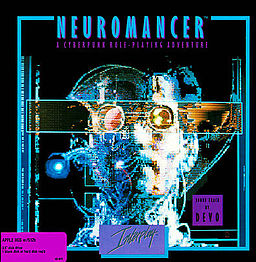
- I also want to mention William Gibson, who was inspired by 8bit games for his work and his writing and plots have many gamic qualities.


 A Great Becoming...