What #Hollywood Does Well: Attention
This is a really interesting article about the idea there are different types of attention, which mean different things:
For the Valley to do that, it’s going to have to get out of the mindset that eyeballs equal quality. My guess is far more people watch a funny video of a talking dog on YouTube than many Oscar nominated films. Even the most commercial blockbuster films have 40,000 showings in a given weekend. Compare that to a YouTube video which can get 40,000 views in a viral minute.
…[but] Eyeballs aren’t equivalent to one another. For Hollywood to be killed, the Internet needs to focus on a metric other than eyeballs. It’s not about mass, it’s about good. That’s absolutely anti-YouTube and anti-Farmville and any other content which we expect to be rapid, mass and disposable. Disposable content isn’t bad, it’s just not everything. And as long as that’s all that the Valley is putting out, we won’t kill Hollywood.

image from graffiti450.blogspot.com
Digital Distribution Does Work…
I was reading this article about suggested dos and don’t for Sony going forward. I’ve also written a bit about all this. What caught my attention is somthing I disagree with:
Sony Shouldn’t;
Bear hug the cloud – The PSPgo flopped for a number of reasons, but one of them was the system’s insistence on only delivering content via the cloud. Make no mistake, cloud services will play a big factor in gaming in the years to come, but it’s not going to be as soon as many proponents think. The mass market – a critical audience for Sony – is simplynot ready for full digital distribution.
Errr? iPhone? Android? Kindle? All huge successes and all digital/cloud distribution only. The PSPgo’s digital failed because, I believe because the digital distribution was not a patch on its competitors. To buy a game on PSPgo was much too complex; (once your account was set up) you had to go into the store, find the game, add credits to your account, buy the game, download the game, then exit the store, select the game file and install it. Compare that to the iPhone – select the game, enter password, it does the rest. There were other issues such as pricing (games and hardware) and how as a user I could get peer feedback on games. But digital only was not the issue, it was its implementation.
Playing on the Brink of Climate Change (Longer Version)
This is a longer version of the article that appeared on the Wellcome Trust blog…
Playing on the Brink of Climate Change
There can be little doubt that one of the major, if not the major challenge of the current age is the threat of climate change. Indeed many influential voices argue it is already here. For example in the book ‘Eaarth‘ by Bill McKibben, the author argues that the planet we are living on is already a different place from the one that civilisation emerged out of several thousand years ago and this change comes with consequences. The Wellcome Trust has set understanding the health implications of climate change as a major policy point;
Climate change has been described as “the biggest global health threat of the 21st century” and is likely to affect the health of millions of people worldwide. Threats include heat waves and flooding, changing patterns of infectious diseases such as malaria and dengue, and water scarcity and rising sea levels, which could displace hundreds of thousands of people. The impacts will be greatest in low and middle-income countries.
Understanding the health impacts of climate change is a challenge for science. Communicating and acting upon that information is a challenge for all of us. Artists have been linking with scientists to help with this important process, for example the 2005 visit to the Arctic by a joint group of artists and scientists, which produced the novel Solar.
The arena of video games has also, in its own way responded too. There are games that look specifically at the health issues (such as Climate Health Impact by The Wellcome Trust and Playgen) and games that put the player in the position of trying to persuade the world’s countries to act together (Fate of the World). But there are also games that use the changed world as a narrative setting to explore what that shared future might be, exploring climate change both as creative inspiration and as gameplay subject matter. The example of this I’m going to look at, and how the science has informed the creative content, is the game ‘Brink‘.

Concept Art from 'Brink'
Brink is a first-person shooter – an action orientated game where the player sees through the eyes of an in-game character and whose interaction with the world is conducted from this first-person view. Most such games use staples such as aliens, World War II or terrorism as their setting. Brink takes a different path from the crowd and opts to use a climate changed world as a narrative setting, as the games writer, Edward Stern, noted when I spoken to him about the process of creating the game’s setting;
We knew the narrative backdrop for Brink had to be visually distinctive and explain why people are fighting, what they’re fighting for, and why they don’t just leave. All of this seemed to require resource scarcity and isolation. Perhaps an island of some sort, but why would people be on an island? I’d read about www.SeaSteading.org, and seen some other amazing terraforming/engineering solutions to rising sea levels on Jeff Manaugh’s amazing BLDG BLOG. So that lead to the Ark: a techno-visionary artificial island, built to combat climate change, but cut off from the outside world and running out of spare parts… it wasn’t anything I’d seen in a game before, and seemed to offer a nice solution to our setting needs. But also, it plugged into current concerns.
Given how much the science drives what you know (and don’t know) about climate change and given that it is fundamental to creating a credible view of it, Edward Stern embraced the gathering of credible sources as part of his research to inform his writing;
My training, such as it is, is as a Historian, so my test for researching a topic is; have I read the primary sources, or am I relying on secondary sources, or have I just read one book, or have I read several web posts but they’re all misquoting each other? I’ve been lucky enough to meet and be taught by some real, actual, factual experts in various topics and I know I’ll never be in that league. But as a concerned citizen and consumer, much less as a writer and infovore, climate change is something I had to know something about. The data and its interpretation get so complex so quickly, I’m pretty much reduced to reading bloggers acting as well-informed collators and aggregators who can summarise experts and some of the experts are bloggers, and some of the bloggers experts. I used to follow the science and the culture/media brouhaha surrounding it as best I could, mainly starting with www.scienceblogs.com and www.realclimate.org and following links from there. I couldn’t understand absolutely every detail of the Mann “Hockeystick” and the stolen CRU emails, but I went through them as thoroughly as I could, keeping as open a mind as I could. If I couldn’t be an active combatant in the information wars, I could at least be a well-informed civilian. I didn’t want to just skim the stuff so I could say in interviews that I had done so.
With all this information, how does the wealth of scientific information become converted into creative aspects of the game? Edward gives us a fascinating insight into that process;
No matter how profound an understanding of the science I might temporarily acquire, it wouldn’t necessarily give me things I could use for the game. I needed to understand as much as I could, but I also needed to find things to exploit dramatically and for gameplay. There’s the old statistics joke that the plural of anecdote is not data. But from a writer’s point of view, the singular of data is not anecdote – you can’t just invoke a scientific buzzword and hope that will make things seem credible or dramatic to a player/reader. It has to be something you can Show or Tell within the game, and games aren’t great as a storytelling medium. As the old joke goes, games are a medium because they’re neither rare, nor well done.
I love it when a game connects to the non-gaming bits of the brain. I always cite Deus Ex as the first game I played where I genuinely didn’t know what to do. Not just what the game would reward me most for, or what would move the action along, but because I genuinely didn’t know how I felt about the real world choices and issues the designers had put in their game for my character to deal with.
It is worth noting that games handle narrative in a very different way to a novel or a film. As an interactive medium, the player chooses the degree to which they engage with the story. They may choose to not listen to a key conversation or ignore a vital text. This makes layering narrative a challenge, as Edward explains;
People play games in very different ways. Some, like me, love the narrative detail, and will dawdle through the environment as slowly as possible, reading every sign and situation like a forensic trainee, because nothing was put there by accident. Many more gamers want a bit of story, but don’t want to get bogged down in the details. And a large majority of them just want to run around and blow stuff up. The challenge is to make the story stuff optional, so that it’s there for the players who want it, but not in the way of those who don’t.
I’ve played and completed Brink and it does indeed have a story that draws you in, as well as some great action too. The setting of the game and the characters responses to the climate-changed world they find themselves in is credible and engaging. Given that climate change is a hot-potato political issue and will be for some time, I also think its a bold decision to place the issue front-and-centre in a key part of popular culture – gaming. This is key as a growing number of people play games and see games as a primary source of understanding about the world around them. Climate change is an emotive issue for many reasons, which to Edward Stern made it a strong place to set a work of interactive fiction;
I was trying to make it as easy as possible for players to let the game stick in their minds, to plug into their existing concerns and prejudices about real world issues, and few people know or care absolutely nothing about climate change, whatever their outlook.
Thanks for your time, Edward!

Brink image of UAV
#PSVita Slips Against 3DS in Like-for-Like Sales Figures
Sony’s ambitious little Vita has not been receiving that warm a welcome in a land traditionally dominated by handheld devices. The latest report puts week-over-week sales for the new Vita at only 18,361 units, representing a drop of 57%.
If interested, read this in context of the console wars predictions for 2012…

PSVita Launch
Analyst: #Zynga Paying More to get Playing Players Than They Spend
[analyst Arvind] Bhatia’s estimate is based on the company’s confirmed $120 million marketing budget for the first nine months of 2011.
“Almost all of that is for acquiring customers,” he said in an interview with Benzinga. “We also know that they had 3.4 million unique payers in the September quarter, which is up from 3 million at the end of December 2010.”
“In other words, they added 400,000 additional payers and they spent $120 million to acquire them.”
The figures indicate that each new customer costs Zynga $300 to acquire, but each one will only spend and average of $150 over the 12 to 15 months that players stay with the company. “That math won’t work for very long,” Bhatia added.
This strikes me as a little of a back-of-the-envelope calculation, as I’m sure there is more to the numbers than that. Nonetheless it is a worrying set of numbers. Read this, if you’re interested with my comments and links of social games going into 2012 (here & here).
Play Themed Graffiti: Can Your Inner Child Come Out and Play?
Seen in Barcelona…

Can Your Inner Child Come Out and Play?
What Virtual Goods do we buy?
An infographic answer from GamesBrief…

More on the Future of Facebook
I’ve post a bit about the future of games and social media. So following on from that, this post on Facebook caught my eye…
And Facebook has “already lasted a long time, in Internet years,” notes Douglas Rushkoff, author of Program or Be Programmed: Ten Commands for a Digital Age. But for Facebook to last decades, it would have to become as prevalent as email, and Rushkoff doesn’t believe that’ll happen.
Rather, Rushkoff predicts a Facebook backlash. Either something disastrous will happen, like a huge privacy violation or security breach, or people will just get sick of Facebook. The way we use the internet and connect socially is always changing, so at some point we’ll probably all fall out of sync with Facebook. If Facebook does survive, it’ll be as something almost unrecognizable, that just keeps the brand name “Facebook.”
“Facebook has a bright future,” as long as it can stay “human and open,” contends Gerd Leonhard, founder of Green Futurist and author of The Future of Content. “Facebook is infrastructure now, like a highway, or water.” He predicts Facebook will rival Google in terms of revenues within three years, and already rivals Google for importance. The main challenge Facebook will face is user fatigue, as it adds more and more services and forms of content.

io9 facebook areticle, Image: ra2 studio/Shutterstock.com
The Mainstream Growth of Games: Just Dance
So yes games like Call of Duty, Halo, Uncharted do really well and rack-up impressive sales, but if there was ever something that showed how video games have moved into the mainstream it is the continued success of Just Dance:
Ubisoft announced today that the Just Dance franchise has surpassed 25 million units sold worldwide, with the recently-released Just Dance 3 having sold 7 million to date. The publisher also touts 23 million minutes of Just Dance 3 played and 7.5 million songs attempted every day.
Red Wasp Design Talk Write-Up
As part of Red Wasp Design, I did a talk at the PM Studio about our up-coming game, Call of Cthulhu: The Wasted Land. There is a great write up of the talk here:
Tomas explained that he felt the main difficulty with adapting their game from the tabletop version of the RPG stems from the original game’s openness: the way that all of the atmosphere and imagery of situations are created in the minds of the players and that it allows for the possibility of taking any course of action. This openness is not so easy to reproduce in a video game, where each option given to the player requires a large amount of code to be written in order to facilitate it.
The other major problem facing Red Wasp was to find a way to fit the game onto a mobile device. They have developed the game with highly detailed visuals so that it can be converted onto multiple platforms in the future (including home consoles such as the PS3). Initially they have decided to release it on iOS as the mobile platform lends itself to single player turn-based play and also as it is quicker and easier to get the product to market, start building a community of players and to gather feedback about what works. However, the relatively small screens involved with smart phones poses the design challenge of conveying an atmosphere of horror in the context of a handheld device.
The full write-up is here. Thanks to all those who attended and have supported us!
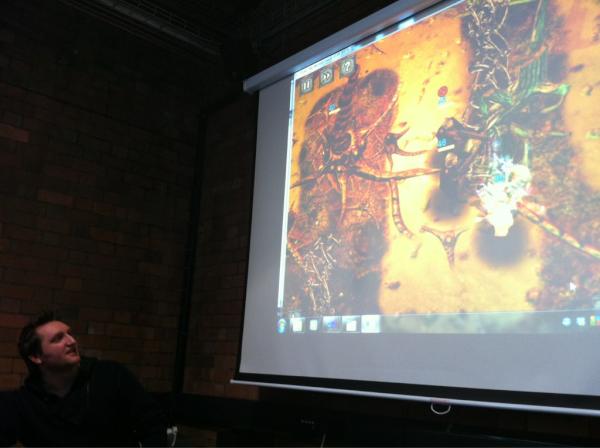
Me doing Red Wasp Design talk on 6th Jan at PM Studio
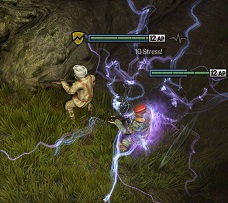


 A Great Becoming...