Games, Children and parents: Media use and Attitudes (Ofcom)
Ofcom has released a new report (PDF link) looking at media use and attitudes of kids and parents. There is lots of interesting stuff in it, but I’m going to look at some of the content in relation to games. One of the ongoing questions that is always in need of an answer is how widespread gaming is? This study also adds some information:
Playing computer and video games on a daily basis is popular among children in each age group (58% of 5-7s, 68% of 8-11s and 59% of 12-15s). Among 8-11s there has been an increase from 59% in 2010.
Interesting that the use is so high amongst the younger 8-11s. Note that is a daily figure. Compare that with 16-19’s across the EU had a 83% rating, but that was not the daily figure, but in last 3 months, or to the US figure of 17% of 5-8 year-olds playing games daily. If you asked those age groups who had played an online game not daily but in the last 3 months, I bet the figure is almost at the 92% who use the net. These figures mean online games are very, very common. So how to parents feel about all this gaming?
Parents of 5-15s are most likely to be concerned about the television content their child watches (31%), compared to internet content (23%), mobile phones (16%), games (19%) or radio (5%). Levels of concern at the overall level for each medium are unchanged since 2010. … Parental controls are unlikely to be in place for either handheld games players (12%) or games consoles connected to a television (15%).
Not as concerned as they are about TV… This surprised me given the ongoing scare campaigns that sections of the media like to wage against games.
The next quote if from the section titled, ‘Devices used to play games‘:
We asked parents and children a number of questions to find out about the devices they use to play games at home.
Games consoles connected to a television and handheld/ portable games consoles are the most commonly-used devices for gaming; used by at least six in ten children in each age group. Compared to 2010. Most children in each of the three age groups use at least one of the devices we asked about to play games; accounting for close to nine in ten 5-7s (86%), and nine in ten 8-11s (93%) and 12-15s (90%).
This graph is also interesting – online gaming in the context of other activities:
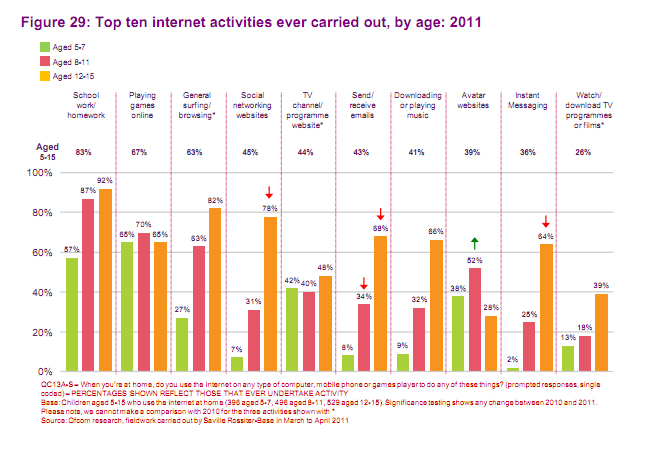
Doing homework is the most common use of the Internet (83%) and gaming is next (67%). The full report is here: PDF link.
Cthulhu Thursday: Making Dark Young!
This is part 2 (part 1 is here) of a series of developer diaries for Gamezebo on Call of Cthulhu: The Wasted Land:
The first stage of creating a 3D image is to use a 3D design tool to build the item, character or object in question. Lets take the example of a Dark Young, these are the monstrous living-tree beasts who are the foul offspring of their mother-deity, Shub-Niggurath. Now their creators describes them as thus; “…it was the black thing of my dreams – that black ropy, slimy jelly tree-thing out of the woods.” (from Robert Bloch’s ‘Notebook Found in a Deserted House’)
Stuart starts by creating a really high resolution model for the Dark Young. With such tools (you can try the free and open source Blender if you want to try 3D creation yourself!) we create a 3-dimensional model of the object, like a virtual sculpture. In graphics terms, the more complex the model, the better it looks, but the more processing time it takes to display it and move it around on the screen. This is why a Pixar film will always look better than a PS3 game – because they are not generating the film in real time. They can take weeks if need be, to generate a few minutes of footage whereas a game is real-time.
Because the player can be anywhere in the level, the graphics have to be calculated on-the-fly continuously. That means in-game we’re always looking to keep the complexity of the model down while trying to keep it looking good. Here’s our high quality (or high poly, as in ‘polygon’, as we call it) version:

Gamezebo Developer Diary: Part 1 Design, Part 2 Art, Part 3 Technology.
(Cthulhu Thursday is a dose of Mythos to brighten darken your week. More on the idea can be found here and a list of posts thus far, here. Also for more Cthulhu news, sign up to the cthulhuHQ twitter feed. Enjoy!)
A Classic Game: Prehistoric Isle in 1930
This is one title I spent lots and lots of 10p coins on back in the day. It’s a shoot’em-up with dinosaurs. Shall I repeat that? It’s a shoot’em-up with dinosaurs.
One of the great things about this game is the multiple position power-up; so depending on where you position it relative to your plane, it shoots in a different way. More about the game here.

Prehistoric Isle in 1930s
ISFE 2010 European Consumer Survey on Gamers (and Non-Gamers)
This is a really interesting report (link as PDF) with lots of fascinating data-points. Here’s a few that caught my eye:
EU Wide Gaming Number:
- On average across the 8 major European nations surveyed, 25.4% of adults have played video games in the last 6 months, a total of 79.2 million gamers. This percentage varies from 38% in France to 17% in Italy and Poland, but is substantial in every country (It’s 32% in UK)
- Using this data we estimate there are 95.2 million adult Video Gamers across all 18 countries covered by the Gamer Survey
- Gaming is most popular among the young, however almost 30% of 30-49 year olds play video game
In the UK the numbers who play games are: 16-19 year-olds 62%, 38% of 30-49 year olds and interestingly 17% of 50+ year olds. Of gamers in the UK, 13% spend 11+ hours/week playing games, 11% 6-10 hours/week, 55% 1-5 hours/week, 22% less 1 hour/week.
Of gender overall:
By gender: 31% of males and 20% of females are Gamers.
Online Gaming Habits:
- 16-19 year olds are most likely to play online (83% have played at least one type of online game in the last 3 months)
- 24% of Males are playing paid online games in comparison to 12% of Females
- PC gamers show the highest level of gaming activity by system user types
- Puzzle games are the most popular type of online games for females and ages 40-4
Gamers as Parents:
- 58% of all Gamers who are parents report playing games with their children.
- UK has the highest figure amongst Europe with 72% of all Gamers who are parents report playing games with their children.
- The likelihood is related to how active a gamer the parent is; the more dedicated a gamer the more likely they are to play with their children.
Hat-tip to SGI for the pointer.

Gamification, Design & Beyond Talk
I’m going to this – totally recommend it! Dan Dixon is talking…
Friday 28th October at 5pm.
Recent years have seen a rapid proliferation of mass-market consumer software that takes inspiration from video games. This is sometimes bundled up in the term ‘gamification’. However this word has become tightly intertwined with a specific flavour of instrumental marketing activity. In this talk I define what is meant by ‘gamification’ in a way that moves it on from this simple, surface, approach to a more engaged form of gameful design. In the process detailing some pre-history and current work that presents a sensitive and thoughtful approach to using games in everyday life.
Q and A about The Wasted Land on Slide to Play
There is an Q&A with myself and Stu from Red Wasp Design on Slide to Play!
For Wasted Land, was Lovecraft’s world just something you guys wanted to play with so you built a game concept around it, or did that come later?
Tomas: I’ve been a Lovecraft fan for many, many years. It started with playing the Call of Cthulhu RPG back in the ’80s, then progressed to his books. Since I started working in games, I’ve been wanting to do a Mythos title, so Wasted Land is really bringing those two itches of Lovecraft and turn-based together to scratch!
Taking Lovecraft into gaming is always tricky. How do you consider the tension and horror elements in a tactical game? Merely having enemies suddenly respawning in at inopportune times would seem like a bit of a letdown.
Tomas: It’s a hard proposition, in part because of the limits of a mobile device. Once something is reduced down to that size, it loses a bit of the horror… However, we’re looking to build the tension from the balancing of the gameplay– it’s not a shoot-’em-up where you can easily kill wave after wave of enemies. We want you to feel like you’re always in danger. The sound is also an important area. We’re working closely with two sound designers to build an audio setting that we hope unsettles the player.
Full article is here.

Call of Cthulhu: The Wasted Land HMG action!
Slime Moulds are So Cool
I read this fantastic piece on Slime Moulds, whom it appears, may be as old as the earth’s ecosystem. They are amazing things that can solve mazes:
As well as predict the best place to build a road network! To me, Slime Moulds are so fascinating in that they represent a mid-point between a single celled organism and multicellular organism. They are also fascinating because they are a network of semi-autonomous cells that co-operate non-hierarchically to find food, reproduce etc.
Flames Rising Design Essay on The Wasted Land
There is a design essay on the site Flames Rising about Call of Ctulhu: The Wasted Land – check it out!
… I’d written a paper supplement for Chaosium, the publishers of Call of Cthulhu a couple of years ago called the Dark Mirror. While working on this I had talked to Chaosium about doing something in video games on a number of occasions but it never seemed to happen for one reason or another. Then, the stars aligned last year, and I found myself in a position to do a mobile adaptation of Call of Cthulhu. Now mobile is not traditionally the first choice as a platform for an RPG especially not a paper one. A core part of what makes Call of Cthulhu such a great game is the people you play with and the role-playing they bring to the table but when faced with a screen that is about the same size as the palm of your hand, re-creating that communal experience is hard. So in deciding how to approach the game I looked back through the many games I’d played, searching for inspiration so we could retain that role-playing vibe yet allow a strong experience that lives as much in your head as in the games machine. …

Very early play-testing of the game...
Cthulhu Thursday: More Evil Mashups
This is great fun – Lovecraft meets Dr. Seuss!!!

Dr. Seuss and Cthulhu
Also check out this miniature work…hat-tip to Adam!
(Cthulhu Thursday is a dose of Mythos to brighten darken your week. More on the idea can be found here and a list of posts thus far, here. Also for more Cthulhu news, sign up to the cthulhuHQ twitter feed. Enjoy!)
WHSmith Gets in on the Digital Game
I noticed with great interest that bricks-and-mortar retailer WHSmith is looking to partner with Canadian firm Kobo to sell its own ebook reader:
Retail chain WH Smith made its first move into the electronic books market on Thursday by sealing a distribution deal with Canadian group Kobo.
Analysts have expressed concern about the impact of electronic books on physical book sales, but chief executive Kate Swann said the move, which will see Smiths sell electronic readers through its stores and website for the first time, would “complement” its traditional print books business.
Customers will have access to the largest ebook catalogue in the UK through the deal, with more than 2.2m titles and 1m free books, while Smiths will sell two versions of the Kobo ereader.
This makes total sense to me and is in many ways a long delayed proper foray into the digital, rather than simply selling physical goods online. Apple showed, via iTunes, that when you marry a technology platform and a customer service system you can make digital distribution really work. Amazon also saw the writing on the wall in the longer term for much of its books and print services and so has been taking strong steps via Kindle Fire, not to be led by the changes but to lead them. We’re also seeing the same with other part-digital/part-physical businesses; Gamestop in the US looking to create its own (Android powered) tablet and LoveFilm’s steady progress in moving from DVDs to digital.


 A Great Becoming...