Wikipedia in Bristol/Wikipedia at 10
Wikipedia will be 10 soon and as part of this, I have it under good authority that the founder, Jimmy Wales, is going to be giving a talk here in Bristol:
Wikipedia at 10: Jimmy Wales talks about the development and future of Wikipedia
13th January 2011 12.00-13.00 – Victoria Rooms, University of Bristol
In association with Bristol Festival of Ideas, Bristol City Council and Wikimedia UK: a special event to mark 10 years of Wikipedia with the man behind the project.
A decade ago the idea of a constantly updated online encyclopaedia, which would be collaboratively written by tens of thousands of people and read by hundreds of millions, was a dream.
Since then, Jimmy Wales has inspired others to join him, and has formed a 100,000-strong online volunteer community, which has built Wikipedia into a worldwide force for free learning and general education, run with modest resources, engaging communities worldwide. It’s now firmly established, but where will it go next?
This is a rare opportunity to hear Jimmy Wales talk about the history of this remarkable project as well as the plans for future development.
Now I’m a huge fan of Wikipedia – I use it all the time. I also contribute to it (donations and content) and think it to be one of the most outstanding achievements of the digital age. Yes it can be inaccurate, but so can any text. In blind tests where experts were given material from Wikipedia and asked to review it (but did not know the source) it held up very well. Yes people vandalise it, but much less than people add to it.
Interestingly it would seem that Wikipedia is an expansion of the vision of H G Wells and his World Brain!

Call of Duty: Black Ops – The Gradual Evolution of FPS…
I was a fan of Call of Duty: Modern Warfare 2 – really well made game and a great example of how evolving a game system builds towards making a better experience. So now Black Ops is out – am I going to buy? (I didn’t pay for the multiplayer add on maps for MW2)…
Call of Duty: Black Ops quite probably represents the pinnacle of the linear military shooter experience – and you wonder where the sub-genre can go from here. Treyarch’s game is exhilarating and beautifully orchestrated, but it feels like a full-stop, it needs to be a full-stop, because toward the end of the campaign, bombardment fatigue begins to set in. As CoD players we have travelled the world, killing people, following orders, hunting down madmen … many of us have had enough. Call of Duty should go out on a high, or at least come back totally re-invented. Perhaps that’s what we’ll get with Modern Warfare 3. But for now, and for the next two-years of multiplayer engagement, revel in this game’s mastery of its well-trodden domain.
I think that was an er… yes. So I’ve been playing it for a couple of days now and it’s good. But here comes the ‘but’. Before I start on a few minor points it is worth saying that this game is great, the production is high, the standard is high and there are lots of things to like about it. It’s well worth playing. So temper my points with that….
But… there is something a little less visceral about the shooting. It’s subtle but until I got the M60, most weapons did not feel like they had the right level of punch. (The G11 felt right, but you don’t get it till later and lots of the mainstay weapons; M16s, AK47s could do with a bit more meat on the bone.) Not sure what it is, possibly sound levels, possibly controller shock effect, possibly the damage each unit takes before it dies. Some of the gameplay is a little too linear; too many enemy units spawning to trot into the same place as where I mowed down several of their colleagues a moment before.
Also the ‘communists=evil’ thing they’ve got going on in the plot is a little tired. Trying to do the same WWII plots where you transpose the Nazis in 1940 for the Cuban Commies in 1960 just does not work. Stalin I can see this with and mean Castro is no saint, far far from it, but then nor was what he replaced. My point is that the politics was a little greyer than depicted in Back Ops, certainly in the earlier levels and it’s a shame that they did not work into this more as the gameplay. (Looks like this annoyed the Cuban’s too!)
Also no campaign style coop missions. The 2 player co-op in MW2 was one of the best bits. I know it has Zombies, and that is fun, but a bit more 2 player is what I’d have liked.
Still I am having fun and will continue to play, so respect to the hard work I know the developers would have done to complete the game. (And love the redaction graphics over the introductory text to each mission!)
(Interesting that the sales projection for Black Ops is 20% less than MW2?!)
Paywalls and Online Economics
There is an interesting article by Clay Shirky about News International’s new paywalls:
In early July, Rupert Murdoch’s News Corporation placed its two London-based “quality” dailies, the Times and Sunday Times, behind a paywall, charging £1 for 24 hours access, or £2 for 2 weeks (after an introductory £1 for the first month.*) At the same time, News Corp also forbad the UK’s Audit Bureau of Circulations from reporting site traffic*, so that no meaningful measure of the paywall’s effect was available.
…
You can see this contraction at the Times and Sunday Times in the reversal of digital to print readers. Before the paywall, the two sites had roughly six times more readers than there were print sales of the paper edition. (6M web vs. 1M print for the Sunday Times* .) Post-paywall, the web audience is less than a sixth of print sales (down to <150K vs. 1M). The paying web audience is less a twentieth of print sales (<50K vs. 1M), and possibly much less.
One way to think of this transition is that online, the Times has stopped being a newspaper, in the sense of a generally available and omnibus account of the news of the day, broadly read in the community. Instead, it is becoming a newsletter, an outlet supported by, and speaking to, a specific and relatively coherent and compact audience. (In this case, the Times is becoming the online newsletter of the Tories, the UK’s conservative political party, read much less widely than its paper counterpart.)
Murdoch and News Corp, committed as they have been to extracting revenues from the paywall, still cannot execute in a way that does not change the nature of the organizations behind the wall. Rather than simply shifting relative subsidy from advertisers to users for an existing product, they are instead re-engineering the Times around the newsletter model, because the paywall creates newsletter economics.
I’ve seen the ads for the Times on TV and I’m not event remotely tempted. There are services, news services indeed that I’m willing (and do) pay for – this is not one.
Cthulhu Thursday: Necronomicon Now on iPhone
Phew! Turns out it is a small game based on Lovecraft’s work and not the actual book that allows users to summon the end of the world…
Fans of H.P. Lovecraft will soon be able to play a new Cthulhu-mythos inspired game on their iPhones. Lucidsphere’s simply titled the Necronomicon. New England author H.P. Lovecraft first mentioned the Necronomicon in the story The Hound in September of 1922.
Interest in the game was sparked by a recently released trailer for the Evil Dead movies. In the first two Evil Dead movies, a passage from the Necronomicon played on a tape recorder awakens zombies. In Lovecraft’s fiction zombies are not mentioned and the book contains secret and long forgotten rights to summon Cthulhu and other deities of the mythos.
Here’s a couple of screenshots I took on my iPod:
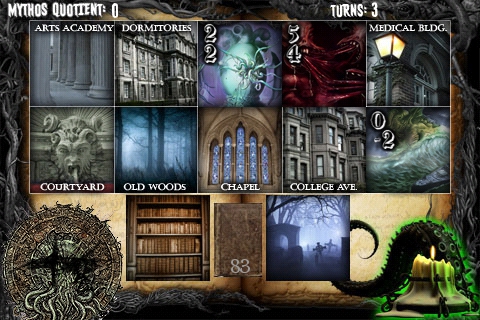
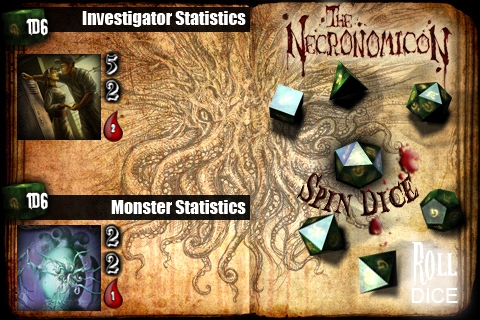
(Cthulhu Thursday is a dose of Mythos to brighten darken your week. More on the idea can be found here and a list of posts thus far, here. Also for more Cthulhu news, sign up to the cthulhuHQ twitter feed. Enjoy!)
Announcing Cthulhu Thursday
We all need a bit more Cthulhu in our lives. Knowing that there is a titanic alien entity snoring below the earth that at any time may emerge from it’s slumber and destroy us all is somehow a comforting thought. I’ve been a fan of the Cthulhu Mythos and Lovecraft’s work in general for a long, long time (aeons!) So for the next few months I’ve decided to get a bit more Cthulhu in my life and share it’s eldrich horror with you gentle readers. So tremble each Thursday as I unleash: Cthulhu Thursday (and it starts later today, when the stars will be right!)
So for those new to all this, who the hell is Cthulhu?
Cthulhu is a fictional cosmic entity created by horror author H. P. Lovecraft in 1926. The first appearance of the entity was in the short story “The Call of Cthulhu” published in Weird Tales in 1928.
Cthulhu is the high priest to the Great Old Ones and one of the central figures of the Lovecraft Mythos. It is often cited for the extreme descriptions given of its hideous appearance, its gargantuan size, and the abject terror that it evokes. Cthulhu is often referred to in science fiction and fantasy circles as a tongue-in-cheek shorthand for extreme horror or evil.
After its first appearance in “The Call of Cthulhu”, Cthulhu makes a few minor appearances in other Lovecraft stories. August Derleth, a correspondent of Lovecraft’s used the creature’s name to identify the system of lore employed by Lovecraft and his literary successors, the Cthulhu Mythos.
And here is what Lovecraft sketched him to look like:

Lovecraft’s Cthulhu
And here is the story, The Call of Cthulhu that started it all. Don’t read it in the dark….
(Cthulhu Thursday is a dose of Mythos to brighten darken your week. More on the idea can be found here and a list of posts thus far, here. Also some upcoming Cthulhu news, sign up to the Auroch Digital’s newsletter. Enjoy!)
More on PS3 Move’s Progress
Following on from this post on the new Sony Move, and with both Nintendo pushing an enhanced Wii and Microsoft pushing Kinect, the motion control game is afoot. Here’s what Sony had to say:

Sony's Move Stats
Couple of comments – it says 1 million shipped – this is not the same as sold (a mistake I’d made, hat-tip to Glennw). While the stats on this – such as that more than 60% of people interested in PS3 Move already own a Wii – are interesting, some information about region and smaple size to allow us to assess this would have been nice. That said, I do think Wii users will migrate to PS3/xbox360 over time as, while the Wii is fun, it does now look a little dated…
But interesting that GameStop think that Kinect will outsell Move… this Xmas.
This is a very interesting article (hat tip to Michel) on why Facebook (and for that matter other social media platforms too) want you to have more friends. In essence it is because more friends equals more activity which equals more content. Keeping the content coming is the key to a living social network. Like a shark, that must keep moving forwards to stay alive, social networks that start to run dry of content, start to die:
Online social networks are built on user-generated content. Without this content, these networks are the equivalent of dying blogs (or MySpace). That said, Facebook faces the (potentially impossible) task of keeping its users engaged and active. Account holders have lives outside of Facebook, what social scientists call opportunity costs, so these social networks need to incentivize participation short of paying people. What better way than to give us a large captive audience of acquaintances, colleagues, classmates, friends and family to share our content with.
A forthcoming American Economic Review article by Xiaoquan Zhang and Feng Zhu demonstrates the importance of group size as an incentive to contribute by using a clever natural experiment of Chinese Wikipedia blockages by the government of China. The researchers analyzed the number of article additions by each contributor — drawing only from those not directly affected by the block — before and after major blockages.
As you may guess, individual contribution falls when group size drops. This fall is especially pronounced for contributors who are considered to be “sociable,” measured by their participation levels in discussion boards and user pages. Sociable contributors enjoy the most utility from participating, so it’s understandable that their incentive to contribute falls as their captive audience falls.
There is also a multiplier effect in operation, as the more activity one individual (node) generates, the more likely people are to follow them. This made me think of the position of theorist Tiziana Terranova who argues;
“Information is neither simply a physical domain nor a social construction, nor the content of a communication act, nor an immaterial entity set to take over the real, but a specific reorientation of forms of power and modes of resistance.”
In that the power and forms of linkages (in this case, social ones) are much more than simple communication links, they are, by definition of their form, function and impact, links of power and assemblage. In simple terms this means that there is a power in links, that the social aspect of humans, amplified by easy means of connection and communication can boost the potential of the individual.
When I read this article, I’d just been looking at the new Twitter web interface which, as Facebook has been doing for some time now, suggests new people you might like to follow. Twitter is also looking to lever the power of the social and now we know why…
(also posted on the p2p blog, blog.p2pfoundation.net)
I’m doing a bit of work for the Wellcome Trust at the moment, and during this research game across this interesting study of just over 1100 young people (PDF) looking at how they play games. What they found was interesting:
The quantity of game play is not strongly related to civic and political engagement. Teens that play video games frequently are just as involved in civic and political activities like raising money for charity and convincing others how to vote as those who play infrequently. Overall, on the eight indicators of civic and political engagement included in the survey, there is no significant difference between teens who play every day and those who play less than once a week.
So there is no correlation between playing games and not caring about the world around you. Not only that but:
Many teens have gaming experiences that parallel aspects of civic life:
– 76% of youth report helping others while gaming,.
– 52% of gamers report playing games where they think about moral and ethical issues.
– 44% report playing games where they learn about a problem in society.
– 43% report playing games where they help make decisions about how a community, city or nation should be run.
So playing games engages people in thinking about the big issues; morality, politics and the like – this means those of us making games have a responsibility as what we do within development.
How is Windows Phone 7 doing? (Updated)
I blogged a bit about the new Windows Phone 7 and both how important it is for Microsoft to make an impact here to stray relevent as a technology company and how hard it is going to be as Google, Apple and RIM are already well established. So a couple of weeks after launch, how is it going? Quite well it seems (at least in the UK…):
It appears that Microsoft may have a success on their hands with their latest operating system, Windows Phone 7, especially when it comes to the United Kingdom and on the Orange network
According to an article over on Digital Trends by Jeffrey Van Camp, The Register has stated that Orange UK and sold out of Windows Phone 7 devices and thus in response to demand Orange is now allowing pre-orders for WP7 devices and offering a £20 HMV voucher for those having to wait for their device.
I’ve seen the TV adverts, and I have to say, it does not really say much about why this phone is so different from the others. It does have quite a nice interface and some good ideas about functions… plus it is early days yet…
Updated! Since I wrote this original post the situation has changed somewhat. We still don’t have exact figures for the sales of Windows Phone 7. Some are suggesting that the lack of sales figures are not positive news. Then Microsoft said it has sold over 2 million phones worldwide. However in context while it’s not bad – its also not amazing. Apple sold 8.5 million iPhones in the first quarter of 2010 alone. This Christmas, over the same period as the lunch of Windows Phone 7, the Blackberry claimed the UK crown for sales, selling half a million in the UK alone.
And then Microsoft and Nokia announced a joint deal and the smart-phone war was back on…
Global Warming Inspires Strategy Game
This is a great bit of news coverage for Red Redemption (no ‘dead’ in there!) who have gone out and raised £1million to create a realistic and in-depth game about Global Warming:
They’ve previously tackled alien invasions, gang violence in New York and how to raise a happy family, but this week computer games wrestle with an even more pressing issue: climate change.
Arriving on PCs on Tuesday and Macs shortly after, the British-made Fate of the World puts players at the helm of a future World Trade Organisation-style environmental body with a task of saving the world by cutting carbon emissions or damning it by letting soaring temperatures wreak havoc through floods, droughts and fires.
The strategy game is already being hailed by gaming experts as a potential breakthrough for such social change titles, and welcomed by climate campaigners as a way of reaching new audiences.
While traditional mainstream games have focused on action, sports and increasingly casual genres, Fate of the World features data from real-world climate models, anecdotes from the polar explorer Pen Hadow and input from a team of scientists and economists in the US and UK. It has been developed by Oxford-based games designers Red Redemption, whose previous browser-based climate game for the BBC has been played more than a million times since it was launched in 2006.
I met one of the people from Red Redemption at Develop this year and was very impressed by their work and plans, so I hope this sells well.


 A Great Becoming...